

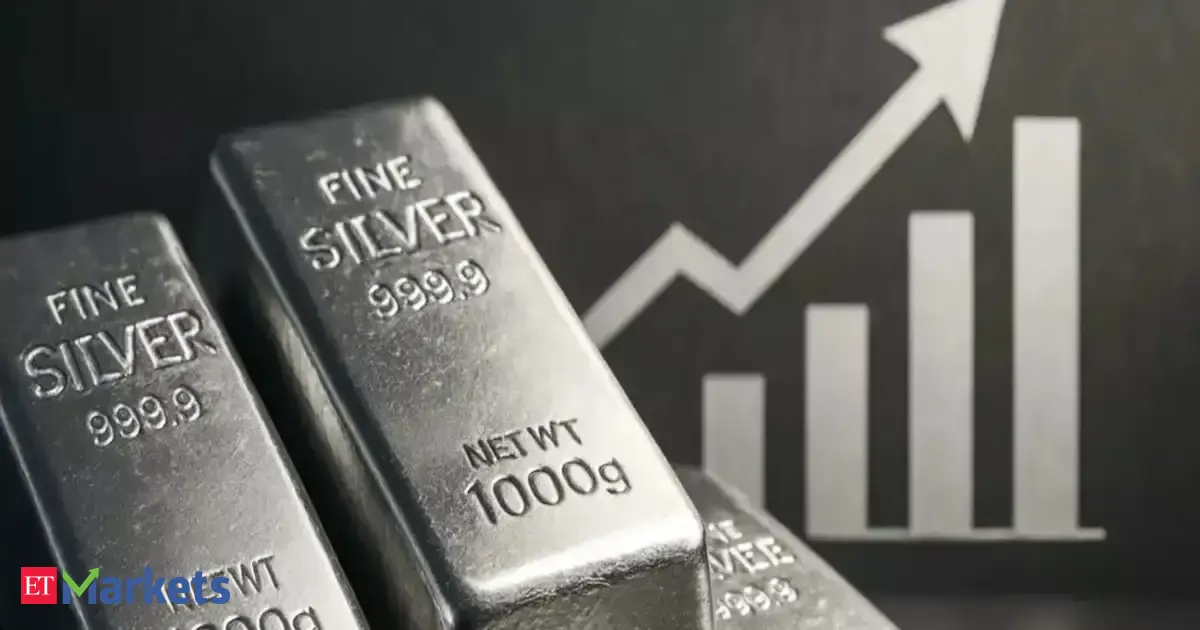
Silver prices surpassed $100 an ounce for the first time in international markets.
GK and monthly revision
Silver hits $100 an ounce for the first time in international markets; gold hits fresh record
Silver prices surged past $100 an ounce for the first time, while gold reached a new record near $5,000/oz, driven by geopolitical tensions, anticipated U.S. interest rate cuts, and supply shortages. This reflects increased investor demand for safe-haven assets amidst global economic uncertainty. For competitive exams, this highlights global economic indicators, commodity market dynamics, and factors influencing precious metal prices.
Revision structure
Monthly events and exam calendar context
Static GK and one-liner notes
Quiz and mock-test revision path
Key points
Exam-ready takeaways
Gold prices reached a new record, nearing $5,000 per ounce.
The surge in precious metal prices is primarily attributed to increased demand for safe-haven assets.
Key factors driving the price increase include geopolitical tensions and expected U.S. interest rate cuts.
Other precious metals such as Platinum and Palladium also experienced significant price gains.
Detailed analysis
Full exam-oriented breakdown
The recent surge in precious metal prices, with silver crossing the unprecedented mark of $100 an ounce and gold hitting a new record near $5,000 per ounce, signals a significant shift in global investor sentiment and economic dynamics. This phenomenon is not merely a headline but a complex interplay of geopolitical events, monetary policy expectations, and supply-demand imbalances, with profound implications for economies worldwide, especially for a major consumer like India. **Background Context and What Happened:** Historically, gold and silver have been revered as 'safe-haven assets' – investments that tend to retain or increase in value during times of market turbulence and economic uncertainty. Their intrinsic value and limited supply make them a preferred store of wealth when traditional financial instruments like stocks and bonds appear risky. The current price explosion is a direct consequence of a confluence of global stressors. The primary drivers include escalating geopolitical tensions in various parts of the world, such as ongoing conflicts in Eastern Europe and the Middle East, which fuel uncertainty and risk aversion. Additionally, the anticipation of interest rate cuts by major central banks, particularly the U.S. Federal Reserve, makes non-yielding assets like gold more attractive. When interest rates are high, investors prefer interest-bearing assets; conversely, lower rates reduce the opportunity cost of holding precious metals. Furthermore, specific supply shortages, especially for silver which has significant industrial demand in sectors like solar panels and electronics, have exacerbated the price rally. The demand for platinum and palladium, also vital industrial metals, further underscores the broad-based appeal of precious metals in the current climate. **Key Stakeholders Involved:** Several key players are central to this market dynamic. **Investors**, ranging from large institutional funds and hedge funds to individual retail investors, are the primary demand-side drivers, actively rebalancing their portfolios towards perceived safety. **Central banks** globally, including the Reserve Bank of India (RBI), have been significant buyers of gold, diversifying their foreign exchange reserves away from traditional fiat currencies like the US dollar. This strategic buying by national monetary authorities provides a strong underlying demand. **Mining companies** benefit from higher prices, although they face challenges in ramping up production quickly due to long lead times and environmental regulations. **Governments** of major importing nations, like India, become critical stakeholders as soaring prices impact their trade balances and domestic economic stability. Finally, **consumers**, particularly in countries with strong cultural affinities for gold and silver, such as India, feel the direct impact on their purchasing power and savings patterns. **Why This Matters for India:** India holds a unique position in the global precious metals market as one of the largest consumers of gold and silver. The surge in prices has several critical implications for the Indian economy. Firstly, it significantly impacts India's **Current Account Deficit (CAD)**. As a net importer of gold, higher international prices translate into a larger import bill, widening the CAD and putting pressure on the Indian rupee. This can lead to imported inflation, as the cost of these metals feeds into various sectors, including the extensive jewellery industry. Secondly, gold is deeply embedded in Indian culture as a traditional form of savings and investment, especially in rural areas. While existing gold holdings appreciate in value, new purchases become more expensive, affecting household budgets and savings behavior. The **jewellery industry**, a major employer, faces a complex situation: higher raw material costs could dampen demand, but also potentially increase the value of inventory. The **Reserve Bank of India (RBI)** plays a crucial role in managing these economic impacts through its monetary policy and foreign exchange management. The government's various schemes, such as the **Gold Monetisation Scheme (GMS)** launched in 2015, aim to mobilize idle household gold and reduce reliance on imports, becoming even more relevant in this high-price environment. **Historical Context and Constitutional/Policy References:** India's fascination with gold dates back millennia, making it a significant cultural and economic asset. Historically, gold was a preferred medium for wealth storage, especially in the absence of developed financial markets. Post-independence, the government has, at various times, attempted to regulate gold imports and ownership, notably through the Gold Control Act of 1968 (repealed in 1990) to curb smuggling and conserve foreign exchange. Today, the import and export of gold and silver are governed by the **Foreign Exchange Management Act (FEMA), 1999**, and the **Customs Act, 1962**, which levies import duties to manage demand and generate revenue. The **RBI Act, 1934**, empowers the central bank to manage India's foreign exchange reserves, which includes a substantial gold component, influencing its stability and external sector management. The current price surge reinforces the need for robust economic policies to manage commodity price volatility and strengthen the domestic economy. **Future Implications:** The immediate future suggests continued volatility in precious metal markets. If geopolitical tensions persist and major central banks proceed with anticipated interest rate cuts, the upward pressure on gold and silver prices is likely to continue. This could lead to further diversification of central bank reserves, increased investor interest in alternative assets, and potential shifts in global trade patterns. For India, it necessitates continued vigilance in managing its CAD, potentially prompting further tweaks in import duties or incentives for domestic gold recycling. The long-term implications could see a re-evaluation of investment strategies globally, with a renewed focus on tangible assets as a hedge against inflation and systemic risk. The interplay between global financial stability, monetary policy, and geopolitical events will continue to shape the trajectory of these valuable commodities.
How to study
Turn news into exam marks
Revise monthly events by exam family instead of reading random updates.
Pair one-liners with mock tests so mistakes become the next revision list.
Keep state job pages, calendar pages and GK packs connected in one path.