

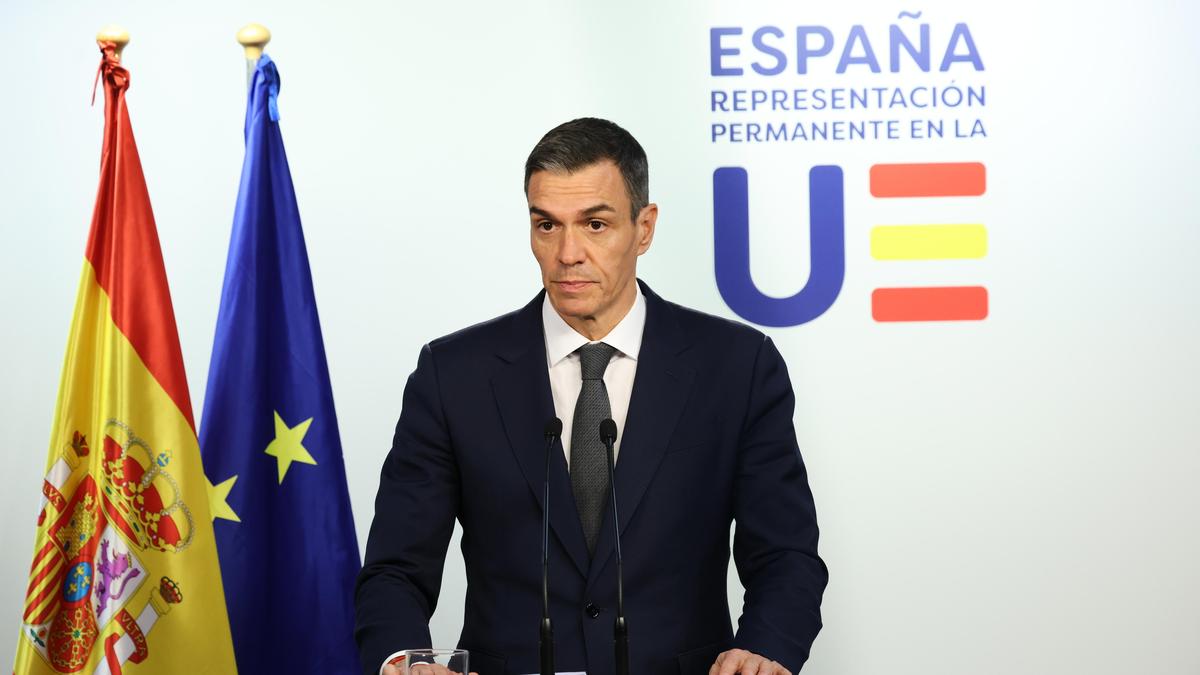
Spain's Prime Minister Pedro Sanchez stated the country would not join "Trump's Board of Peace".
GK and monthly revision
Spain will not join Trump’s Board of Peace, says PM Pedro Sanchez
Spain's Prime Minister Pedro Sanchez announced the country would not join "Trump's Board of Peace". This decision underscores Madrid's strong commitment to international law, the United Nations, and multilateralism. It signifies a divergence in foreign policy approaches, emphasizing Spain's adherence to global cooperation over unilateral initiatives, a key aspect for international relations questions in competitive exams.
Revision structure
Monthly events and exam calendar context
Static GK and one-liner notes
Quiz and mock-test revision path
Key points
Exam-ready takeaways
The primary reasons cited for Spain's refusal were consistency with its commitment to international law.
Spain also emphasized its adherence to the United Nations (U.N.) principles.
Madrid's decision highlighted its strong belief in multilateralism as a foreign policy approach.
The initiative Spain declined to participate in was referred to as "Trump's Board of Peace".
Detailed analysis
Full exam-oriented breakdown
Spain's emphatic refusal to join what was termed "Trump's Board of Peace" serves as a significant case study in contemporary international relations, highlighting the enduring tension between unilateral and multilateral approaches to global governance. This decision, articulated by Prime Minister Pedro Sanchez, was rooted in Madrid's steadfast commitment to international law, the United Nations, and the broader principle of multilateralism. To truly grasp its implications, especially for competitive exam aspirants, it's crucial to delve into the background, key players, and its resonance with India's foreign policy. ### Background Context: The Unilateral vs. Multilateral Divide The period of the Trump administration (2017-2021) was characterized by an "America First" foreign policy doctrine, which often prioritized perceived national interests over established international norms and institutions. This approach led to the withdrawal of the U.S. from significant multilateral agreements like the Paris Climate Accord and the Iran Nuclear Deal (JCPOA), and a general skepticism towards organizations such as the World Health Organization (WHO) and even NATO. In this climate, the concept of a "Trump's Board of Peace" likely represented an ad-hoc, U.S.-centric initiative designed to bypass existing multilateral frameworks like the UN Security Council or established diplomatic channels. Such initiatives were often seen by traditional allies as undermining the rules-based international order that had been carefully constructed since World War II. ### What Happened and Key Stakeholders Spain's Prime Minister Pedro Sanchez explicitly stated that Spain would not participate in this proposed "Board of Peace." The reasons cited were clear: consistency with Spain's commitment to international law, its adherence to the principles of the United Nations, and its strong belief in multilateralism. This was not merely a diplomatic snub but a principled stand. The key stakeholders involved were: 1. **Spain (Pedro Sanchez Government):** As a member of the European Union and a democratic nation, Spain has historically championed a foreign policy rooted in international law and cooperation. Its decision reflected a broader European commitment to multilateralism, often in contrast to the Trump administration's approach. 2. **United States (Trump Administration):** The initiator of the "Board of Peace," aiming to project American influence and resolve global issues through what was often perceived as a more transactional and unilateral lens, rather than through consensus-building within established international bodies. 3. **United Nations (UN):** The primary symbol and institutional embodiment of multilateralism. Spain's affirmation of its commitment to the UN was a direct endorsement of the global body and its foundational principles, including collective security and the peaceful resolution of disputes. 4. **European Union (EU):** Spain's stance aligns perfectly with the EU's common foreign and security policy, which strongly advocates for a rules-based international order and effective multilateralism. The EU often positioned itself as a defender of global norms during this period. ### Significance for India This episode holds significant relevance for India, a nation that has consistently championed multilateralism and a rules-based international order since its independence. India's foreign policy, articulated through its commitment to the Non-Aligned Movement (NAM) during the Cold War and its continued engagement with global institutions today, mirrors Spain's principled stand. For India, the strength and legitimacy of multilateral institutions like the UN, WTO, and various international conventions are paramount. India's aspiration for a permanent seat in the UN Security Council, for instance, underscores its belief in the UN's pivotal role in global governance. Furthermore, a stable and predictable international legal framework is crucial for India's economic growth, facilitating global trade, investment, and technological exchange. Unilateral actions, which can lead to instability and protectionism, invariably impact India's economic interests. From a strategic autonomy perspective, India, like Spain, seeks to navigate a complex geopolitical landscape by fostering diverse partnerships while upholding its core values. A world where international law and multilateral frameworks are weakened makes it harder for countries like India to assert their interests and contribute to global stability without being forced to choose sides or succumb to great power pressures. ### Historical Context and Future Implications Historically, the post-World War II era saw the establishment of a robust international architecture – the UN, Bretton Woods institutions, and international law – designed to prevent future conflicts and foster cooperation. India, a founding member of the UN, has been a consistent beneficiary and contributor to this system. Spain's decision reaffirms the commitment of many nations to this historical legacy against forces that seek to dismantle or circumvent it. Looking ahead, this incident underscores the ongoing debate about the future of global governance. While the Trump administration's approach represented a significant challenge to multilateralism, subsequent administrations, like the Biden administration, have signaled a return to more traditional engagement with international institutions. However, the underlying tensions remain. The rise of new global challenges – climate change, pandemics, cyber warfare – necessitates even stronger global cooperation and multilateral solutions. Spain's stand serves as a reminder that middle powers and established democracies continue to play a crucial role in defending and strengthening these essential frameworks. For India, its consistent advocacy for reforms within these institutions, rather than their abandonment, will be vital in shaping a more equitable and stable international order. ### Related Constitutional Articles and Policies India's commitment to international peace and cooperation is enshrined in its Constitution. **Article 51** of the Directive Principles of State Policy explicitly directs the State to: * Promote international peace and security. * Maintain just and honourable relations between nations. * Foster respect for international law and treaty obligations in the dealings of organised peoples with one another. * Encourage settlement of international disputes by arbitration. This constitutional mandate directly aligns with the principles cited by Spain's Prime Minister. India's foreign policy has consistently reflected these tenets, advocating for adherence to the **UN Charter**, peaceful resolution of disputes, and respect for the sovereignty of nations. Therefore, Spain's decision reinforces a shared international outlook that resonates deeply with India's constitutional values and foreign policy objectives.
How to study
Turn news into exam marks
Revise monthly events by exam family instead of reading random updates.
Pair one-liners with mock tests so mistakes become the next revision list.
Keep state job pages, calendar pages and GK packs connected in one path.