

The issue was flagged by West Bengal Congress president Subhankar Sarkar.
GK and monthly revision
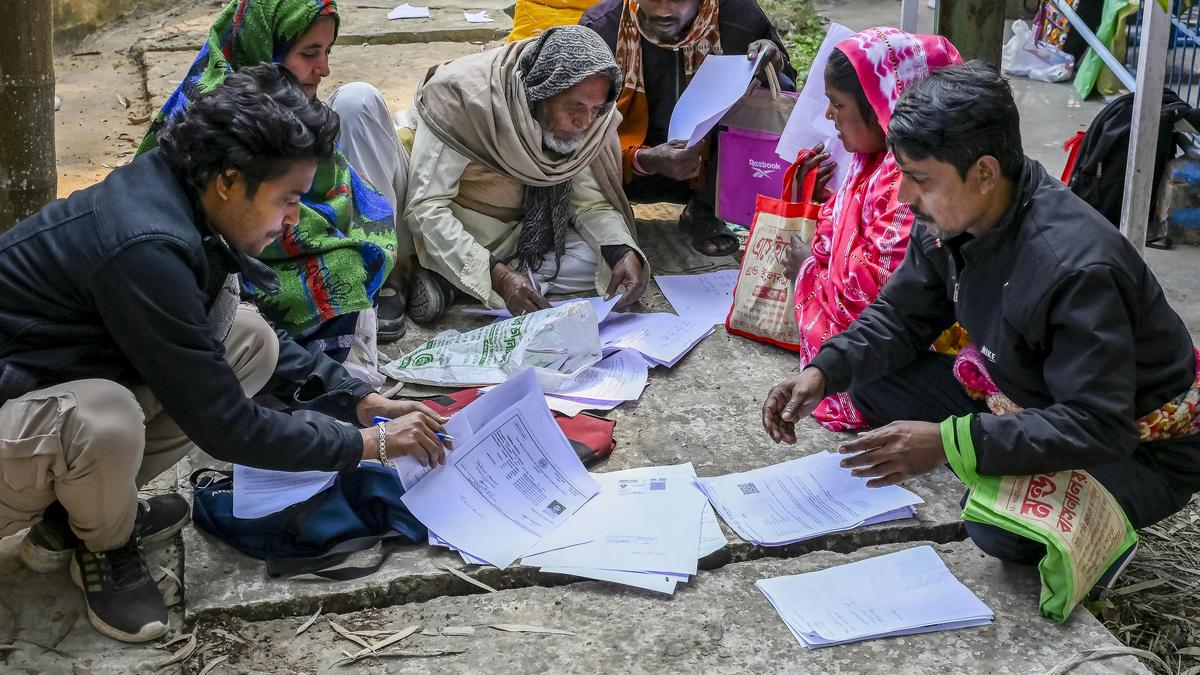
Thousands in Bengal receive SIR notices over ‘unusually high number’ of children linked to electors
West Bengal Congress president Subhankar Sarkar has raised concerns over the Election Commission's 'arbitrary' threshold for identifying electors with an unusually high number of children linked to them. This issue highlights potential irregularities in voter lists within West Bengal, with 2,06,056 electors reportedly having six or more children linked. This development is significant for competitive exams as it pertains to electoral integrity, the functioning of the Election Commission, and the role of political parties in scrutinizing democratic processes, relevant for Indian Polity and Governance.
Revision structure
Monthly events and exam calendar context
Static GK and one-liner notes
Quiz and mock-test revision path
Key points
Exam-ready takeaways
The concern relates to the Election Commission's 'arbitrary' threshold setting for electors with many linked children.
A total of 2,06,056 electors in West Bengal were identified with six or more children linked to them.
If the threshold was raised to 10, the number of such electors significantly dropped to 8,682.
The core issue pertains to the integrity of voter lists and potential electoral irregularities in West Bengal.
Detailed analysis
Full exam-oriented breakdown
The recent flagging by West Bengal Congress president Subhankar Sarkar regarding an 'unusually high number' of children linked to electors, and the Election Commission's (ECI) 'arbitrary' threshold setting, brings into sharp focus the perennial challenge of maintaining accurate and clean electoral rolls in India. This issue is not merely a regional political skirmish but strikes at the very heart of India's democratic process and electoral integrity. Understanding its nuances is crucial for competitive exam aspirants. **Background Context and What Happened:** India, as the world's largest democracy, relies heavily on credible electoral rolls to ensure free and fair elections. The Election Commission of India (ECI) is constitutionally mandated to prepare and periodically revise these rolls. Historically, electoral roll purification has been a complex exercise, often plagued by issues like duplicate entries, names of deceased voters, migration, and, at times, attempts to create 'bogus voters'. To combat these, the ECI employs various mechanisms, including door-to-door verification, photo electoral rolls, and the issuance of Electors Photo Identity Cards (EPIC). The current controversy in West Bengal revolves around the ECI's use of a specific metric: the number of 'children' linked to an elector in the electoral database. Subhankar Sarkar highlighted that 2,06,056 electors in West Bengal were identified as having six or more children linked to them. He termed the ECI's threshold for identifying such anomalies as 'arbitrary', noting that if the threshold were raised to ten or more children, the number of such electors drastically dropped to 8,682. This significant difference in numbers based on a seemingly minor adjustment to the threshold raises questions about the methodology and the potential for misidentification or, conversely, overlooking larger-scale irregularities. **Key Stakeholders Involved:** 1. **Election Commission of India (ECI):** As the independent constitutional body responsible for conducting elections, the ECI is the primary stakeholder. Its role involves setting guidelines for electoral roll preparation, conducting verification drives, and ensuring the integrity of the process. The ECI's credibility hinges on its ability to act impartially and effectively. Its internal processes for identifying anomalies, such as issuing 'Suspicious Irregularity Report' (SIR) notices, are under scrutiny. 2. **Political Parties (e.g., Indian National Congress, ruling party in West Bengal):** Political parties, particularly the opposition, play a vital role in scrutinizing the electoral process. By raising concerns, they act as watchdogs, pushing for transparency and accountability. The Congress's move to flag this issue is an example of this critical function in a democracy. The ruling party, on the other hand, would be concerned about the implications for its voter base and the overall perception of the state's electoral fairness. 3. **Electors/Citizens:** Ultimately, the integrity of the electoral roll affects every voter. Errors can lead to disenfranchisement or the dilution of legitimate votes by fraudulent ones, eroding public trust in the democratic system. 4. **State Election Machinery:** This includes District Election Officers (DEOs), Electoral Registration Officers (EROs), and Booth Level Officers (BLOs) who are on the ground implementing ECI directives and conducting verification. **Why This Matters for India:** This issue holds immense significance for India's democratic health. Firstly, **Electoral Integrity** is paramount. Any suspicion of manipulation or inaccuracy in voter lists undermines the principle of 'one person, one vote' and can cast a shadow over the legitimacy of election outcomes. Secondly, it highlights the challenges in **Governance and Administration**. The ECI's guidelines must be robust, transparent, and consistently applied to avoid accusations of bias or arbitrariness. Thirdly, the potential for **Social and Political Impact** is considerable. If a significant number of voters are incorrectly identified or removed, it can lead to social unrest and political polarization, especially in a politically charged state like West Bengal. Concerns about profiling certain communities or demographics based on family size could also arise. **Historical Context and Constitutional Provisions:** Efforts to clean electoral rolls are not new. Post-independence, the ECI has continuously refined its processes. The introduction of photo electoral rolls in the 1990s and EPIC cards were major steps. More recently, the **Election Laws (Amendment) Act, 2021**, allowed for the voluntary linking of Aadhaar with voter ID to help identify duplicate entries, though this has been subject to privacy concerns and Supreme Court rulings. The ECI derives its powers from **Article 324** of the Indian Constitution, which vests in it the 'superintendence, direction and control of the preparation of the electoral rolls for, and the conduct of, all elections'. Further, the **Representation of the People Act, 1950**, governs the preparation and revision of electoral rolls, while the **Representation of the People Act, 1951**, deals with the conduct of elections and electoral offences. These legal frameworks empower the ECI but also demand accountability and fairness in its operations. **Future Implications:** This incident underscores the urgent need for the ECI to develop and clearly articulate transparent, objective, and scientifically sound criteria for identifying potential irregularities in electoral rolls. Arbitrary thresholds, even if well-intentioned, can be misinterpreted or misused. Future implications include increased scrutiny of ECI's methodologies, potential for more legal challenges, and a renewed push for technological solutions balanced with human oversight in electoral roll management. It may also lead to further electoral reforms aimed at strengthening the integrity of voter lists, perhaps by standardizing data collection and verification processes across states. The resolution of this issue will set a precedent for how such anomalies are handled in other states and will significantly impact public confidence in the electoral system as India heads into crucial election cycles. This incident is a reminder that the health of India's democracy depends not just on the act of voting, but equally on the meticulous and unbiased preparation of the very lists that define who can vote.
How to study
Turn news into exam marks
Revise monthly events by exam family instead of reading random updates.
Pair one-liners with mock tests so mistakes become the next revision list.
Keep state job pages, calendar pages and GK packs connected in one path.