

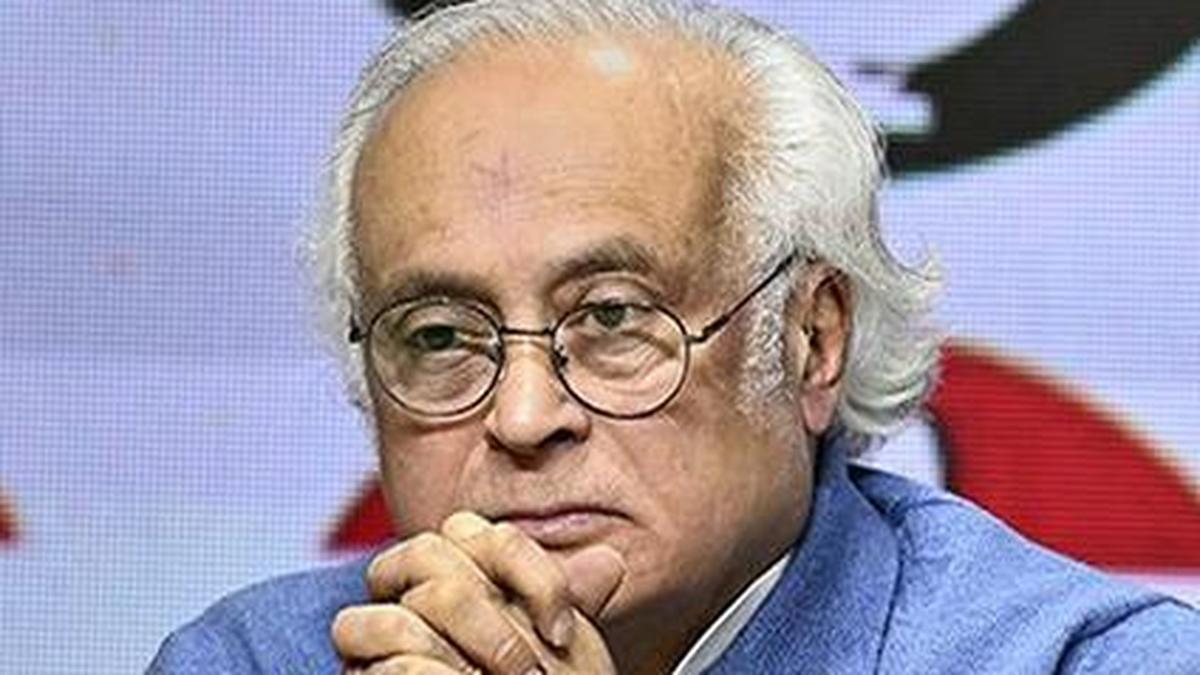
Congress General Secretary Jairam Ramesh stated that 264 Constituent Assembly members signed the Indian Constitution.
GK and monthly revision
76 years ago, 264 Constituent Assembly members signed Indian Constitution: Jairam Ramesh
Congress general secretary Jairam Ramesh recalled that 264 Constituent Assembly members signed the Indian Constitution 76 years ago. This event, marking a pivotal moment in India's democratic journey, highlights the foundational work of the Constituent Assembly. For competitive exams, understanding the Constitution's drafting, adoption, and commencement dates, along with key figures, is crucial for questions on Indian Polity and History.
Revision structure
Monthly events and exam calendar context
Static GK and one-liner notes
Quiz and mock-test revision path
Key points
Exam-ready takeaways
The Indian Constitution was signed by the members of the Constituent Assembly on January 24, 1950.
The Constituent Assembly formally adopted the Constitution of India on November 26, 1949.
The Constitution of India came into full effect on January 26, 1950, celebrated annually as Republic Day.
Dr. Rajendra Prasad served as the President of the Constituent Assembly, overseeing the drafting and adoption process.
Detailed analysis
Full exam-oriented breakdown
The statement by Congress General Secretary Jairam Ramesh, recalling that 264 Constituent Assembly members signed the Indian Constitution 76 years ago, serves as a poignant reminder of a defining moment in India's democratic journey. This event, which took place on January 24, 1950, just two days before the Constitution's full commencement, marked the culmination of nearly three years of painstaking deliberation and debate by the nation's founding fathers and mothers. The journey to a written Constitution began with the deep-seated aspiration for self-governance during the freedom struggle. The idea of a Constituent Assembly, first articulated by M.N. Roy in 1934 and officially demanded by the Indian National Congress in 1935, gained momentum. The British government finally conceded this demand with the Cabinet Mission Plan of 1946, which laid down the framework for the formation of the Constituent Assembly. Elections were held in July-August 1946, and the Assembly convened for its first session on December 9, 1946. Initially, it had 389 members, but after the partition of India in 1947, the membership was reduced to 299. The Assembly's task was monumental: to draft a Constitution for a diverse nation emerging from centuries of colonial rule and grappling with the scars of partition. Under the temporary presidency of Dr. Sachchidananda Sinha and later, the permanent presidency of Dr. Rajendra Prasad, the Assembly embarked on its mission. A crucial step was the adoption of the 'Objectives Resolution' on January 22, 1947, moved by Jawaharlal Nehru on December 13, 1946. This resolution outlined the fundamental philosophy and guiding principles for the Constitution, emphasizing India as an independent, sovereign, republic guaranteeing justice, liberty, equality, and fraternity to all its citizens. Key stakeholders in this process included the members of the Constituent Assembly themselves, representing various regions, communities, and ideologies. The Drafting Committee, chaired by Dr. B.R. Ambedkar, played the most pivotal role in preparing the draft Constitution. Other prominent members like Sardar Vallabhbhai Patel, Maulana Abul Kalam Azad, and Alladi Krishnaswami Ayyar made invaluable contributions. Dr. B.N. Rau, the Constitutional Advisor, prepared the initial draft that served as the basis for the Drafting Committee's work. After extensive debates, clause-by-clause consideration, and three readings, the Constituent Assembly formally adopted the Constitution of India on November 26, 1949. On this date, certain provisions related to citizenship, elections, provisional parliament, and temporary and transitional provisions (Articles 5, 6, 7, 8, 9, 60, 324, 366, 367, 379, 380, 388, 391, 392, 393, and 394) came into force. The final act of signing, involving 264 members, took place on January 24, 1950, during the last session of the Constituent Assembly. On the same day, Dr. Rajendra Prasad was elected as the first President of India. The full commencement of the Constitution occurred on January 26, 1950, a date deliberately chosen to commemorate 'Purna Swaraj Day' (January 26, 1930), when the Indian National Congress had declared complete independence from British rule. This day is celebrated annually as Republic Day, symbolizing India's birth as a sovereign democratic republic. This event matters profoundly for India as it established the supreme law of the land, laying the foundation for its democratic governance, protecting fundamental rights, and providing a framework for socio-economic justice. The Constitution, with its Preamble enshrining ideals of Justice, Liberty, Equality, and Fraternity, and detailed provisions on Fundamental Rights (Part III) and Directive Principles of State Policy (Part IV), guides the nation's progress. It established a parliamentary form of government, a federal structure with a unitary bias, and an independent judiciary, all critical for maintaining unity and integrity in a diverse nation. The power to amend the Constitution, outlined in Article 368, ensures its adaptability as a 'living document' capable of responding to changing times. Looking ahead, the Indian Constitution continues to be the bedrock of the nation. Its resilience has been tested through various challenges, and its principles remain vital for addressing contemporary issues like social inequality, economic disparities, and federal tensions. The 'Basic Structure Doctrine,' enunciated by the Supreme Court in the Kesavananda Bharati case (1973), ensures that the core tenets of the Constitution cannot be altered by amendments, thereby safeguarding its foundational values. Understanding this historical process is crucial for appreciating India's democratic ethos and the enduring legacy of its framers.
How to study
Turn news into exam marks
Revise monthly events by exam family instead of reading random updates.
Pair one-liners with mock tests so mistakes become the next revision list.
Keep state job pages, calendar pages and GK packs connected in one path.