

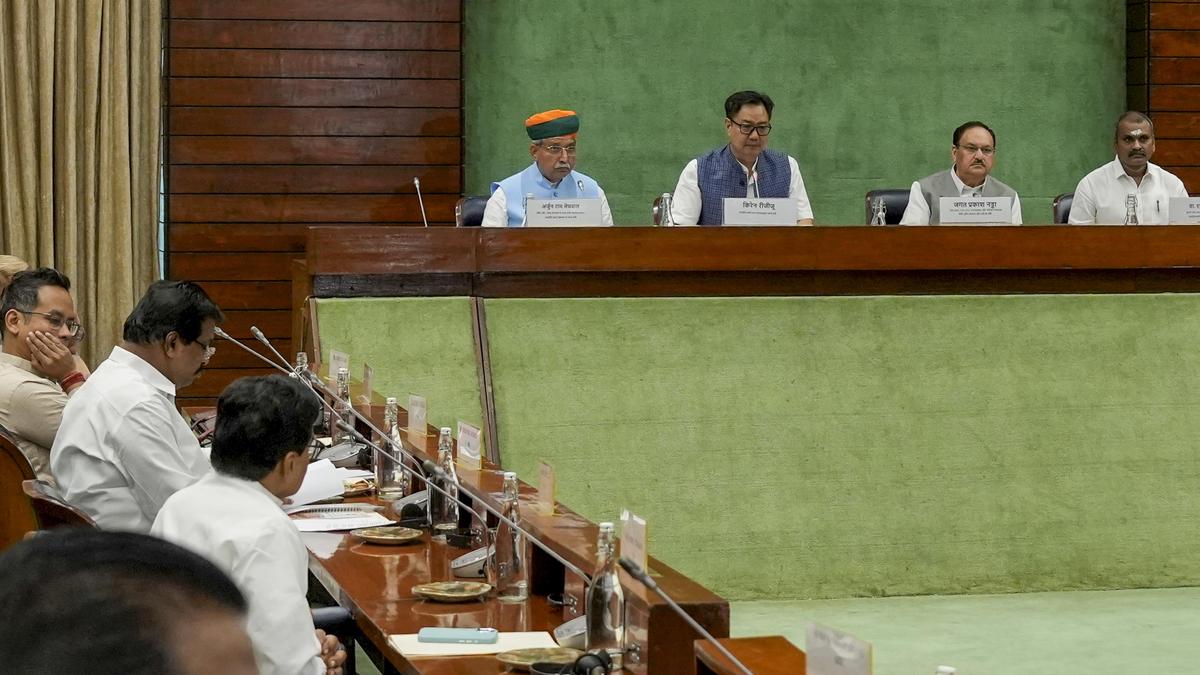
An all-party meet was convened by the government on January 27.
GK and monthly revision
Ahead of Budget Session, Govt convenes all-party meet on January 27
The government has scheduled an all-party meet for January 27, just a day before the commencement of the crucial Budget Session on January 28. This session will formally begin with President Droupadi Murmu's address to a joint sitting of both Lok Sabha and Rajya Sabha, a constitutional formality marking the start of a new parliamentary year. This event is significant for competitive exams as it tests knowledge of parliamentary procedures, key dates, and constitutional roles.
Revision structure
Monthly events and exam calendar context
Static GK and one-liner notes
Quiz and mock-test revision path
Key points
Exam-ready takeaways
The Budget Session is scheduled to commence on January 28.
President Droupadi Murmu will address the joint sitting of Parliament.
The President's address will be delivered to both the Lok Sabha and Rajya Sabha.
The parliamentary session starting on January 28 is the 'Budget Session'.
Detailed analysis
Full exam-oriented breakdown
The announcement of an all-party meet on January 27, followed by the commencement of the Budget Session on January 28 with President Droupadi Murmu's address, is a standard yet profoundly significant event in India's parliamentary calendar. This annual ritual underscores the democratic functioning of the nation and sets the stage for crucial legislative and financial decisions that impact every citizen. **Background Context:** India's parliamentary system, inspired by the Westminster model, operates through sessions. Typically, there are three main sessions in a year: the Budget Session (February-May), the Monsoon Session (July-September), and the Winter Session (November-December). The Budget Session is arguably the most important, as it primarily deals with the Union Budget, the government's financial blueprint for the upcoming fiscal year. Before such a crucial session, it is customary for the government to convene an all-party meeting. This serves as a vital platform for dialogue, where the government seeks cooperation from opposition parties for the smooth functioning of Parliament and listens to their concerns and legislative priorities. This tradition helps in building consensus and reducing disruptions during the session. **What Happened:** The government scheduled an all-party meeting for January 27, a day prior to the official start of the Budget Session. The session itself was slated to begin on January 28, marked by President Droupadi Murmu's address to a joint sitting of both the Lok Sabha (House of the People) and the Rajya Sabha (Council of States). This address is a constitutional formality and a key element of the parliamentary calendar, outlining the government's achievements, policies, and legislative agenda for the upcoming year. **Key Stakeholders Involved:** Several entities play crucial roles in this process. The **Government (the ruling party/coalition)**, represented by ministers and parliamentary affairs officials, convenes the all-party meet to ensure legislative business proceeds smoothly. **Opposition parties** are vital stakeholders, using the all-party meet to express their concerns and demand discussions on specific issues. During the session, they act as a check on the government, holding it accountable. The **President of India**, as the constitutional head, delivers the address, symbolizing the state's continuity and constitutional authority. The **Speaker of the Lok Sabha** and the **Chairman of the Rajya Sabha** (who is also the Vice-President of India) preside over their respective houses, ensuring decorum and adherence to parliamentary procedures. Ultimately, the **citizens of India** are the primary beneficiaries or recipients of the policies and financial allocations debated and passed during this session. **Significance for India:** The Budget Session holds immense significance for India. **Economically**, it is where the Union Budget is presented (Article 112 of the Constitution), detailing revenue and expenditure for the next financial year (April 1 to March 31). This budget allocates funds for various sectors, schemes, and infrastructure projects, directly influencing economic growth, inflation, employment, and social welfare. **Politically**, it is a period of intense legislative activity and political discourse. The President's address sets the government's agenda, followed by debates on the 'Motion of Thanks'. The budget itself undergoes scrutiny, with various ministries' demands for grants debated. This ensures accountability and transparency in governance. **Socially**, the budget's provisions directly impact citizens through subsidies, welfare programs, taxation policies, and investments in education, health, and social security. It reflects the government's priorities for inclusive development. **Democratically**, the session provides a crucial platform for elected representatives to voice the concerns of their constituents, debate national issues, and shape public policy, thus reinforcing the principles of representative democracy. **Historical Context:** The practice of an annual financial statement (the Budget) and the President's address has roots in India's colonial past but has evolved significantly since independence. The Government of India Act, 1935, laid some groundwork for legislative financial control. Post-independence, the framers of the Constitution meticulously crafted provisions for parliamentary oversight over finances, recognizing the principle of 'no taxation without representation'. The tradition of an all-party meet, while not constitutionally mandated, has become an integral part of parliamentary practice to foster cooperation and avoid legislative logjams, especially in an era of coalition politics and diverse political landscapes. **Future Implications:** The outcomes of the Budget Session have far-reaching implications. The budget's passage dictates the government's spending capacity and policy direction for the year. It can influence economic growth, attract investments, and shape social development. The legislative agenda pursued during the session can lead to the enactment of new laws or amendments to existing ones, impacting various aspects of Indian life. The political debates and discussions can also set the tone for future elections and impact the government's public perception and political stability. Furthermore, the efficiency and decorum with which the session is conducted reflect on the health of India's democratic institutions and the ability of its political class to work collaboratively for national interest. **Related Constitutional Articles, Acts, or Policies:** * **Article 87(1):** Mandates the President to address both Houses of Parliament assembled together at the commencement of the first session after each general election to the House of the People and at the commencement of the first session of each year. * **Article 112:** Defines the 'Annual Financial Statement' (Union Budget), which the President shall cause to be laid before both Houses of Parliament. * **Article 85:** Empowers the President to summon, prorogue (discontinue a session without dissolving), and dissolve the Lok Sabha. * **Article 113:** Deals with the Procedure in Parliament with respect to estimates (Demands for Grants). * **Article 114:** Pertains to the Appropriation Bills, which allow the government to withdraw money from the Consolidated Fund of India after the budget is passed. * **Rules of Procedure and Conduct of Business in Lok Sabha and Rajya Sabha:** These rules govern the specific conduct of parliamentary proceedings, including debates on the President's address and the budget. The all-party meet, while extra-constitutional, is a crucial part of the parliamentary affairs ministry's efforts to manage these procedures effectively.
How to study
Turn news into exam marks
Revise monthly events by exam family instead of reading random updates.
Pair one-liners with mock tests so mistakes become the next revision list.
Keep state job pages, calendar pages and GK packs connected in one path.