

Parakram Diwas is observed annually on January 23.
GK and monthly revision
India knows how to manage power responsibly: PM Modi
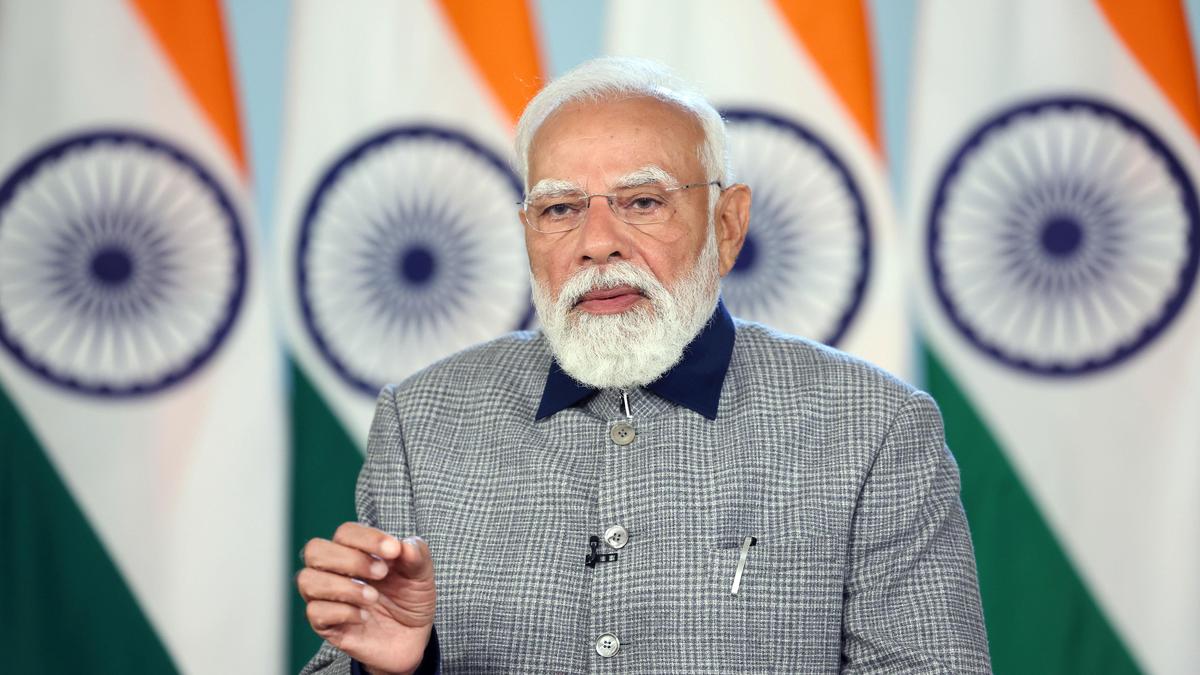
Prime Minister Modi addressed a function celebrating Parakram Diwas, marking the birth anniversary of Netaji Subhas Chandra Bose. He highlighted India's responsible approach to power management. This event is vital for competitive exams, covering national observances, significant historical figures, and government initiatives, frequently tested in history and current affairs sections.
Revision structure
Monthly events and exam calendar context
Static GK and one-liner notes
Quiz and mock-test revision path
Key points
Exam-ready takeaways
It commemorates the birth anniversary of Netaji Subhas Chandra Bose.
Netaji Subhas Chandra Bose was born on January 23, 1897.
The Government of India officially declared January 23 as 'Parakram Diwas' in 2021.
Prime Minister Narendra Modi addressed the Parakram Diwas function.
Detailed analysis
Full exam-oriented breakdown
The Prime Minister's address on Parakram Diwas, commemorating the birth anniversary of Netaji Subhas Chandra Bose, is far more than just a ceremonial speech; it's a strategic articulation of India's evolving national identity, its historical narrative, and its aspirations on the global stage. Understanding this event requires delving into its rich background, the underlying messages, and its broad implications for India. **Background Context and What Happened:** Parakram Diwas, or 'Day of Valour,' is observed annually on January 23rd, marking the birth anniversary of one of India's most iconic freedom fighters, Netaji Subhas Chandra Bose. Born on January 23, 1897, Netaji's contributions to India's independence struggle are immense, characterized by his unwavering courage and revolutionary spirit. For decades, there has been a strong public sentiment, particularly from his native West Bengal and across the nation, for greater official recognition of his legacy. Responding to this, the Government of India officially declared January 23rd as 'Parakram Diwas' in 2021, aiming to inspire the youth with Netaji's life and ideals of resilience and patriotism. The event this year saw Prime Minister Narendra Modi addressing the function, where he underscored a significant message: "India knows how to manage power responsibly." This statement, delivered on such an important national observance, carries profound weight, suggesting India's mature and strategic approach to its increasing global influence. **Key Stakeholders Involved:** Several key stakeholders are central to this event. Firstly, the **Government of India** and specifically the **Ministry of Culture** are the primary organizers, responsible for institutionalizing 'Parakram Diwas' and shaping its narrative. **Prime Minister Narendra Modi** is a crucial stakeholder, not only by delivering the keynote address but also by actively steering the discourse around national heroes and India's global positioning. His words reflect the government's foreign policy stance and domestic vision. The **Indian populace**, particularly the youth, are significant stakeholders as the intended recipients of the message of patriotism, historical awareness, and national pride. Lastly, the **legacy of Netaji Subhas Chandra Bose** and his family members and admirers constitute an important historical and emotional stakeholder group, whose long-standing demands for greater recognition have culminated in observances like Parakram Diwas. **Why This Matters for India: Significance and Broader Themes:** The celebration of Parakram Diwas and the Prime Minister's statement hold multi-faceted significance for India. Firstly, it's a powerful act of **historical reclamation and narrative building**. By elevating figures like Netaji, the government is actively reshaping how the nation's struggle for independence is perceived, ensuring that diverse contributions are highlighted. This fosters a more inclusive national identity. Secondly, it serves as a robust platform for **nationalism and patriotism**, inspiring citizens, particularly the younger generation, to draw lessons from Netaji's extraordinary courage and sacrifice. This aligns with broader governmental efforts to strengthen national pride and cultural roots. Economically, such national observances can indirectly boost cultural tourism and local economies through related events. Politically, it reinforces the government's commitment to honoring national heroes and can resonate with various regional sentiments. Socially, it promotes national integration by uniting people under shared symbols of heroism. The Prime Minister's assertion that "India knows how to manage power responsibly" is particularly pertinent. It's a clear message to the international community, signaling India's rise as a responsible global power that is capable of wielding its influence for peace and stability, while also asserting its national interests. This ties into India's strategic autonomy and its growing role in multilateral forums like the G20 and BRICS, reflecting a mature foreign policy that balances power projection with diplomatic responsibility. **Historical Context and Future Implications:** Netaji's life itself provides crucial historical context. His formation of the Indian National Army (INA) with Japanese support during World War II, his famous slogan "Give me blood and I will give you freedom," and his enigmatic disappearance, all mark him as a figure of immense courage and strategic thinking. His revolutionary path often contrasted with Mahatma Gandhi's non-violent methods, offering a different perspective on the freedom struggle. Parakram Diwas aims to integrate this valiant chapter more prominently into the national consciousness. Looking ahead, we can expect a continued emphasis on celebrating national heroes from various regional and historical backgrounds, aiming to strengthen national unity and identity. The government's focus on 'responsible power' suggests a trajectory where India will increasingly assert its influence on global issues, from climate change to security, while advocating for a multipolar world order. This narrative will likely be woven into India's foreign policy pronouncements and diplomatic engagements, shaping its future role as a leading global player. **Related Constitutional Articles, Acts, or Policies:** While there isn't a specific constitutional article declaring 'Parakram Diwas,' the spirit of such observances aligns with the **Fundamental Duties** enshrined in **Part IVA of the Indian Constitution**. Specifically, **Article 51A(b)** mandates every citizen to "cherish and follow the noble ideals which inspired our national struggle for freedom." Celebrating Netaji's birth anniversary directly embodies this duty. Furthermore, **Article 51A(c)**, which states to "uphold and protect the sovereignty, unity and integrity of India," resonates with Netaji's ultimate goal. The declaration of Parakram Diwas itself is a **policy decision** by the Union Government, primarily through the Ministry of Culture, showcasing the government's prerogative in shaping national commemorations and public memory. The Prime Minister's statements on India's responsible use of power reflect the principles guiding India's foreign policy, though these are not codified in a single constitutional article but rather derived from the Preamble's ideals of justice, liberty, equality, and fraternity, and the constitutional framework for external affairs.
How to study
Turn news into exam marks
Revise monthly events by exam family instead of reading random updates.
Pair one-liners with mock tests so mistakes become the next revision list.
Keep state job pages, calendar pages and GK packs connected in one path.