

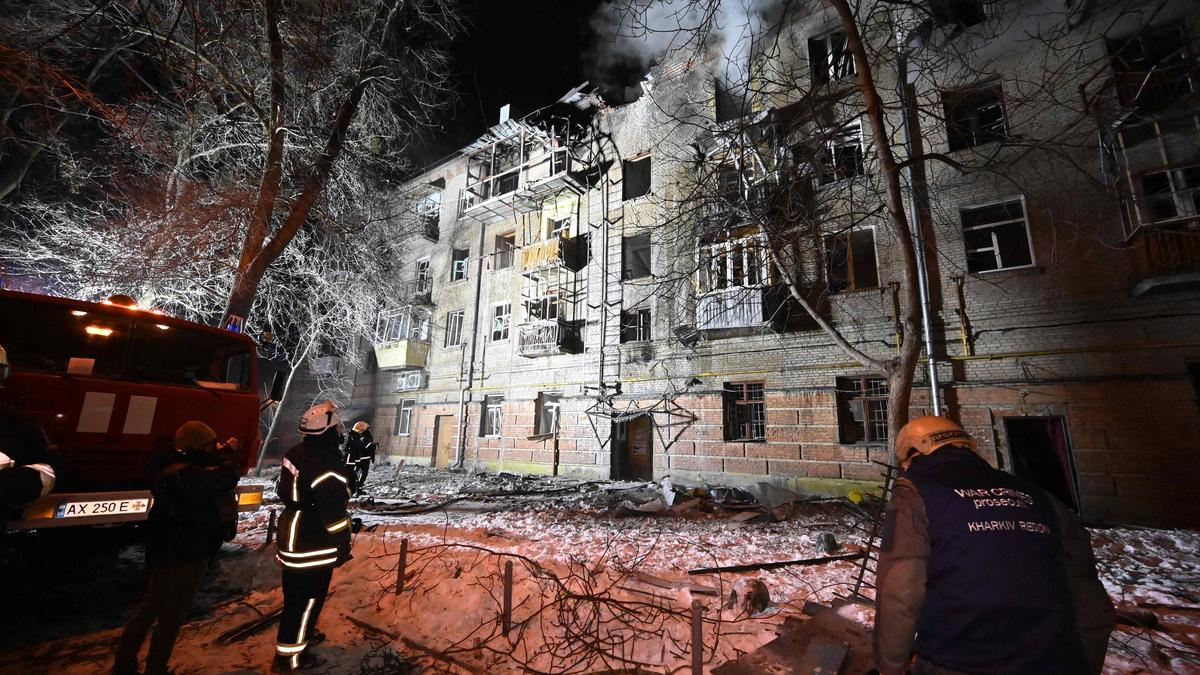
Russian strikes in Ukraine resulted in 1 fatality and 23 injuries.
GK and monthly revision
Russian strikes kill one, wound 23 in Ukraine
Russian strikes in Ukraine resulted in one fatality and 23 injuries, occurring shortly after the first direct talks between Russia, Ukraine, and the United States. These crucial negotiations took place on Friday, January 23, 2026, in Abu Dhabi. This incident highlights the ongoing geopolitical tensions and the complex nature of international diplomacy, making it vital for competitive exam aspirants to track global conflicts and peace efforts.
Revision structure
Monthly events and exam calendar context
Static GK and one-liner notes
Quiz and mock-test revision path
Key points
Exam-ready takeaways
The strikes occurred after the first direct talks involving Russia, Ukraine, and the United States.
These trilateral negotiations were held on Friday, January 23, 2026.
The direct talks between the three nations took place in Abu Dhabi.
Negotiators from Russia, Ukraine, and the United States participated in the meeting.
Detailed analysis
Full exam-oriented breakdown
The news of Russian strikes in Ukraine, resulting in casualties shortly after direct talks involving Russia, Ukraine, and the United States in Abu Dhabi on January 23, 2026, underscores the persistent volatility of the conflict and the complex nature of international diplomacy. This incident highlights the ongoing struggle between de-escalation efforts and continued military aggression, a pattern that has defined the Russia-Ukraine war since its full-scale escalation. **Background Context and What Happened:** The conflict's roots trace back to the dissolution of the Soviet Union, NATO's eastward expansion, and Russia's perceived security concerns regarding its borders. The annexation of Crimea in 2014 and support for separatists in eastern Ukraine marked a significant turning point, leading to a prolonged low-intensity conflict. The full-scale invasion launched by Russia in February 2022 drastically escalated the situation, transforming it into the largest conventional war in Europe since World War II. Millions have been displaced, and cities have been devastated. Against this backdrop of intense fighting, diplomatic efforts, though often fraught, continue. The recent trilateral talks in Abu Dhabi represent one such attempt, bringing together key adversaries and a major international mediator. The subsequent strikes, however, demonstrate that even as diplomatic channels open, the ground realities of conflict persist, potentially indicating a lack of genuine commitment to peace from one or more parties, or simply a strategy to gain leverage at the negotiating table. **Key Stakeholders Involved:** * **Russia:** Views the conflict as a defense against perceived Western encroachment and a means to secure its geopolitical interests and influence in its 'near abroad.' Its actions aim to reshape the regional security architecture and prevent Ukraine from aligning with Western blocs. * **Ukraine:** Fights for its sovereignty, territorial integrity, and the right to self-determination. It relies heavily on military and financial support from Western allies, particularly the United States and European Union, to resist Russian aggression. * **United States:** A key supporter of Ukraine, providing substantial military aid, intelligence, and humanitarian assistance. The U.S. also plays a crucial role in rallying international support against Russia, imposing sanctions, and leading diplomatic efforts. Its involvement reflects its broader commitment to European security and the rules-based international order. * **Other International Actors:** The European Union, United Nations, and various other countries and international organizations are involved through sanctions, humanitarian aid, and attempts at mediation. **Why This Matters for India:** The Russia-Ukraine conflict has profound implications for India, touching upon its foreign policy, economic stability, and strategic autonomy. * **Geopolitical Balancing Act:** India has historically maintained strong strategic ties with Russia, particularly in defense and energy. Simultaneously, it is cultivating a robust strategic partnership with the United States and other Western nations. The conflict forces India into a delicate balancing act, navigating its relationships without alienating either side. India's stance has generally emphasized dialogue and diplomacy, abstaining from votes condemning Russia at the UN, while also calling for respect for sovereignty and territorial integrity. * **Economic Impact:** The conflict has disrupted global supply chains, particularly for energy, food grains (wheat), and fertilizers. India, a major importer of crude oil and fertilizers, faces inflationary pressures and supply uncertainties. Rising global crude oil prices directly impact India's current account deficit and domestic fuel costs. * **Defence Implications:** India remains significantly dependent on Russian military hardware. The conflict has raised concerns about the timely delivery of spares and new equipment, prompting India to accelerate its diversification of defense imports and boost indigenous manufacturing under the 'Atmanirbhar Bharat' initiative. * **Multilateralism and International Law:** India, as an aspiring global power and a proponent of a rules-based international order, faces the challenge of upholding international law and the principles of sovereignty while managing its complex foreign policy interests. India's active participation in forums like the G20, SCO, and BRICS provides platforms to articulate its position and influence global discourse. **Historical Context and Future Implications:** The current conflict is a culmination of historical grievances, geopolitical rivalries, and security dilemmas stretching back decades. The post-Cold War order, characterized by a unipolar moment and the expansion of democratic ideals, is now giving way to a more multipolar world with renewed great power competition. The future implications are vast: * **Peace Prospects:** The simultaneous occurrence of talks and strikes suggests a long and arduous path to peace. A 'frozen conflict' scenario, where fighting subsides but no comprehensive peace agreement is reached, remains a strong possibility, perpetuating instability in the region. * **Global Order Reshaping:** The conflict accelerates the reshaping of global alliances and economic blocs. It reinforces the divide between democratic and authoritarian states, potentially leading to a more fragmented international system. * **India's Foreign Policy:** India will likely continue to pursue its policy of 'strategic autonomy,' prioritizing its national interests, engaging with all major powers, and advocating for a multipolar world order. This includes diversifying its strategic partnerships and reducing dependencies where possible. **Related Constitutional Articles, Acts, or Policies:** * **Directive Principles of State Policy (DPSP) - Article 51:** This article mandates the state to promote international peace and security, maintain just and honourable relations between nations, foster respect for international law and treaty obligations, and encourage settlement of international disputes by arbitration. This forms the foundational principle for India's foreign policy approach to conflicts like the Russia-Ukraine war, guiding its emphasis on diplomacy and peaceful resolution. * **Preamble of the Constitution:** Principles like 'sovereign' and 'integrity' are indirectly relevant, as India's foreign policy often champions the sovereignty and territorial integrity of nations, even while navigating complex relationships. * **Non-Alignment Movement (NAM) / Strategic Autonomy:** While not a constitutional article, India's historical foreign policy principle of non-alignment and its contemporary manifestation as 'strategic autonomy' are crucial in understanding its approach to such conflicts. It allows India to make independent foreign policy decisions based on its national interests, rather than aligning with any specific power bloc. * **United Nations Charter:** India's commitment as a signatory to the UN Charter, which emphasizes peaceful resolution of disputes and non-use of force, influences its diplomatic stance. Understanding these dynamics is crucial for aspirants, as the conflict continues to be a major determinant of global geopolitics and India's strategic calculations.
How to study
Turn news into exam marks
Revise monthly events by exam family instead of reading random updates.
Pair one-liners with mock tests so mistakes become the next revision list.
Keep state job pages, calendar pages and GK packs connected in one path.