

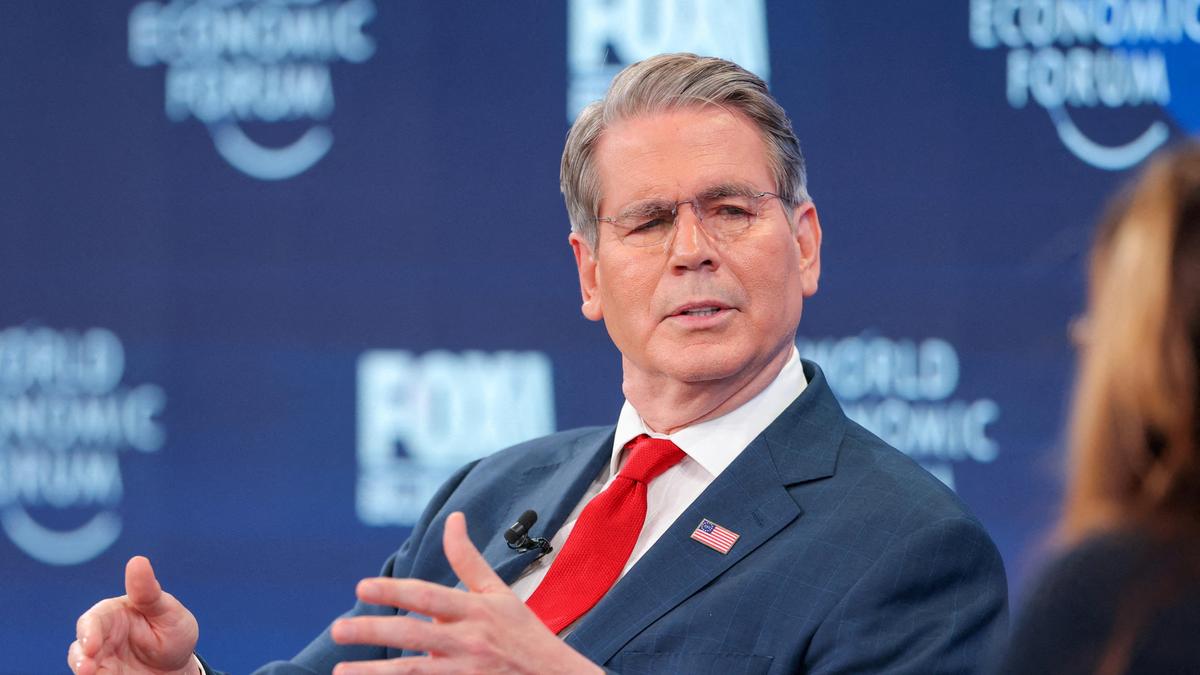
U.S. Treasury Secretary Scott Bessent hinted at possible tariff relief for India on Russian oil.
GK and monthly revision
U.S. Treasury Secretary hints at possible tariff relief for India as Russian oil imports drop
U.S. Treasury Secretary Scott Bessent hinted at potential tariff relief for India on Russian oil imports. This comes as Indian refinery purchases of Russian oil have significantly decreased, which the U.S. views as a success. The existing 25% tariffs on Russian oil are still in place, but Bessent sees a "path to take them off," highlighting evolving international energy dynamics and their impact on India-U.S. economic relations. This is crucial for understanding global trade policies.
Revision structure
Monthly events and exam calendar context
Static GK and one-liner notes
Quiz and mock-test revision path
Key points
Exam-ready takeaways
The potential tariff relief is linked to a significant drop in Indian purchases of Russian oil by refineries.
Currently, the U.S. has 25% tariffs imposed on Russian oil imports.
Secretary Bessent stated that he would imagine there is a 'path to take them off' the tariffs.
This development reflects shifts in global energy trade and U.S.-India economic relations.
Detailed analysis
Full exam-oriented breakdown
The recent statement by U.S. Treasury Secretary Scott Bessent, hinting at potential tariff relief for India on Russian oil imports, marks a significant development in global energy dynamics and international relations. This comes on the heels of a notable decrease in Indian refinery purchases of Russian oil, a trend the U.S. views as a positive outcome of its sanctions regime against Russia. **Background Context: The Russia-Ukraine War and Sanctions** To truly grasp the significance of this development, one must recall the geopolitical landscape following Russia's full-scale invasion of Ukraine in February 2022. In response to the aggression, Western nations, led by the United States and the G7, imposed unprecedented economic sanctions on Russia. A key component of these sanctions was the G7 price cap on Russian seaborne oil, implemented in December 2022. This mechanism aimed to limit Russia's revenue from oil sales, thereby curtailing its ability to finance the war, while simultaneously ensuring a stable global oil supply by allowing Russian oil to flow if sold below a certain price (initially $60 per barrel). India, a major oil importer, found itself in a unique position. Despite Western pressure, India significantly increased its purchases of discounted Russian crude, which was available at prices well below the G7 cap, prioritizing its energy security and economic interests. This move, while economically beneficial for India, created a point of contention with Western allies, particularly the U.S. **What Happened: A Shift in Dynamics** Secretary Bessent's remarks highlight a perceived shift in India's oil procurement strategy. The 'significant drop' in Indian purchases of Russian oil, which the U.S. considers a 'success,' indicates either a diversification of India's import sources or a re-evaluation of its energy strategy in light of evolving geopolitical realities. The U.S. currently levies 25% tariffs on Russian oil, a measure designed to further penalize Moscow. Bessent's suggestion of a 'path to take them off' these tariffs, particularly in relation to India, signals a potential reward or acknowledgment of India's efforts to align, at least partially, with Western objectives concerning Russian energy trade. It suggests a diplomatic opening where previous points of friction could be eased. **Key Stakeholders Involved** 1. **India:** As the world's third-largest oil consumer, India's energy security is paramount. Its refineries, like Indian Oil Corporation (IOC), Bharat Petroleum (BPCL), and Hindustan Petroleum (HPCL), are key commercial players making procurement decisions. India's foreign policy, guided by strategic autonomy, seeks to balance its diverse relationships. 2. **United States:** The architect of the sanctions regime, the U.S. seeks to maintain pressure on Russia while also strengthening its strategic partnership with India, a crucial ally in the Indo-Pacific. 3. **Russia:** Its economy heavily relies on oil and gas exports. Sanctions and shifts in purchasing patterns directly impact its revenue and geopolitical leverage. 4. **Global Oil Markets:** The actions of major importers like India, and the impact of sanctions, significantly influence global oil prices and supply chains. **Why This Matters for India** This development holds multifaceted significance for India. Economically, potential tariff relief or a signal of easing U.S. concerns could lead to more stable and diversified energy supplies, potentially reducing India's import bill and inflationary pressures. Politically, it signifies an improvement in the delicate balancing act India maintains between its long-standing strategic ties with Russia and its deepening partnership with the U.S. and other Western nations. It suggests a U.S. acknowledgement of India's efforts to navigate complex global challenges while protecting its national interests. Furthermore, it reinforces India's growing stature on the global stage, where its actions have tangible impacts on international policy and trade. **Historical Context and Broader Themes** Historically, India and Russia have shared a robust strategic partnership, particularly in defence and technology, dating back to the Cold War era. India's policy of non-alignment, while evolving, has always emphasized strategic autonomy. In recent decades, India's relations with the U.S. have deepened significantly, driven by shared democratic values, economic ties, and security concerns in the Indo-Pacific (e.g., through the Quad grouping). This current situation perfectly encapsulates India's challenge of managing these complex, often divergent, relationships. It reflects broader themes of energy security, geopolitical competition, and the evolving world order where economic interdependence often clashes with political rivalries. **Future Implications** The future implications are substantial. If the U.S. indeed lifts tariffs or provides other forms of relief, it could incentivize India to further diversify its oil imports away from Russia, potentially strengthening its energy security by reducing over-reliance on any single source. This could also pave the way for enhanced India-U.S. cooperation in other critical sectors, such as defence, clean energy, and technology. It might signal a more nuanced approach from the U.S. towards nations navigating the complexities of sanctions, potentially setting a precedent for other countries. For Russia, it means continued pressure on its oil revenue, forcing it to seek alternative markets or accept deeper discounts. Ultimately, this move could contribute to a more stable and predictable global energy market, while solidifying India's position as a crucial player in shaping the geopolitical and geoeconomic landscape. **Related Constitutional Articles, Acts, or Policies** * **Article 51 of the Indian Constitution:** This Directive Principle of State Policy mandates the state to endeavor to promote international peace and security, maintain just and honorable relations between nations, foster respect for international law and treaty obligations, and encourage settlement of international disputes by arbitration. India's foreign policy decisions, including energy procurement, are guided by these principles. * **Foreign Trade (Development and Regulation) Act, 1992:** This Act empowers the Central Government to make provisions for the development and regulation of foreign trade, including imports and exports. Policies regarding oil imports and tariffs fall under this legislative framework. * **Customs Act, 1962:** This Act governs the levy and collection of customs duties on goods imported into and exported from India. Any changes in tariffs, whether by the U.S. or India, directly impact the application of this act for Indian importers. * **India's Energy Security Policy:** This overarching policy aims to ensure adequate, affordable, and sustainable energy supplies for the nation, emphasizing diversification of sources and strategic reserves. This statement directly impacts this policy's implementation.
How to study
Turn news into exam marks
Revise monthly events by exam family instead of reading random updates.
Pair one-liners with mock tests so mistakes become the next revision list.
Keep state job pages, calendar pages and GK packs connected in one path.