

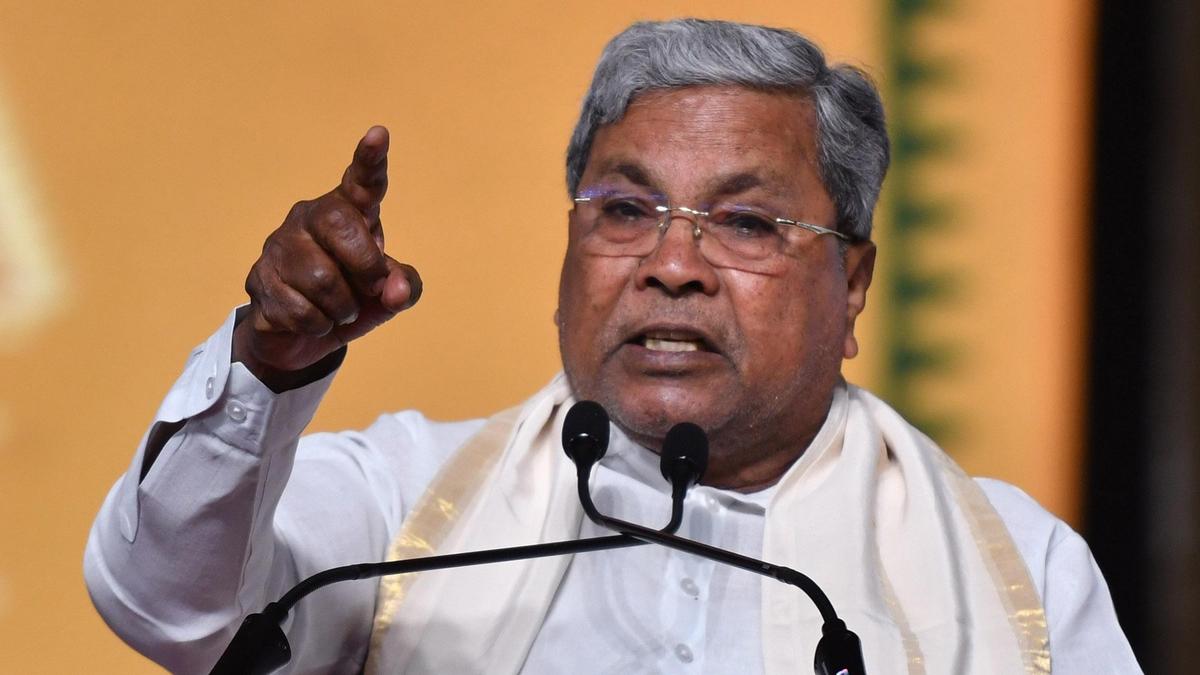
Karnataka Chief Minister Siddaramaiah made a statement regarding the Governor's discretion over the 'government's speech'.
GK and monthly revision
Governor is free to make changes to ‘government’s speech’ during Republic Day: CM Siddaramaiah
Karnataka CM Siddaramaiah stated that the Governor is free to make changes to the 'government's speech' on Republic Day. This statement highlights the constitutional role of the Governor as the state's head and the relationship with the elected government. For competitive exams, understanding the Governor's powers, duties, and interaction with the Council of Ministers, particularly regarding ceremonial speeches and legislative addresses, is crucial for Polity sections.
Revision structure
Monthly events and exam calendar context
Static GK and one-liner notes
Quiz and mock-test revision path
Key points
Exam-ready takeaways
The context of the statement is the Governor's address during Republic Day celebrations.
The Governor is the constitutional head of the state, appointed by the President of India under Article 155 of the Constitution.
Traditionally, the Governor's speech, particularly during legislative sessions (Article 176), is prepared by the Council of Ministers.
This issue underscores the constitutional relationship and potential points of contention between the Governor and the elected state government.
Detailed analysis
Full exam-oriented breakdown
The statement by Karnataka Chief Minister Siddaramaiah, asserting the Governor's freedom to modify the 'government's speech' during Republic Day celebrations, opens a critical window into the nuanced and often contentious relationship between the constitutional head of a state and its elected government. This issue is a recurrent theme in Indian federalism, highlighting the delicate balance of power and the interpretation of constitutional conventions. **Background Context and What Happened:** Traditionally, the Governor, as the constitutional head of the state, delivers an address to the state legislature at the commencement of the first session after each general election and at the commencement of the first session of each year, as mandated by Article 176 of the Indian Constitution. This address, much like the President's address to Parliament, is essentially a statement of the government's policies, programmes, and achievements for the preceding year, and its legislative agenda for the upcoming year. Crucially, this speech is prepared by the Council of Ministers, and the Governor is expected to read it as prepared, reflecting the principle that the Governor acts on the 'aid and advice' of the Council of Ministers (Article 163). While CM Siddaramaiah's specific comment referred to a Republic Day speech, which is more ceremonial than a legislative address, the underlying principle of governmental ownership of the speech remains the same. His statement, whether intended to concede a right or merely acknowledge a possibility, stirs the pot on the extent of the Governor's discretionary powers and the nature of their role. **Key Stakeholders Involved:** 1. **The Governor:** As the constitutional head of the state, appointed by the President under Article 155, the Governor is meant to be a neutral figure. They serve as a vital link between the Union and the State. However, their dual role – as a constitutional head acting on advice and as a representative of the Centre – often leads to complex situations. 2. **The Chief Minister and Council of Ministers:** This is the elected executive arm of the state, directly accountable to the state legislature and, by extension, to the people. They formulate policies and govern the state. The 'government's speech' is their policy blueprint and report card. 3. **The President of India:** As the appointing authority for Governors, the President's office is indirectly involved. The President, too, acts on the aid and advice of the Union Council of Ministers, making the Governor's position somewhat susceptible to central government influence. **Why This Matters for India:** This issue strikes at the heart of India's quasi-federal structure and the principles of parliamentary democracy. If a Governor were to unilaterally alter or omit parts of a speech prepared by the elected government, it would signify a breakdown of constitutional conventions and a direct challenge to the democratic mandate of the state government. It raises fundamental questions about accountability: who is responsible for the content of the speech if the Governor makes changes? It could lead to political instability, accusations of gubernatorial overreach, and further strain Centre-State relations, especially in states governed by opposition parties. Such actions can undermine public trust in democratic institutions and the neutrality of constitutional offices. **Historical Context and Constitutional Provisions:** India's constitutional framework envisages the Governor as a nominal head, much like the British monarch. However, unlike the monarch, the Governor has certain 'discretionary powers' explicitly mentioned in the Constitution (e.g., Article 163(1) allows the Governor to act in his discretion in certain matters, though the scope is debated). The Sarkaria Commission (1983) on Centre-State Relations and the M.M. Punchhi Commission (2007) both extensively deliberated on the Governor's role, generally recommending that Governors should act on the aid and advice of the Council of Ministers, especially in legislative matters. There have been numerous instances where Governors have deviated from prepared speeches, withheld assent to bills passed by the assembly (Article 200), or exercised discretion in forming governments, leading to significant political controversies across states like Kerala, West Bengal, and Tamil Nadu. **Future Implications:** CM Siddaramaiah's statement, whether a strategic political move or a genuine acknowledgment, could set a precedent or at least fuel further debate. If Governors begin to frequently exercise such discretion in ceremonial speeches, it could escalate to more significant interference in legislative and executive functions. This could lead to: 1. Increased friction between state governments and Raj Bhavans. 2. Potential legal challenges, seeking judicial interpretation of the extent of gubernatorial discretion. 3. A demand for clearer constitutional guidelines or even amendments to define the Governor's role more precisely, especially concerning the 'aid and advice' clause. 4. Further politicization of the Governor's office, eroding its constitutional sanctity and perceived impartiality. Ultimately, it impacts the smooth functioning of state administration and the health of India's federal polity. The sanctity of the 'government's speech' is not just about words; it's about the respect for the democratic mandate and the constitutional division of powers. Any deviation by the Governor, unless explicitly provided for by the Constitution, is seen as an encroachment on the executive authority of the elected government.
How to study
Turn news into exam marks
Revise monthly events by exam family instead of reading random updates.
Pair one-liners with mock tests so mistakes become the next revision list.
Keep state job pages, calendar pages and GK packs connected in one path.