

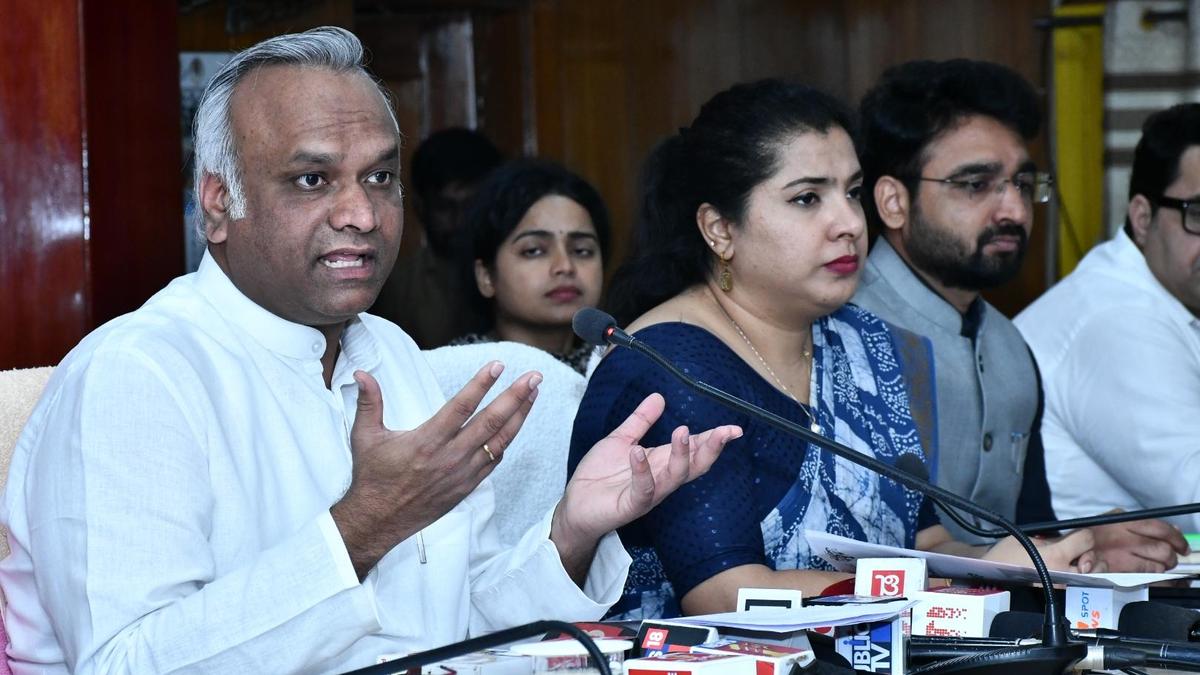
The statement was made by Minister Priyank Kharge regarding a Governor's action.
GK and monthly revision
Governor’s action against Constitutional norms: Priyank Kharge
Minister Priyank Kharge stated that the Governor's actions against constitutional norms were unwarranted, as the State Government's drafted address contained no offensive references to the Union Government. This incident highlights the recurring friction between Governors and elected state governments over constitutional duties and discretionary powers. For competitive exams, understanding the Governor's role, constitutional provisions like Article 163 and Article 176, and relevant commission recommendations (e.g., Sarkaria, Punchhi) is crucial.
Revision structure
Monthly events and exam calendar context
Static GK and one-liner notes
Quiz and mock-test revision path
Key points
Exam-ready takeaways
The core issue involves a Governor's alleged deviation from constitutional norms concerning a State Government's address.
The Minister asserted that the State Government's drafted address contained no offensive or derogatory references to the Union Government.
This incident underscores the constitutional relationship and potential friction between a Governor and the elected State Council of Ministers.
Relevant constitutional provisions include Article 163 (Council of Ministers to aid and advise Governor) and Article 176 (Special address by the Governor).
Detailed analysis
Full exam-oriented breakdown
The statement by Minister Priyank Kharge regarding a Governor's alleged deviation from constitutional norms brings to the forefront a recurring and critical issue in India's federal structure: the often-contentious relationship between the Governor and the elected State Government. This incident, where the Governor reportedly acted against the State Government's drafted address despite it containing no 'offensive or derogatory references to the Union Government,' highlights the inherent tension in the Governor's dual role. **Background Context and What Happened:** The office of the Governor, established by Article 153 of the Indian Constitution, serves as the constitutional head of the state and simultaneously as a vital link and representative of the Union Government. Appointed by the President (Article 155), the Governor is expected to act on the 'aid and advice' of the Council of Ministers (CoM) headed by the Chief Minister, as per Article 163, except in certain specified circumstances where they may exercise discretion. One such crucial constitutional duty is the Governor's address to the State Legislature. Article 176 mandates that the Governor address the Legislative Assembly (or both Houses in states with a bicameral legislature) at the commencement of the first session after each general election and at the commencement of the first session of each year. This address is essentially a policy statement of the elected government, drafted by the CoM, outlining its legislative agenda, achievements, and future plans. The recent incident implies that the Governor either omitted parts of the government's prepared address or added their own remarks, thereby challenging the established constitutional convention and the democratic mandate of the state government. **Key Stakeholders Involved:** 1. **The Governor:** As the nominal head of the state and the representative of the Centre, their actions have significant constitutional and political implications. Their role is to uphold the Constitution, but questions arise when their actions are perceived to be politically motivated or beyond the scope of their discretionary powers. 2. **The State Government (Council of Ministers):** Led by the Chief Minister, this is the democratically elected body responsible for governance. Their prerogative to draft the Governor's address reflects their policy mandate, and any alteration by the Governor is seen as an infringement on their constitutional authority. 3. **The Union Government:** Although not directly involved in the immediate incident, the Union Government's influence is significant, as Governors are appointed by the President on the advice of the Union Cabinet. Concerns often arise regarding Governors acting as agents of the Centre, especially when the state government belongs to an opposition party. 4. **The State Legislature:** This is the forum where the address is delivered, and any deviation from the government's prepared text can lead to disruptions, protests, and a breakdown of legislative decorum. **Why This Matters for India:** This issue strikes at the very heart of India's federalism and democratic principles. Such actions by a Governor can: * **Undermine Cooperative Federalism:** They exacerbate Centre-State tensions, particularly when different political parties govern at the Centre and in the State. This goes against the spirit of cooperative federalism envisioned by the Constitution. * **Challenge Democratic Mandate:** By altering the address prepared by an elected government, the Governor effectively questions the mandate of the people, leading to a perception that an unelected appointee is overriding the will of the electorate. * **Erode Constitutional Morality:** Frequent instances of Governors acting contrary to established conventions or perceived constitutional norms weaken public trust in constitutional institutions and the rule of law. * **Lead to Political Instability:** Such friction can disrupt governance, lead to legislative stalemates, and divert focus from developmental issues to political squabbles. **Historical Context and Future Implications:** The history of Governor-state government friction is long and complex, dating back to the early years of the Republic. Landmark cases and commissions have addressed this. The **Sarkaria Commission (1983-1988)**, set up to examine Centre-State relations, recommended that Governors should 'scrupulously follow the advice tendered to them by the Chief Minister' in matters where they are required to act on advice. It also stated that the Governor should not 'edit, add to, or subtract from' the address prepared by the State Government. Similarly, the **Punchhi Commission (2007-2010)** reiterated the need for Governors to act as constitutional heads and not as agents of the Centre. Despite these recommendations, such incidents persist. Looking ahead, continued friction could lead to demands for significant reforms in the Governor's office, potentially including changes in the mode of appointment, clearer definitions of discretionary powers, and mechanisms for accountability. It might also lead to increased judicial intervention to clarify the boundaries of gubernatorial powers. The long-term implication is a potential weakening of India's federal fabric if political considerations consistently override constitutional propriety and conventions. **Related Constitutional Articles, Acts, or Policies:** * **Article 153:** Governors of States. * **Article 155:** Appointment of Governor by the President. * **Article 156:** Term of office of Governor (holds office during the pleasure of the President). * **Article 163:** Council of Ministers to aid and advise Governor. This article is central, as it specifies the limited circumstances where the Governor can act in their discretion. * **Article 176:** Special address by the Governor. This is the direct constitutional provision related to the incident. * **Article 200:** Assent to Bills, another area where Governors often exercise discretion and face criticism. * **Sarkaria Commission (1988) & Punchhi Commission (2010) Reports:** These reports contain crucial recommendations on the role, powers, and appointment of Governors, directly relevant to understanding the constitutional conventions and proposed reforms.
How to study
Turn news into exam marks
Revise monthly events by exam family instead of reading random updates.
Pair one-liners with mock tests so mistakes become the next revision list.
Keep state job pages, calendar pages and GK packs connected in one path.