

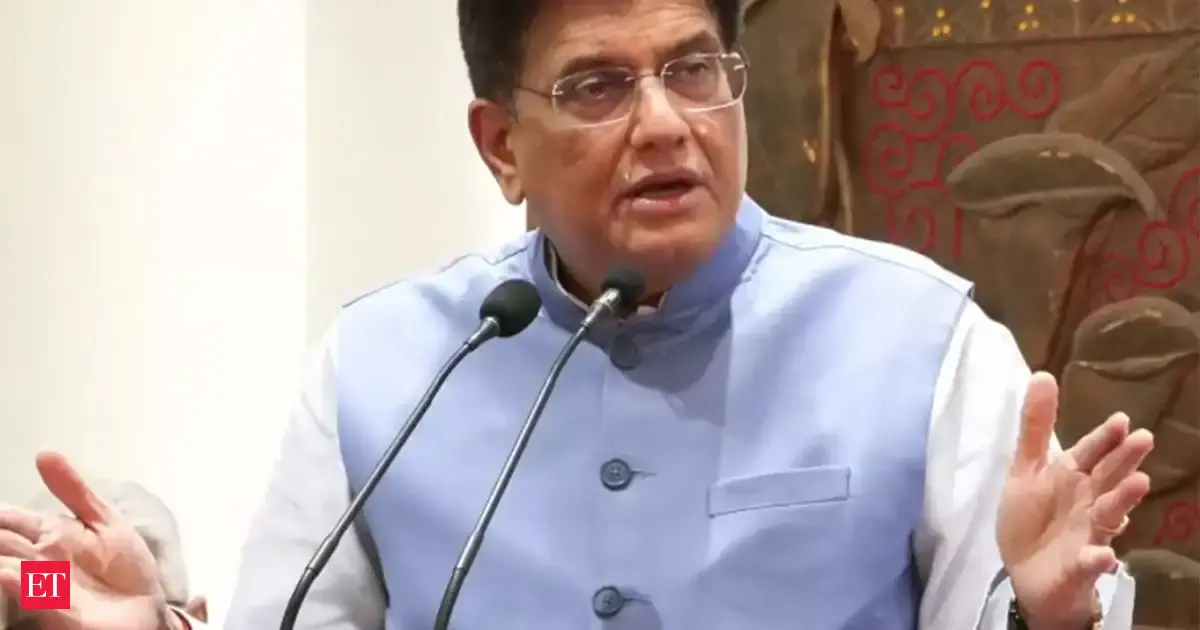
Union Minister Piyush Goyal met with EU Trade Commissioner Maros Sefcovic.
GK and monthly revision
India, EU committed to ambitious, mutually beneficial FTA: Piyush Goyal
Union Minister Piyush Goyal and EU Trade Commissioner Maros Sefcovic reaffirmed their commitment to an ambitious and mutually beneficial India-EU Free Trade Agreement (FTA). This development signifies progress in strengthening economic ties between India and the European Union, aiming for a fruitful outcome after sustained engagement. Such agreements are crucial for boosting trade, investment, and economic growth, making it a key topic for competitive exams focusing on international relations and economy.
Revision structure
Monthly events and exam calendar context
Static GK and one-liner notes
Quiz and mock-test revision path
Key points
Exam-ready takeaways
Both leaders reaffirmed their commitment to an 'ambitious and mutually beneficial' India-EU Free Trade Agreement (FTA).
Piyush Goyal serves as India's Minister of Commerce and Industry.
Maros Sefcovic holds the position of EU Trade Commissioner.
The sustained and constructive engagement over the past year has brought both sides closer to a 'fruitful outcome' on the FTA.
Detailed analysis
Full exam-oriented breakdown
The recent reaffirmation by Union Minister Piyush Goyal and EU Trade Commissioner Maros Sefcovic of their commitment to an 'ambitious and mutually beneficial' India-EU Free Trade Agreement (FTA) marks a significant moment in the evolving economic relationship between India and the European Union. This development underscores a renewed vigour in bilateral trade discussions, promising a substantial impact on India's economic trajectory and geopolitical standing. **Background Context and Historical Journey:** India and the European Union share a strategic partnership that dates back to the early 1960s. The EU is one of India's largest trading partners, and vice-versa. The idea of a comprehensive trade agreement is not new; formal negotiations for a Broad-based Trade and Investment Agreement (BTIA) commenced in 2007. However, these talks stalled in 2013 due to significant divergences on key issues. India sought greater market access for its services and professionals, while the EU pushed for deeper cuts in tariffs on automobiles, wines, and spirits, as well as robust intellectual property rights (IPR) protection and data security provisions. After nearly a decade, the geopolitical shifts and the imperative for supply chain diversification, particularly in the post-pandemic era and amid global uncertainties, prompted both sides to re-engage. The negotiations for the current India-EU FTA officially resumed in June 2022, signaling a fresh approach and a stronger political will to overcome past hurdles. **What Happened and Key Stakeholders:** Union Minister for Commerce and Industry, Piyush Goyal, met with EU Trade Commissioner Maros Sefcovic, expressing satisfaction with the sustained and constructive engagement that has brought both sides closer to a fruitful outcome. This meeting highlights high-level political commitment. The key stakeholders involved are diverse and have significant interests at stake. For **India**, the Ministry of Commerce and Industry, led by Piyush Goyal, is the primary negotiator. Indian businesses, particularly in sectors like textiles, pharmaceuticals, IT services, and agriculture, stand to gain from enhanced market access. Consumers could benefit from a wider range of goods at potentially lower prices. For the **European Union**, the European Commission, represented by Maros Sefcovic (who also serves as Executive Vice-President for the European Green Deal), leads the negotiations. EU member states and their respective industries, particularly in manufacturing, technology, and luxury goods, are keen on accessing India's vast and growing market. Farmers and environmental groups in both regions also have a vested interest, pushing for specific standards and protections within the agreement. The broader international trade community, including the World Trade Organization (WTO), also watches these developments closely, as a successful FTA between two major economies can influence global trade norms. **Significance for India:** An India-EU FTA holds immense significance for India. Economically, the EU is India's third-largest trading partner, accounting for 10.8% of India's total trade in goods in 2022-23. A comprehensive FTA could unlock significant export opportunities for Indian goods and services, especially in labour-intensive sectors, contributing to job creation and boosting the 'Make in India' initiative. It could attract increased Foreign Direct Investment (FDI) from European companies, bringing in capital, technology, and best practices. From a geopolitical perspective, strengthening ties with the EU diversifies India's economic partnerships, reducing over-reliance on any single region and enhancing its strategic autonomy. It also aligns with India's broader foreign policy objectives of engaging with like-minded democracies and promoting a rules-based international order. A successful FTA would bolster India's position as a reliable global supply chain partner, crucial for its ambition to become a $5 trillion economy. **Future Implications and Constitutional Context:** While the commitment is strong, the path to a concluded FTA is complex. Future negotiations will likely focus on resolving contentious issues such as tariff reductions across various product categories, non-tariff barriers, geographical indications, sustainable development provisions (including environmental and labour standards), and digital trade. The EU's emphasis on climate change and green initiatives, as championed by Commissioner Sefcovic, means that environmental and sustainability clauses will be prominent. India will need to balance its developmental imperatives with these evolving global standards. A successful agreement will require careful calibration to protect sensitive domestic sectors while opening doors for growth. Constitutionally, the power to enter into and implement international treaties and agreements rests with the Union government. **Article 253** of the Indian Constitution empowers Parliament to make laws for implementing any international treaty, agreement, or convention. Furthermore, **Entry 14 of the Union List (List I) in the Seventh Schedule** explicitly grants the Union Parliament the exclusive power to legislate on "entering into treaties and agreements with foreign countries and implementing of treaties, agreements and conventions with foreign countries." This legal framework ensures that any FTA, once negotiated, can be ratified and implemented through appropriate domestic legislation, such as amendments to the Foreign Trade (Development and Regulation) Act, 1992, or new policies aligned with India's Foreign Trade Policy. The success of this FTA will be a testament to India's diplomatic prowess and its commitment to integrating further into the global economy while pursuing its national interests.
How to study
Turn news into exam marks
Revise monthly events by exam family instead of reading random updates.
Pair one-liners with mock tests so mistakes become the next revision list.
Keep state job pages, calendar pages and GK packs connected in one path.