

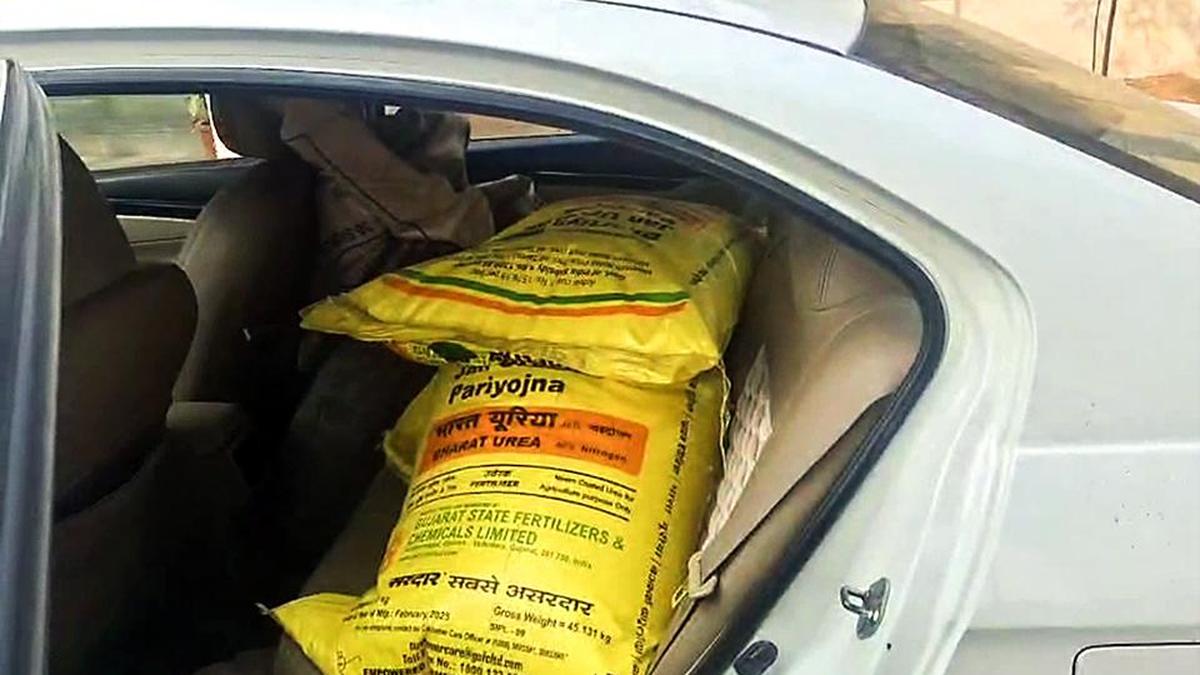
A total of 9,550 kg of explosives was seized by police in Rajasthan.
GK and monthly revision
9,550 kg of explosives seized in Rajasthan, man arrested; Central agencies likely to get involved
Police in Rajasthan seized a massive 9,550 kg of explosives, primarily ammonium nitrate, along with a large quantity of detonators and fuse wires, leading to one arrest. This significant seizure highlights critical internal security concerns and the potential for misuse of such materials for illicit activities. The anticipated involvement of central agencies underscores the gravity of the situation, making it highly relevant for competitive exams focusing on law enforcement, internal security, and current affairs.
Revision structure
Monthly events and exam calendar context
Static GK and one-liner notes
Quiz and mock-test revision path
Key points
Exam-ready takeaways
The primary explosive seized was ammonium nitrate, a common component in improvised explosive devices.
The seizure also included a large quantity of explosive accessories, specifically nine cartons of detonators.
Police recovered 12 cartons and 15 bundles of blue fuse wire, and 12 cartons and five bundles of red fuse wire.
One individual was arrested in connection with the seizure, and Central agencies are likely to get involved in the investigation.
Detailed analysis
Full exam-oriented breakdown
The recent seizure of a massive 9,550 kg of explosives, primarily ammonium nitrate, along with a significant cache of detonators and fuse wires in Rajasthan, represents a critical incident highlighting persistent internal security challenges in India. This event, leading to one arrest and the anticipated involvement of central agencies, underscores the sophisticated nature of illicit networks dealing with dangerous materials. **Background Context:** Ammonium nitrate (AN) is a chemical compound widely used as a fertilizer in agriculture and as an explosive in mining and construction. Its dual-use nature makes its regulation complex. In its pure form, AN is relatively stable, but when mixed with fuel oil (ANFO), it becomes a potent explosive. India has unfortunately witnessed the devastating misuse of AN in several terror attacks, including the 2008 Mumbai attacks, the 2010 German Bakery blast in Pune, and the 2013 Bodh Gaya blasts. These incidents prompted the government to tighten regulations, leading to the notification of the Ammonium Nitrate Rules, 2012, which mandates strict licensing for storage, sale, and transport of AN, classifying it as an 'explosive' for regulatory purposes. **What Happened:** Rajasthan police successfully intercepted a large quantity of explosives, including 9,550 kg of ammonium nitrate, nine cartons of detonators, and numerous bundles of fuse wires. This indicates a well-organized attempt to transport or store these materials, likely for illicit purposes. The scale of the seizure suggests a potential for large-scale destruction, raising alarm bells for intelligence and law enforcement agencies. **Key Stakeholders Involved:** * **Rajasthan Police:** As the initial responders and investigating agency, they played a crucial role in the seizure and preliminary investigation. Their efficiency in intelligence gathering and execution is paramount for maintaining state-level law and order. * **Central Agencies (e.g., National Investigation Agency - NIA, Intelligence Bureau - IB, Research and Analysis Wing - RAW):** Their likely involvement signifies that the case may have wider ramifications, potentially involving inter-state networks, organized crime, or even cross-border terrorism. The NIA, established under the NIA Act, 2008, is specifically mandated to investigate and prosecute offenses affecting the sovereignty, security, and integrity of India, including terror acts. * **Ministry of Home Affairs (MHA):** The MHA oversees internal security and coordinates efforts between central and state agencies. It sets policies and provides guidelines for combating terrorism and managing hazardous substances. * **The Public:** Citizens are indirect stakeholders, whose safety and security are directly impacted by such threats. Public cooperation with law enforcement is vital for intelligence gathering. **Why This Matters for India:** This incident is deeply significant for India's internal security landscape. Firstly, it highlights the continued vulnerability to the illicit procurement and movement of explosive materials. The sheer quantity seized could have been used to construct multiple powerful improvised explosive devices (IEDs), posing a severe threat to public safety and critical infrastructure. Secondly, it points to potential gaps in the enforcement of the Ammonium Nitrate Rules, 2012, and the Explosives Act, 1884, which govern the manufacture, possession, use, sale, transport, import, and export of explosives. Thirdly, the involvement of central agencies underscores the federal nature of India's security apparatus, where state police handle local law and order (a subject under List II of the Seventh Schedule), but serious crimes with national implications often require central intervention (Criminal Law and Criminal Procedure are Concurrent subjects under List III). This cooperation is vital for effective counter-terrorism efforts. **Historical Context and Related Legislation:** The Explosives Act of 1884 is the foundational law governing explosives in India. Post-independence, the Explosive Substances Act, 1908, was enacted to address the unlawful possession and manufacture of explosive substances with intent to endanger life or property. The series of terror attacks using AN, particularly in the early 2010s, provided the impetus for specific regulations like the Ammonium Nitrate Rules, 2012, which aim to track and control the entire supply chain of AN, from production to end-use, to prevent its diversion for illicit purposes. The Unlawful Activities (Prevention) Act, 1967 (UAPA), would also be invoked if a terror angle is established, providing stringent provisions for dealing with unlawful associations and terrorist acts. **Future Implications:** This seizure will likely lead to intensified efforts by security agencies to map and dismantle networks involved in the illicit trade of explosives. Expect stricter enforcement of existing regulations, enhanced surveillance of precursor chemicals, and improved intelligence sharing mechanisms between state and central agencies. There might also be a review of the efficacy of the Ammonium Nitrate Rules, 2012, to identify any loopholes. Furthermore, the incident serves as a reminder of the need for continuous vigilance against organized crime and terror groups, which often exploit such materials to destabilize peace and order.
How to study
Turn news into exam marks
Revise monthly events by exam family instead of reading random updates.
Pair one-liners with mock tests so mistakes become the next revision list.
Keep state job pages, calendar pages and GK packs connected in one path.