

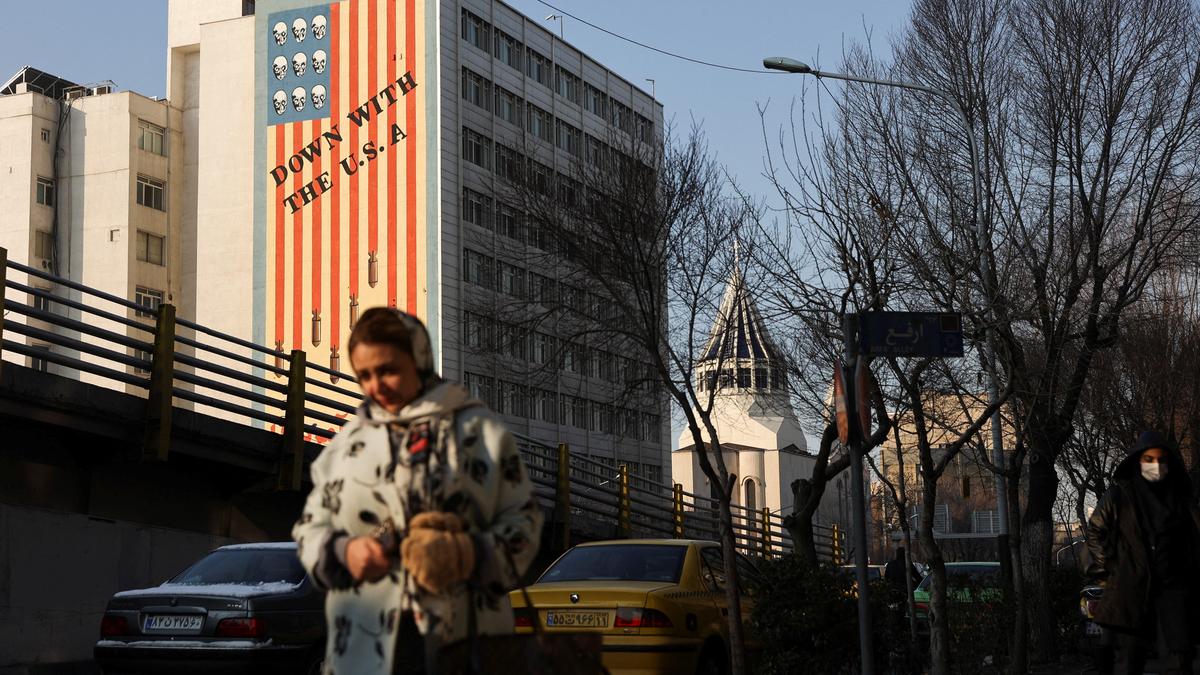
Iran unveiled a mural warning of retaliation against a potential U.S. military strike.
GK and monthly revision
Iran unveils mural warning of retaliation if U.S. conducts a military strike
Iran recently unveiled a mural warning of retaliation if the U.S. conducts a military strike, signaling heightened geopolitical tensions. This development follows a brutal crackdown on nationwide protests in Iran, which resulted in thousands killed and tens of thousands arrested, further escalating friction with Western nations. For competitive exams, understanding the dynamics of U.S.-Iran relations and the internal situation in Iran is crucial for international current affairs.
Revision structure
Monthly events and exam calendar context
Static GK and one-liner notes
Quiz and mock-test revision path
Key points
Exam-ready takeaways
The unveiling signifies a spike in tension between the U.S. and Iran.
This escalation follows a brutal crackdown on nationwide protests within Iran.
The crackdown on protests reportedly led to thousands of people killed.
Additionally, tens of thousands of individuals were arrested during the Iranian protests.
Detailed analysis
Full exam-oriented breakdown
The recent unveiling of a mural in Iran, explicitly warning of retaliation against potential U.S. military strikes, is a stark indicator of the deeply volatile relationship between Tehran and Washington. This development isn't an isolated incident but rather a symptom of escalating tensions fueled by a complex interplay of historical grievances, geopolitical rivalries, and internal pressures within Iran. For competitive exam aspirants, understanding this intricate dynamic is crucial for grasping international relations. To truly grasp the current situation, we must first delve into the historical context. The animosity between the U.S. and Iran largely solidified after the 1979 Islamic Revolution, which overthrew the U.S.-backed Shah and established an anti-Western Islamic Republic. The subsequent hostage crisis at the U.S. embassy in Tehran cemented decades of mistrust. Iran's pursuit of a nuclear program, perceived by the U.S. and its allies as a threat to regional and global security, further exacerbated tensions. This culminated in the landmark 2015 Joint Comprehensive Plan of Action (JCPOA), an international agreement that limited Iran's nuclear activities in exchange for sanctions relief. However, in 2018, the Trump administration controversially withdrew from the JCPOA, reimposing a 'maximum pressure campaign' of sanctions aimed at crippling Iran's economy and forcing it to renegotiate a new deal. This withdrawal was a critical turning point, leading to increased Iranian defiance and a gradual escalation of its nuclear program. Adding another layer of complexity are the internal dynamics within Iran. The mural's unveiling closely followed a brutal crackdown on nationwide protests that erupted in the wake of Mahsa Amini's death in September 2022. Amini, a 22-year-old woman, died in the custody of Iran's morality police, allegedly for violating the country's strict dress code. This tragedy ignited the 'Woman, Life, Freedom' movement, which saw unprecedented demonstrations across the country, challenging the very legitimacy of the Islamic Republic. The Iranian government responded with severe force, resulting in thousands killed, tens of thousands arrested, and numerous executions, as reported by human rights organizations and international media. This crackdown drew widespread condemnation from Western nations, including the U.S., intensifying calls for accountability and further straining diplomatic ties. Key stakeholders in this volatile scenario include the **Iranian government**, led by Supreme Leader Ayatollah Ali Khamenei and President Ebrahim Raisi, along with powerful entities like the Islamic Revolutionary Guard Corps (IRGC). Their primary objective is regime survival, maintaining internal control, and projecting strength against external threats. The **United States**, under President Joe Biden, aims to prevent Iran from acquiring nuclear weapons, counter its destabilizing regional activities, and promote human rights, while also seeking a potential return to nuclear negotiations. **Regional powers** like Saudi Arabia and Israel are also significant stakeholders, viewing Iran's nuclear ambitions and regional influence with deep suspicion and often advocating for stronger international action. Finally, the **Iranian populace**, particularly the youth and women, who are increasingly vocal in their demands for greater freedoms and economic reforms, represent a powerful internal force. For India, these U.S.-Iran tensions carry significant implications. Firstly, **energy security** is paramount. India is a major oil importer, and any disruption in the Persian Gulf, a crucial global shipping lane, can lead to spikes in crude oil prices, directly impacting India's economy and inflation. Secondly, India has strategic investments in **Chabahar Port** in Iran, which is vital for connecting India to Afghanistan and Central Asia, bypassing Pakistan. U.S. sanctions have periodically complicated the port's development and utilization, forcing India to seek waivers and navigate complex diplomatic pathways. Thirdly, India maintains a large **diaspora** in the Gulf region; regional instability poses risks to their safety and economic well-being. India's foreign policy is guided by the principle of **strategic autonomy**, seeking to maintain good relations with both the U.S. and Iran without aligning fully with either side. This balancing act is crucial for protecting its diverse national interests, from energy needs to regional connectivity. While no direct Indian constitutional article dictates foreign policy towards specific countries, **Article 51** of the Indian Constitution, which mandates the promotion of international peace and security and the fostering of respect for international law, underpins India's approach to complex geopolitical situations like this. Looking ahead, the future implications are fraught with uncertainty. The risk of miscalculation leading to military confrontation remains a serious concern, especially with both sides making provocative gestures. The economic pressure on Iran is likely to continue, potentially exacerbating internal dissent and further hardening the regime's stance. The prospects for reviving the JCPOA remain dim given the current climate of mistrust and the wide gaps in negotiating positions. For India, maintaining its strategic autonomy will become even more challenging as it navigates between its traditional partner Iran and its growing strategic partner, the U.S. The human rights situation in Iran will continue to be a global concern, potentially leading to further international sanctions and diplomatic isolation, impacting regional stability and global energy markets.
How to study
Turn news into exam marks
Revise monthly events by exam family instead of reading random updates.
Pair one-liners with mock tests so mistakes become the next revision list.
Keep state job pages, calendar pages and GK packs connected in one path.