

The 'Halwa Ceremony' signifies the commencement of the final stage of Union Budget preparation.
GK and monthly revision
Budget 2026: Final-stage preparations begin with 'Halwa Ceremony'
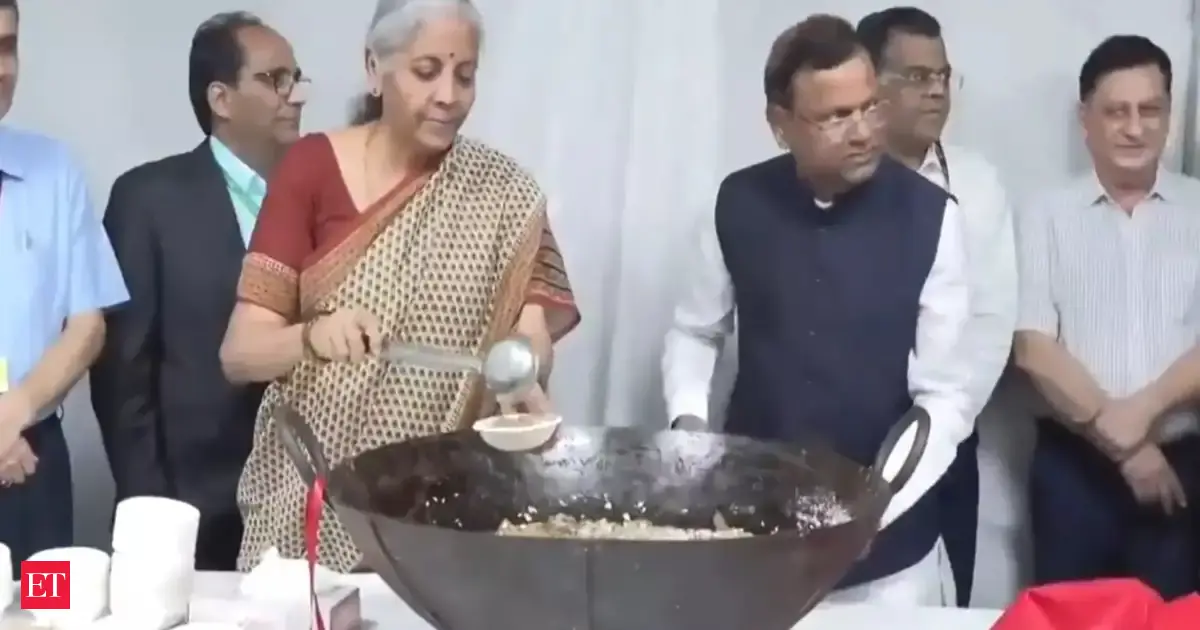
The traditional 'Halwa Ceremony' has concluded, marking the final stage of preparations for the Union Budget 2026-27. Union Finance Minister Nirmala Sitharaman attended the event, after which budget officials enter a lock-in period. This ceremony is a significant annual ritual, symbolizing the commencement of the budget's printing process and is important for exams as a recurring event related to India's economic policy cycle, highlighting the procedural aspects of budget formulation.
Revision structure
Monthly events and exam calendar context
Static GK and one-liner notes
Quiz and mock-test revision path
Key points
Exam-ready takeaways
Union Finance Minister Nirmala Sitharaman attended the ceremony for Budget 2026-27.
The event took place at the Budget Press, followed by a 'lock-in period' for officials involved.
The ceremony traditionally marks the beginning of the budget document printing process.
The Union Budget for the financial year 2026-27 is scheduled to be presented on February 1, 2026.
Detailed analysis
Full exam-oriented breakdown
The 'Halwa Ceremony' is a vibrant, albeit symbolic, tradition marking the final stage of preparations for India's Union Budget. For the 2026-27 Union Budget, this ceremony has just concluded, with Union Finance Minister Nirmala Sitharaman overseeing the ritual at the Budget Press. This event is not merely a cultural custom; it signifies the imminent printing of the voluminous budget documents and the subsequent 'lock-in' period for officials involved in its creation. This lock-in, often lasting several days, ensures the utmost secrecy and prevents any leaks of budget proposals before their official presentation in Parliament, typically on February 1st each year. **Background and Historical Context:** The Union Budget is the most significant annual financial statement of the Government of India, outlining its estimated receipts and expenditures for the upcoming financial year (April 1st to March 31st). Its origins can be traced back to the British colonial era, with the first budget presented in India on February 18, 1860, by James Wilson. Over the decades, the process has evolved significantly. A major reform occurred in 2017 when the budget presentation date was advanced from the last working day of February to February 1st. This change allowed for the timely completion of the budgetary process before the start of the new financial year, enabling ministries to implement schemes from April 1st itself, rather than waiting for parliamentary approvals to trickle in. Additionally, in 2017, the Railway Budget, which had been presented separately since 1924, was merged with the General Budget, streamlining the overall financial planning. **Key Stakeholders Involved:** The preparation of the Union Budget is a colossal exercise involving numerous stakeholders. At its core is the **Ministry of Finance**, particularly the Budget Division of the Department of Economic Affairs, which coordinates the entire process. The **Finance Minister** plays a pivotal role in shaping the budget's philosophy and final proposals. Other ministries and departments provide their expenditure estimates and revenue requirements. The **NITI Aayog** (National Institution for Transforming India) provides strategic inputs and long-term vision. Consultations are also held with the **Reserve Bank of India (RBI)**, various industry associations, trade bodies, economists, and civil society groups to gather diverse perspectives and feedback. The 'lock-in' period involves a dedicated team of officials, including those from the Finance Ministry, printers, and security personnel, who work in complete isolation to finalize and print the budget documents. **Significance for India:** The Union Budget is the government's most powerful tool for economic management and social engineering. It determines the direction of India's economy, influencing everything from inflation and employment to investment and consumption. It outlines the government's fiscal policy, including taxation proposals and expenditure plans, which directly impact citizens' disposable income, business profitability, and the cost of goods and services. For India, a developing nation with diverse needs, the budget is crucial for allocating resources to critical sectors like agriculture, infrastructure (roads, railways, ports), education, healthcare, and social welfare schemes. It reflects the government's priorities for growth, equity, and stability, impacting both domestic and international confidence in the Indian economy. A well-crafted budget can spur economic activity, attract foreign investment, and improve the living standards of millions. **Constitutional Provisions and Legal Framework:** The Union Budget is enshrined in the Indian Constitution under **Article 112**, which mandates the President to lay before both Houses of Parliament an 'Annual Financial Statement' for every financial year. This statement details the estimated receipts and expenditures of the Government of India. The budget process also involves other crucial articles: **Article 110** defines a 'Money Bill,' under which most budget-related legislation falls. **Article 113** deals with 'Estimates related to Expenditure,' requiring Parliament's approval for government spending. Finally, **Article 114** mandates an 'Appropriation Bill' to authorize the government to withdraw funds from the Consolidated Fund of India to meet approved expenditures. The **Fiscal Responsibility and Budget Management (FRBM) Act, 2003**, provides a legal framework for fiscal discipline, aiming to reduce the fiscal deficit and revenue deficit, thereby ensuring long-term macroeconomic stability. **Future Implications:** As India progresses towards becoming a developed economy, the Union Budget 2026-27 will be critical in navigating various domestic and global economic challenges. It will likely focus on sustaining economic growth, managing inflation, boosting manufacturing through initiatives like 'Make in India,' enhancing infrastructure, and investing in human capital. The budget will also need to address issues like job creation, income inequality, and environmental sustainability, potentially introducing new policies or strengthening existing ones in areas like renewable energy and climate resilience. The fiscal choices made in this budget will have long-term implications for India's debt trajectory, its credit rating, and its ability to fund future development initiatives, shaping the nation's economic landscape for years to come. The 'Halwa Ceremony' thus serves as a sweet prelude to a document that profoundly impacts the lives of over a billion people and the trajectory of one of the world's fastest-growing major economies.
How to study
Turn news into exam marks
Revise monthly events by exam family instead of reading random updates.
Pair one-liners with mock tests so mistakes become the next revision list.
Keep state job pages, calendar pages and GK packs connected in one path.