

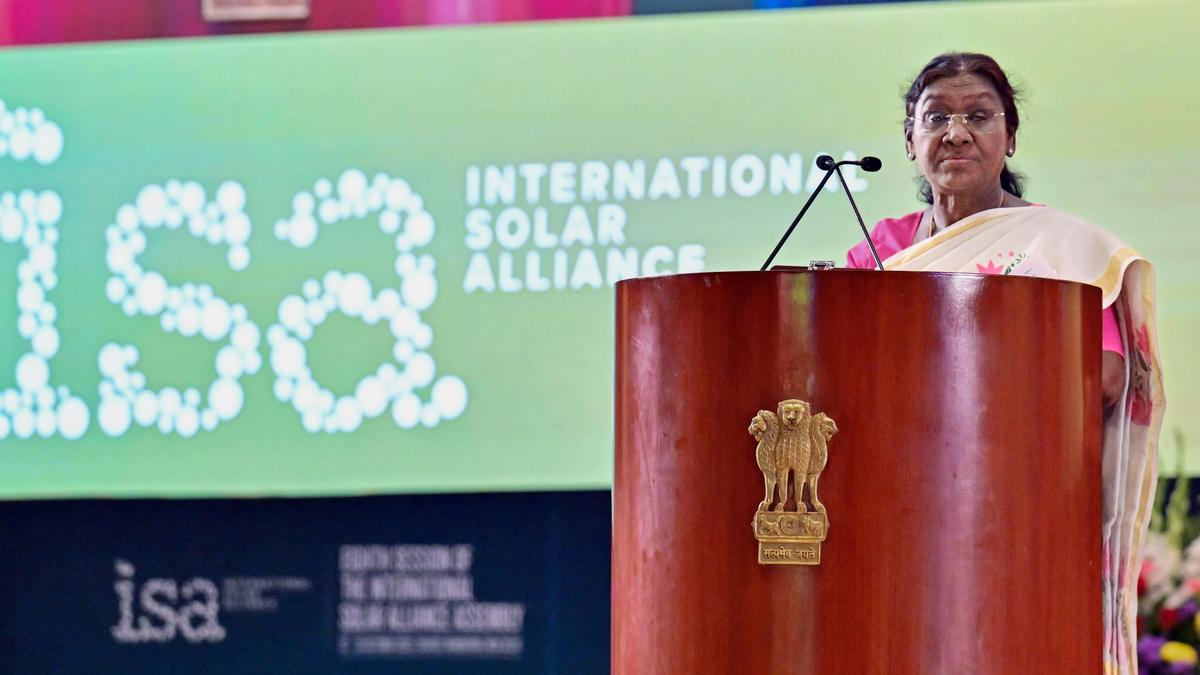
The International Solar Alliance (ISA) was launched on November 30, 2015, during COP21 in Paris, France, by India and France.
GK and monthly revision
How will U.S. exit affect solar alliance? | Explained
The International Solar Alliance (ISA), launched by India and France at COP21 in 2015, is headquartered in Gurugram, India. While the article's premise of a U.S. exit is incorrect as the U.S. joined in January 2022, its participation is crucial for mobilizing investments and technology transfer, impacting India's solar manufacturing and solar projects globally, especially in African and developing nations. Understanding ISA's structure, objectives, and key members is vital for competitive exams.
Revision structure
Monthly events and exam calendar context
Static GK and one-liner notes
Quiz and mock-test revision path
Key points
Exam-ready takeaways
The permanent secretariat of the ISA is located in Gurugram, Haryana, India, making it the first treaty-based international intergovernmental organization headquartered in India.
The United States officially joined the ISA as its 102nd member country on January 8, 2022, not exited, enhancing its global reach and financial potential.
The ISA's primary objective is to mobilize over $1 trillion in solar investments by 2030 to deploy 1,000 GW (1 TW) of solar energy capacity worldwide.
ISA focuses on promoting solar energy in member countries, particularly developing nations between the Tropics of Cancer and Capricorn, to reduce fossil fuel dependence and achieve sustainable development goals.
Detailed analysis
Full exam-oriented breakdown
The International Solar Alliance (ISA) stands as a beacon of India's commitment to global climate action and sustainable energy transition. Conceived as a joint initiative by India and France, the ISA was officially launched on November 30, 2015, during the 21st Conference of Parties (COP21) to the UNFCCC in Paris. This momentous occasion laid the groundwork for an international treaty-based organization dedicated to promoting solar energy globally. **Background Context and Genesis:** The genesis of the ISA can be traced to the urgent global need to combat climate change and transition away from fossil fuels. India, a rapidly developing nation with significant energy demands and abundant solar resources, recognized the immense potential of solar energy to achieve energy security, reduce carbon emissions, and foster sustainable development. Prime Minister Narendra Modi, alongside then-French President François Hollande, championed the idea of an alliance of 'sunshine countries' – nations largely located between the Tropics of Cancer and Capricorn, blessed with ample solar irradiation. The core idea was to overcome the challenges of high costs, financing, and technology transfer for solar energy deployment in these regions. **What Happened and Key Objectives:** The ISA was established with the ambitious goal of mobilizing over $1 trillion in solar investments by 2030 to deploy 1,000 GW (1 TW) of solar energy capacity worldwide. Its permanent secretariat is uniquely headquartered in Gurugram, Haryana, India, making it the first treaty-based international intergovernmental organization to be based in India. This signifies India's growing stature in global governance and its leadership in climate diplomacy. The ISA's objectives include facilitating the deployment of solar energy technologies, promoting research and development, building capacity, and reducing the cost of solar financing and technology through collective action. It is crucial to correct a common misconception: the United States did not exit the ISA; rather, it officially joined as its 102nd member country on January 8, 2022. This accession significantly bolstered the ISA's global reach and financial potential, bringing in one of the world's largest economies and technological powerhouses, further enhancing its credibility and capacity to mobilize investments and technology transfer. **Key Stakeholders Involved:** * **India and France:** As co-founding members, they provide significant leadership, diplomatic support, and initial funding. India's role as the host nation is particularly prominent. * **Member Countries:** Over 100 countries have joined the ISA, primarily developing nations rich in solar resources, especially those in Africa, Latin America, and Asia. These countries are both beneficiaries and active participants in achieving the ISA's goals. * **International Organizations:** Bodies like the United Nations, World Bank, Asian Development Bank, and other multilateral development banks are crucial partners, offering financial assistance, technical expertise, and facilitating project implementation. * **Private Sector:** Critical for investment, innovation, manufacturing, and project execution, the private sector plays an indispensable role in scaling up solar energy deployment. **Significance for India:** The ISA holds profound significance for India. It solidifies India's position as a global leader in climate action and renewable energy. Hosting its secretariat provides India with a unique platform to shape global energy policy and foster South-South cooperation. Economically, the ISA's focus on solar deployment creates immense opportunities for India's burgeoning solar manufacturing sector, aligning with the 'Make in India' initiative. It aids India in achieving its ambitious Nationally Determined Contributions (NDCs) under the Paris Agreement, which include achieving 50% cumulative electric power installed capacity from non-fossil fuel-based energy resources by 2030 and reducing the emissions intensity of its GDP by 45% from 2005 levels by 2030. Furthermore, by promoting solar energy, India enhances its energy security, reducing reliance on volatile fossil fuel imports. **Historical Context and Broader Themes:** The ISA emerged from the broader international efforts to address climate change, particularly the Paris Agreement adopted at COP21. It represents a concrete example of multilateral cooperation to achieve environmental and developmental goals. The alliance also aligns with India's long-standing foreign policy principle of promoting cooperation among developing countries, particularly in Africa, to address common challenges like energy access and sustainable development. It's a prime example of 'energy diplomacy' and 'climate leadership' on the global stage. **Related Constitutional Articles, Acts, or Policies:** While there isn't a direct constitutional article for the ISA, India's commitment to environmental protection and sustainable development is enshrined in its legal framework. **Article 48A** of the Directive Principles of State Policy (DPSP) mandates that "The State shall endeavour to protect and improve the environment and to safeguard the forests and wildlife of the country." This provides a constitutional underpinning for policies promoting renewable energy like solar. Furthermore, the **National Solar Mission (NSM)**, launched in 2010 as part of the National Action Plan on Climate Change (NAPCC), is a flagship policy demonstrating India's long-term commitment to solar energy, directly complementing the ISA's objectives. Various acts and policies related to renewable energy, such as the Electricity Act, 2003, and subsequent amendments, along with state-specific renewable energy policies, facilitate the deployment of solar power in India. **Future Implications:** The future of the ISA is critical for accelerating the global energy transition. With greater participation, especially from developed nations like the US, it can unlock significant financial resources and technological innovations. The alliance aims to make solar energy more affordable and accessible, particularly for developing countries that face energy poverty. Success in achieving its 1 TW target would significantly contribute to global climate goals, foster green job creation, and drive economic growth in member countries. The ISA's continued focus on capacity building, standardization, and risk mitigation will be crucial in shaping a solar-powered future, making it a vital player in global sustainable development efforts.
How to study
Turn news into exam marks
Revise monthly events by exam family instead of reading random updates.
Pair one-liners with mock tests so mistakes become the next revision list.
Keep state job pages, calendar pages and GK packs connected in one path.