

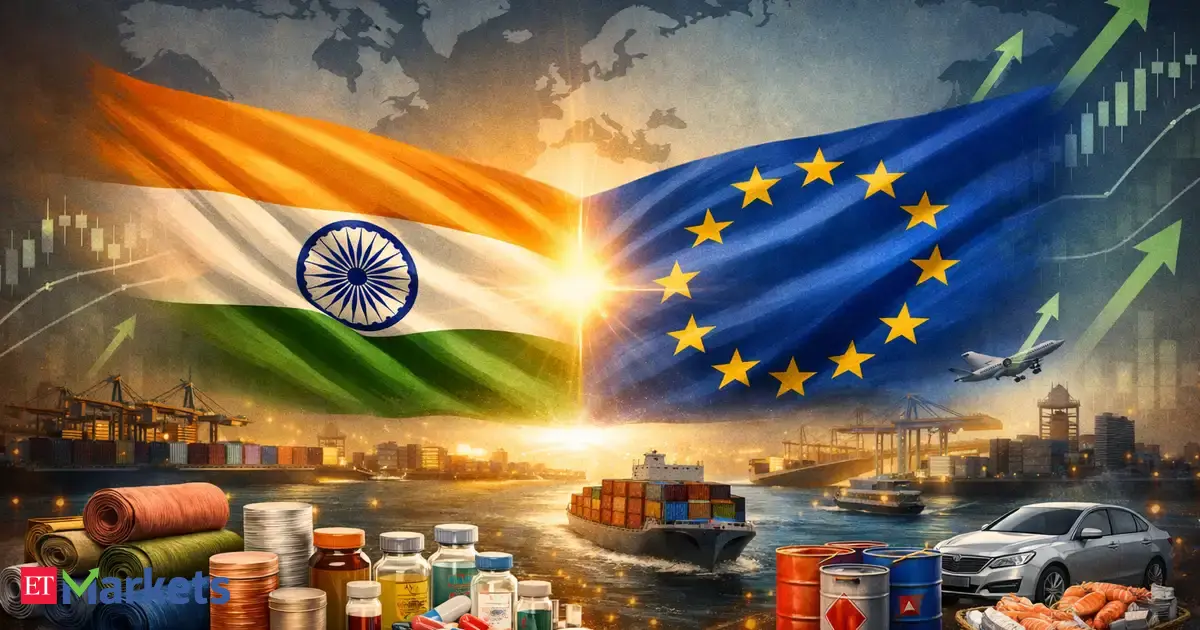
India and the European Union (EU) have signed a landmark Free Trade Agreement (FTA).
GK and monthly revision
India-EU sign ‘mother of all deals’: Stocks to buy, winners and losers
India and the European Union have signed a landmark Free Trade Agreement, termed the 'mother of all deals,' aimed at boosting India's exports through tariff cuts and regulatory easing. This agreement is crucial for competitive exams as it signifies a major international trade policy, impacting various sectors of the Indian economy. Understanding its implications for different industries is vital for economic and current affairs sections.
Revision structure
Monthly events and exam calendar context
Static GK and one-liner notes
Quiz and mock-test revision path
Key points
Exam-ready takeaways
The India-EU FTA is colloquially referred to as the 'mother of all deals' due to its extensive scope.
The agreement primarily aims for tariff cuts and regulatory easing to structurally boost India's exports.
Key sectors identified as near-term winners from the FTA include Textiles, Pharmaceuticals, and Specialty Chemicals.
Sectors such as Automakers and Sula Vineyards are expected to face near-term pressure due to the FTA.
Detailed analysis
Full exam-oriented breakdown
The recent signing of the Free Trade Agreement (FTA), Investment Protection Agreement (IPA), and Agreement on Geographical Indications (GIs) between India and the European Union, colloquially dubbed the 'mother of all deals,' marks a pivotal moment in India's economic and geopolitical trajectory. This comprehensive package, which has been over a decade in the making, aims to significantly deepen trade and investment ties between two of the world's largest economies. **Background Context and Historical Journey:** India and the EU, a bloc of 27 nations, began negotiations for a broad-based FTA (BTIA) in 2007. These talks, however, stalled in 2013 primarily due to significant differences on issues such as market access for automobiles and alcoholic beverages, intellectual property rights, and data security. The revival of negotiations in 2021, post-COVID-19 and amid shifting global supply chains and geopolitical realignments, underscored a renewed commitment from both sides. The EU sought to diversify its supply chains away from over-reliance on China, while India aimed to enhance its export competitiveness and attract foreign investment, aligning with its 'Atmanirbhar Bharat' (Self-Reliant India) vision by making its industries globally competitive. **What Happened: The 'Mother of All Deals' Unpacked:** This isn't just a single FTA; it's a triad of agreements. The Free Trade Agreement focuses on eliminating or significantly reducing tariffs on a vast majority of goods, easing customs procedures, and addressing non-tariff barriers. The Investment Protection Agreement aims to provide a stable and predictable legal framework for investors from both sides, fostering greater cross-border investment. The Agreement on Geographical Indications protects products specific to a region, like Darjeeling Tea or Champagne, preventing misuse and ensuring fair competition. The core objective is a structural boost to India's exports by providing preferential access to the massive EU market, one of the largest consumer markets globally. Sectors like textiles, pharmaceuticals, and specialty chemicals are identified as immediate beneficiaries due to existing strengths and potential for tariff reductions. Conversely, domestic automakers and wine producers (like Sula Vineyards) might face near-term pressure from increased competition from European imports. **Key Stakeholders Involved:** On the Indian side, the **Government of India**, particularly the Ministry of Commerce and Industry, has been the primary negotiator. **Indian businesses and industries**, from large conglomerates to MSMEs, are the ultimate beneficiaries and, in some cases, those who will face increased competition. Exporters, farmers (for GI products), and consumers are all stakeholders. For the EU, the **European Commission**, as the executive arm, led the negotiations on behalf of the 27 **EU member states**. European businesses, consumers, and agricultural sectors are also key players. International organizations like the **World Trade Organization (WTO)** provide the overarching framework for such agreements, ensuring adherence to multilateral trade rules. **Significance for India:** This agreement holds profound significance for India. Economically, it promises to be a game-changer. The EU is India's third-largest trading partner, and enhanced market access will boost India's exports, potentially creating millions of jobs and contributing to the government's goal of making India a $5 trillion economy. It is expected to attract greater Foreign Direct Investment (FDI) into India, bringing capital, technology, and best practices. Politically, it strengthens India's strategic partnership with a major global power, diversifying its foreign policy engagements and enhancing its geopolitical influence, especially in the Indo-Pacific context. Socially, increased economic activity could lead to improved living standards, while consumers might benefit from a wider array of goods at potentially lower prices. This aligns well with India's 'Make in India' initiative, encouraging domestic manufacturing to be globally competitive. **Constitutional and Policy Framework:** From a constitutional perspective, **Article 253** of the Indian Constitution is highly relevant, empowering Parliament to make any law for implementing any international treaty, agreement, or convention. This provides the legal basis for domestic legislation required to operationalize the provisions of the FTA. The **Foreign Trade (Development and Regulation) Act, 1992**, and the **Customs Act, 1962**, would be the primary legislative instruments through which tariff changes and regulatory easing would be implemented. The agreement also aligns with India's broader **Foreign Trade Policy**, which aims at boosting exports and integrating India further into the global economy. **Future Implications:** The India-EU FTA is expected to foster deeper economic integration, leading to increased trade volumes, investment flows, and technological cooperation. Its successful implementation could serve as a template for India's engagement with other major economies, signaling India's commitment to liberalized trade. However, challenges remain, including ensuring domestic industries can adapt to increased competition, addressing potential non-tariff barriers that may emerge, and effectively leveraging the GI protection for Indian products. The agreement's long-term success will depend on its effective implementation and the ability of Indian industries to seize the opportunities presented, contributing significantly to India's ambition of becoming a global economic powerhouse.
How to study
Turn news into exam marks
Revise monthly events by exam family instead of reading random updates.
Pair one-liners with mock tests so mistakes become the next revision list.
Keep state job pages, calendar pages and GK packs connected in one path.