

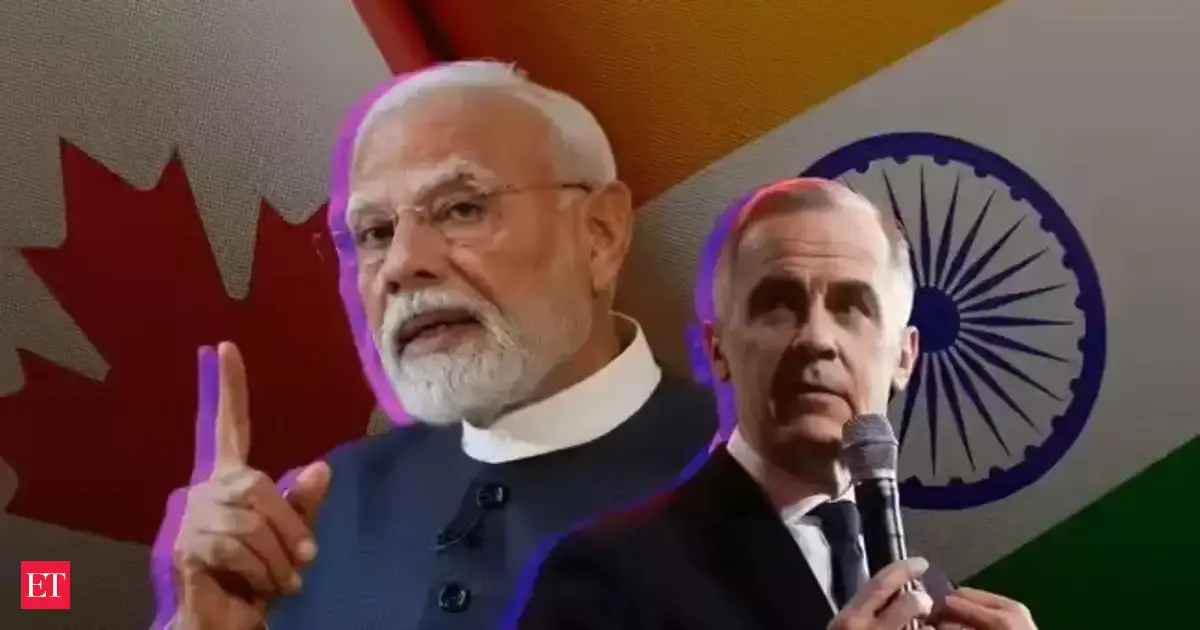
Canada is actively strengthening its economic and strategic ties with India.
GK and monthly revision
Not just EU, another jilted ally of the US is courting India
Canada is actively strengthening its economic and strategic ties with India, signaling a significant pivot from traditional US-led trade frameworks. This renewed engagement, driven by a desire to diversify export markets and counter Trump-era protectionism, focuses on critical sectors like energy cooperation, critical minerals, and potential uranium supply. For competitive exams, this highlights evolving global trade dynamics, India's growing strategic importance, and bilateral relations with key countries.
Revision structure
Monthly events and exam calendar context
Static GK and one-liner notes
Quiz and mock-test revision path
Key points
Exam-ready takeaways
This engagement signifies a pivot away from US-led trade frameworks.
The move is partly a response to Trump-era protectionism.
Key areas of cooperation include energy, critical minerals, and potential uranium supply deals.
Canada aims to diversify its export markets beyond the US and mitigate economic pressures.
Detailed analysis
Full exam-oriented breakdown
The recent overtures from Canada to strengthen economic and strategic ties with India represent a significant geopolitical and economic realignment, moving away from its traditional reliance on US-led trade frameworks. This pivot is a direct response to a confluence of factors, primarily the rise of protectionist sentiments in the United States during the Trump administration and a broader strategic imperative for Canada to diversify its export markets and reduce economic vulnerability. **Background Context and What Happened:** For decades, Canada's economy has been inextricably linked to the United States, with the vast majority of its exports heading south. The North American Free Trade Agreement (NAFTA), signed in 1994, cemented this relationship. However, the 'America First' policy championed by former US President Donald Trump introduced considerable uncertainty. Tariffs on Canadian steel and aluminum, and the contentious renegotiation of NAFTA into the US-Mexico-Canada Agreement (USMCA), highlighted the risks of over-reliance on a single trading partner. This period spurred Canada to actively seek new partners and markets, a strategy known as 'de-risking' its trade portfolio. India, with its rapidly growing economy, massive consumer base, and increasing geopolitical stature, emerged as a natural and attractive alternative. The current engagement focuses on critical sectors: energy cooperation, critical minerals, and potential uranium supply deals. Canada is a significant global producer of crude oil, natural gas, and uranium. It also possesses substantial reserves of critical minerals vital for green technologies, such as lithium, cobalt, and rare earth elements, which are crucial for electric vehicles and renewable energy infrastructure. India, on the other hand, is a net importer of energy and critical minerals, and its ambitious clean energy transition and 'Make in India' initiatives demand a secure and diversified supply chain for these resources. **Key Stakeholders Involved:** On the Canadian side, the primary stakeholders include the Canadian government (led by Prime Minister Justin Trudeau's administration), which is driving the foreign policy and trade agenda, and Canadian industries, particularly those in the energy, mining, and nuclear sectors, eager to tap into India's burgeoning market. For India, the key stakeholders are the Indian government (Ministry of External Affairs, Ministry of Commerce and Industry, Ministry of Power, Department of Atomic Energy), public sector undertakings (PSUs) like Nuclear Power Corporation of India Ltd (NPCIL), and private sector companies involved in infrastructure, manufacturing, and technology. The United States, while not directly involved in this bilateral pivot, remains an indirect, yet significant, stakeholder as its past policies continue to shape Canada's strategic decisions. **Significance for India:** This renewed Canadian interest holds immense significance for India. Economically, it offers diversification of import sources, particularly for critical resources like uranium and other minerals, bolstering India's energy security and reducing reliance on potentially volatile regions. It can lead to increased foreign direct investment (FDI) from Canada, technology transfer, and job creation in sectors aligned with India's 'Atmanirbhar Bharat' (Self-Reliant India) vision. Strategically, strengthening ties with a G7 nation like Canada enhances India's global diplomatic footprint and provides a counter-balance in a multipolar world. Politically, it reinforces India's position as a preferred partner for developed economies seeking to diversify their trade and supply chains, further solidifying its role as a key player in the Indo-Pacific. **Historical Context:** India-Canada relations have seen ups and downs. A significant period of strain occurred after India's 1974 Pokhran-I nuclear test, as Canada had supplied the CIRUS reactor under the Colombo Plan, leading to a breakdown in nuclear cooperation. Relations normalized gradually, culminating in a landmark Civil Nuclear Cooperation Agreement in 2010, followed by subsequent uranium supply deals. This historical context is crucial for understanding the renewed focus on uranium, indicating a deeper level of trust and strategic partnership. **Future Implications and Related Policies:** Looking ahead, this deepening relationship could lead to a Comprehensive Economic Partnership Agreement (CEPA) between the two nations, which is currently under negotiation. Increased collaboration in emerging technologies, climate change mitigation, and education are also probable. However, challenges persist, including human rights concerns sometimes raised by Canada and the issue of Khalistani extremism in Canada, which has occasionally strained bilateral ties. Addressing these sensitivities will be crucial for sustained growth in the relationship. From a policy perspective, this aligns with India's multi-alignment foreign policy strategy, seeking partners across the globe to advance its national interests. The pursuit of energy security is a core tenet of India's energy policy, and access to Canadian uranium and critical minerals directly contributes to this goal. The **Atomic Energy Act, 1962**, governs India's nuclear energy program, and any uranium supply deals would operate under its framework and international safeguards. India's broader **Foreign Trade Policy** aims to diversify export markets and import sources, making Canada a valuable partner. Furthermore, the executive power of the Union government, as implied by **Article 73** of the Constitution, allows it to enter into international treaties and agreements, facilitating such bilateral engagements. The **Directive Principle of State Policy under Article 51** encourages the promotion of international peace and security, which is implicitly served by stable economic and strategic partnerships. This evolving partnership underscores a broader global trend of nations re-evaluating their alliances and trade dependencies in an increasingly complex and interconnected world, where economic security is intertwined with national security and strategic autonomy.
How to study
Turn news into exam marks
Revise monthly events by exam family instead of reading random updates.
Pair one-liners with mock tests so mistakes become the next revision list.
Keep state job pages, calendar pages and GK packs connected in one path.