

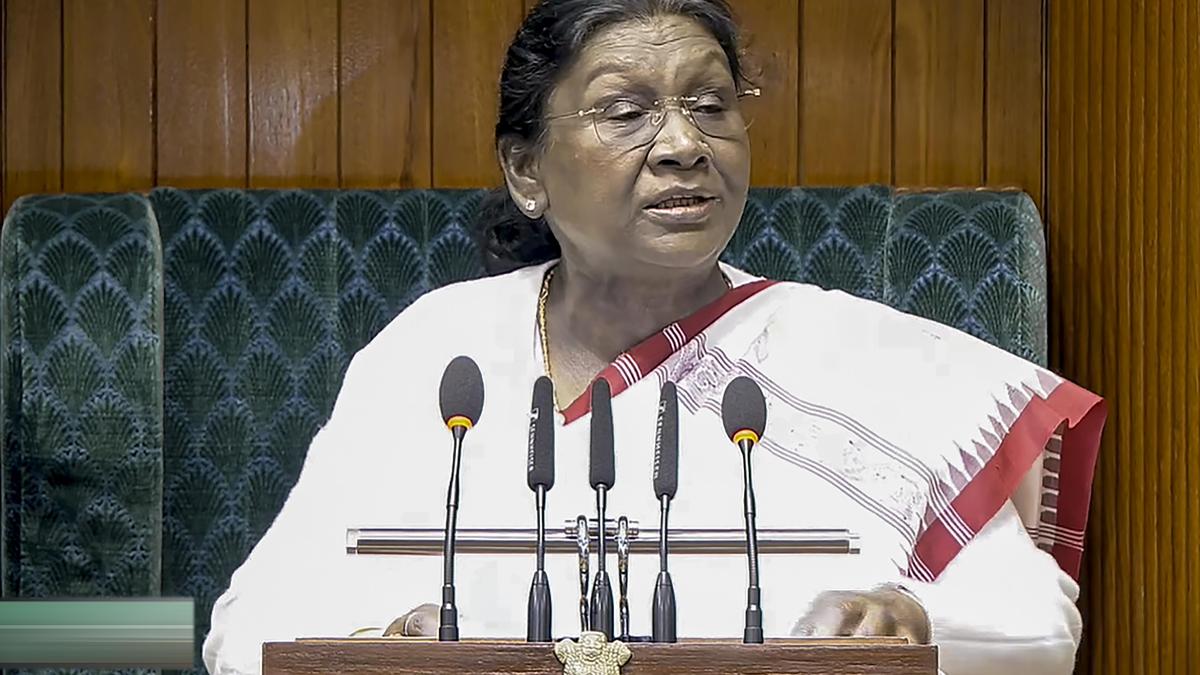
Members of Congress and its allies raised slogans during President Droupadi Murmu's address to Parliament.
GK and monthly revision
Government demands apology from Opposition for protesting during President’s address to Parliament
Opposition parties, led by Congress and its allies, protested during President Droupadi Murmu's address to a joint sitting of Parliament, demanding the rollback of the 'VB-G RAM G Act'. This incident, occurring at the commencement of the Budget Session, highlights issues of parliamentary decorum during a constitutionally mandated event. It is significant for understanding parliamentary procedures and political dynamics for competitive exams, especially regarding the President's role and parliamentary conduct.
Revision structure
Monthly events and exam calendar context
Static GK and one-liner notes
Quiz and mock-test revision path
Key points
Exam-ready takeaways
The protest occurred at a joint sitting of Parliament, typically held at the commencement of the first session of each year.
The Opposition demanded the rollback of the 'VB-G RAM G Act' during their protest.
The government subsequently demanded an apology from the protesting Opposition members for their conduct.
The President's address to a joint sitting of Parliament is a constitutional requirement under Article 87(1) of the Indian Constitution.
Detailed analysis
Full exam-oriented breakdown
The recent incident where Opposition parties, led by the Congress and its allies, protested vociferously during President Droupadi Murmu's address to a joint sitting of Parliament marks a significant moment in India's parliamentary history, raising pertinent questions about decorum, political discourse, and constitutional propriety. This event, occurring at the very commencement of the Budget Session, saw members raising slogans against the 'VB-G RAM G Act' and demanding its rollback, even as the President delivered her constitutionally mandated speech. **Background Context and What Happened:** The President's address to a joint sitting of Parliament is not merely a ceremonial event; it is a solemn constitutional obligation under Article 87(1) of the Indian Constitution. This article mandates the President to address both Houses of Parliament assembled together at the commencement of the first session after each general election to the House of the People and at the commencement of the first session of each year. The address outlines the government's policy agenda, achievements, and future plans, essentially serving as a policy blueprint for the upcoming year. It is prepared by the Union Cabinet and reflects the government's perspective. The protest involved Opposition members, immediately upon the President beginning her address, raising slogans and demanding the rollback of a specific piece of legislation, the 'VB-G RAM G Act', which they clearly deem controversial and detrimental. **Key Stakeholders Involved:** * **The President (Droupadi Murmu):** As the Head of State and the first citizen of India, the President represents the dignity of the Indian Republic. Her address is considered sacrosanct and above partisan politics. Disrupting it is seen as a direct affront to the constitutional office and parliamentary traditions. * **The Government (Ruling Party and Cabinet):** The government, led by the Prime Minister, drafts the President's address. It views the protest as a disrespect to the President and an obstruction of parliamentary proceedings. Their demand for an apology underscores their concern for maintaining parliamentary decorum and the sanctity of constitutional events. * **Opposition Parties (Congress and Allies):** These parties utilized the high-profile occasion of the President's address to register their strong dissent against the 'VB-G RAM G Act'. Their motivation likely stems from deep disagreement with the Act's provisions, a desire to highlight perceived government failures, and to garner public attention for their cause. While parliamentary protests are common, doing so during the President's address is an escalated form of protest. **Why This Matters for India:** This incident carries profound implications for India's democratic fabric. Firstly, it concerns **parliamentary decorum and tradition**. The President's address has historically been an occasion for sober reflection and dignified conduct. Disrupting it sets a precedent that could further erode parliamentary standards. Secondly, it highlights the **deterioration of government-opposition relations**. A healthy democracy thrives on constructive debate, but continuous disruptions, especially during constitutional events, indicate a breakdown in dialogue and mutual respect. Thirdly, it impacts **public perception of democratic institutions**. Such scenes can lead to disillusionment among citizens regarding the effectiveness and dignity of their elected representatives and parliamentary processes. For a country like India, which prides itself on being the world's largest democracy, maintaining the sanctity of its institutions is paramount. **Historical Context:** While parliamentary disruptions are not new to India's legislative history, protests during the President's address have been relatively rare and, when they occur, are viewed with particular seriousness. There have been instances of walkouts or mild protests, but sustained slogan-raising during the address itself is considered a severe breach of protocol. This trend reflects a broader pattern of increasing polarization and a shift from debate-centric parliamentary functioning to more confrontational politics, a phenomenon observed over the last few decades. **Future Implications:** This incident could have several future implications. It might lead to further **strained relations** between the government and the opposition, making consensus-building on critical legislative matters even more challenging. It could also prompt **calls for stricter enforcement of parliamentary rules** by the presiding officers (Speaker of Lok Sabha and Chairman of Rajya Sabha) to maintain order during such events. Furthermore, it might intensify the **debate on the role of dissent in a democracy** versus the need for parliamentary decorum, especially during constitutionally mandated events. The incident could also shape how future Budget Sessions commence, potentially leading to more preemptive measures or heightened political tensions right from the outset. **Related Constitutional Articles, Acts, or Policies:** Beyond **Article 87(1)**, which mandates the President's address, the incident touches upon other constitutional principles and parliamentary rules: * **Article 86:** Grants the President the right to address either House of Parliament or both Houses assembled together, and for that purpose to require the attendance of members. * **Rules of Procedure and Conduct of Business in Lok Sabha/Rajya Sabha:** These rules govern the conduct of members, the order of business, and the powers of the presiding officers to maintain decorum and order. While the President's address is a joint sitting, the general principles of these rules apply. * **Parliamentary Privileges:** Members of Parliament enjoy certain privileges to ensure their effective functioning, but these are not absolute and do not extend to disrupting constitutional processes or showing disrespect to constitutional offices. The government's demand for an apology could be seen in the context of upholding these privileges and responsibilities. This event underscores the delicate balance between the right to protest and the imperative to uphold the dignity of constitutional institutions in India's vibrant, yet often turbulent, democracy.
How to study
Turn news into exam marks
Revise monthly events by exam family instead of reading random updates.
Pair one-liners with mock tests so mistakes become the next revision list.
Keep state job pages, calendar pages and GK packs connected in one path.