

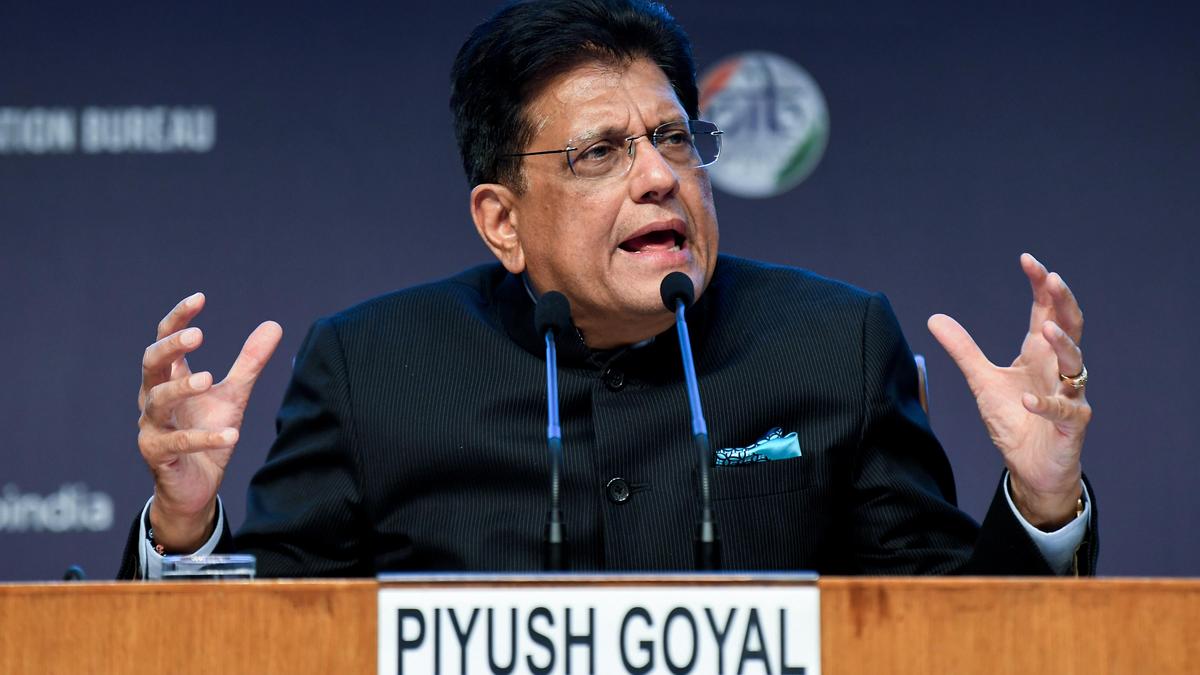
Union Minister Piyush Goyal criticized the Congress party regarding the India-EU Free Trade Agreement (FTA).
GK and monthly revision
Goyal hits out at Congress for raising concerns over India-EU FTA
Union Minister Piyush Goyal criticized the Congress party for its "negative and pessimistic approach" concerning the India-EU Free Trade Agreement (FTA). This statement underscores the government's strong commitment to global trade and economic integration, contrasting with opposition's apprehensions. The ongoing India-EU FTA negotiations are pivotal for boosting India's trade relations and economic growth, making it a highly relevant topic for competitive exam preparation on international relations and economy.
Revision structure
Monthly events and exam calendar context
Static GK and one-liner notes
Quiz and mock-test revision path
Key points
Exam-ready takeaways
The criticism focused on the Congress's 'negative and pessimistic approach' towards India's global business aspirations.
Negotiations for the India-EU FTA were officially relaunched in June 2022, aiming to enhance economic ties.
The FTA seeks to reduce tariffs and non-tariff barriers across trade in goods, services, and investment between India and the 27-member European Union.
Bilateral trade in goods between India and the EU reached USD 116.36 billion in the financial year 2022-23.
Detailed analysis
Full exam-oriented breakdown
The recent statement by Union Minister Piyush Goyal, criticizing the Congress party's 'negative and pessimistic approach' towards the India-EU Free Trade Agreement (FTA), brings to the forefront a critical aspect of India's economic diplomacy and its ambitions for global integration. This political exchange underscores the significance and often contentious nature of such mega-trade deals for a developing economy like India. Understanding this issue requires delving into its background, key players, implications, and constitutional framework. **Background Context and Historical Threads:** India's engagement with Free Trade Agreements is not new. FTAs are pacts between two or more countries to reduce barriers to imports and exports among them. The primary goal is to foster trade by eliminating or reducing tariffs, quotas, and other non-tariff barriers. The relationship between India and the European Union, a bloc of 27 nations and the world's largest trading entity, has historically been robust. The EU is India's second-largest trading partner, and India is the EU's tenth-largest. Recognizing this potential, negotiations for a Broad-based Trade and Investment Agreement (BTIA) between India and the EU first commenced in 2007. These talks, however, stalled in 2013 due to significant divergences on key issues such as market access for goods and services, intellectual property rights, and data security. After a hiatus of nearly a decade, both sides agreed to relaunch negotiations for a comprehensive FTA in June 2022, signaling renewed political will and a strategic imperative to deepen economic ties. **What Transpired and Key Stakeholders:** Minister Goyal's remarks highlight the government's strong commitment to pursuing this FTA, viewing it as a gateway for India's 'aspirational people' to engage globally. The government's narrative often positions such agreements as crucial for boosting exports, attracting foreign investment, and integrating India into global supply chains, thereby contributing to economic growth and job creation. The Congress party's 'concerns' likely stem from a different perspective, potentially focusing on the potential adverse impacts on domestic industries, agriculture, labour standards, or the implications of stringent EU regulations on Indian producers. Such concerns are common in FTA debates, where the balance between opening up markets and protecting domestic interests is a delicate one. Key stakeholders involved in this intricate process include: 1. **Government of India**: Led by the Ministry of Commerce and Industry, actively negotiating the terms, aiming to secure favourable market access and investment opportunities. 2. **European Union**: Represented by the European Commission, seeking similar benefits while also pushing for higher standards on environmental protection, labour rights, and intellectual property. 3. **Indian Industry and Business Chambers (CII, FICCI, ASSOCHAM)**: These bodies represent various sectors, some advocating for greater market access in the EU, while others express apprehension about increased competition from European goods and services. 4. **Indian Farmers and Agricultural Sector**: A significant stakeholder, often concerned about the implications of liberalized trade on agricultural produce, dairy, and food processing. 5. **Indian Political Opposition (Congress)**: Plays a crucial role in parliamentary oversight, raising questions, and ensuring public debate on the potential pros and cons of such a significant agreement. 6. **Consumers**: Who ultimately benefit or are impacted by changes in prices, quality, and availability of goods and services. **Significance for India and Future Implications:** Successfully concluding the India-EU FTA holds immense significance for India. Economically, it promises to provide preferential access to a vast market of over 450 million consumers, potentially boosting India's exports across sectors like textiles, pharmaceuticals, automotive components, and IT services. It could also attract significant foreign direct investment (FDI) from EU countries, bringing capital, technology, and best practices. Strategically, an FTA with the EU enhances India's geopolitical leverage, diversifying its trade partnerships and reducing over-reliance on any single region. It aligns with India's broader economic liberalization agenda and its aspiration to become a major global economic power. However, the path is fraught with challenges. India needs to ensure that the FTA does not disproportionately harm domestic industries, particularly MSMEs, or compromise its food security concerns. Issues like non-tariff barriers, sustainability standards, and data localization policies will be critical negotiation points. The political debate surrounding the FTA will likely intensify as negotiations progress, shaping public opinion and potentially influencing the final contours of the agreement. A successful FTA could propel India's economic growth and global standing, while a failure or a poorly negotiated deal could lead to missed opportunities and domestic discontent. **Constitutional and Policy Framework:** India's ability to enter into and implement international treaties and agreements like FTAs is rooted in its constitutional provisions. **Article 253** of the Constitution empowers the Parliament to make any law for implementing any treaty, agreement, or convention with any other country or any decision made at any international conference, association, or other body. This provides the legal basis for enacting domestic legislation required to operationalize an FTA. Furthermore, **Article 246** delineates the legislative powers, placing 'foreign affairs' and 'trade and commerce with foreign countries' under the Union List (List I, Seventh Schedule), underscoring the central government's authority in such matters. The Foreign Trade (Development and Regulation) Act, 1992, is the primary legislation governing India's foreign trade, and any FTA would operate within its framework. The government's broader economic policies, such as 'Make in India' and 'Atmanirbhar Bharat' (Self-Reliant India), also influence the negotiation strategy. While these initiatives emphasize domestic production, the government argues that FTAs can complement them by providing market access for Indian-made goods and attracting investment to strengthen domestic manufacturing. The ongoing debate on the India-EU FTA is thus not merely an economic discussion but a reflection of India's evolving approach to globalization, balancing domestic interests with international opportunities.
How to study
Turn news into exam marks
Revise monthly events by exam family instead of reading random updates.
Pair one-liners with mock tests so mistakes become the next revision list.
Keep state job pages, calendar pages and GK packs connected in one path.