

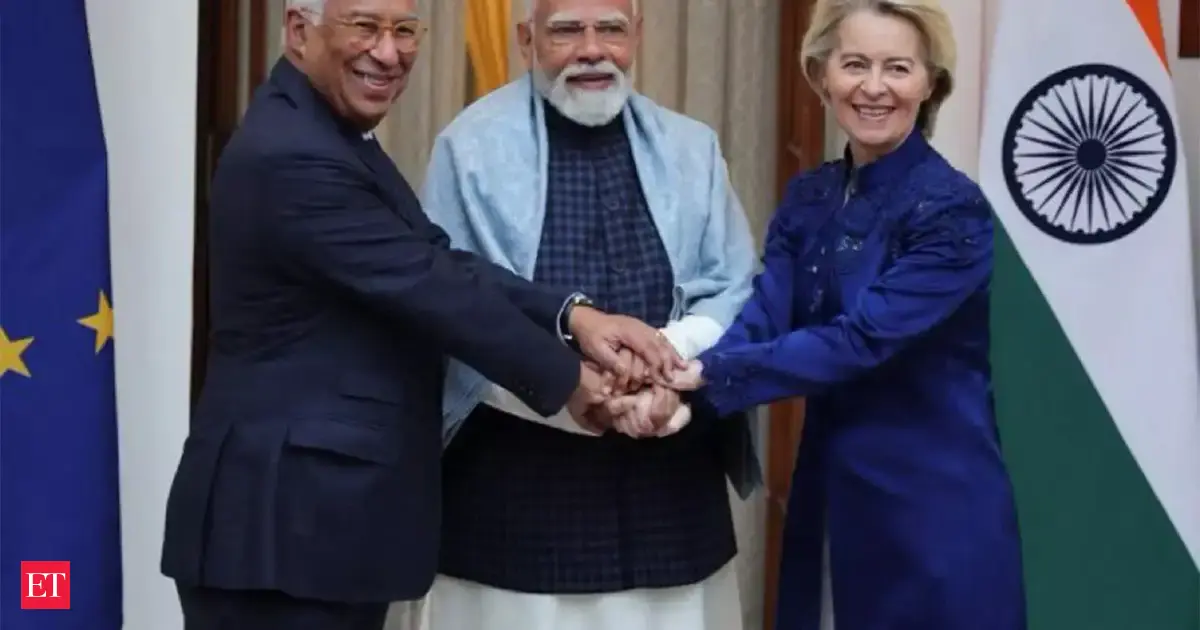
India has recently secured three free trade pacts across Europe.
GK and monthly revision
After Europe pacts, India eyes Chile, Canada for next trade deals: Report
India is aggressively pursuing new free trade agreements (FTAs) globally, having recently secured three pacts across Europe. The nation is now focusing on expanding its trade footprint by progressing talks with Chile and Canada, while also improving agreements with ASEAN nations. Discussions are also underway with Israel, the Gulf Cooperation Council (GCC), and the Mercosur bloc, signifying India's strategic push for economic integration and diversification of trade partners, crucial for understanding India's foreign policy and economic strategy in competitive exams.
Revision structure
Monthly events and exam calendar context
Static GK and one-liner notes
Quiz and mock-test revision path
Key points
Exam-ready takeaways
India is actively progressing talks for new trade deals with Chile and Canada.
Agreements with ASEAN nations are currently under improvement.
Discussions are ongoing with Israel and the Gulf Cooperation Council (GCC) for trade pacts.
India is exploring potential trade agreements with the Mercosur bloc, a South American trade bloc.
Detailed analysis
Full exam-oriented breakdown
India's aggressive pursuit of Free Trade Agreements (FTAs) marks a significant shift in its economic and foreign policy strategy. Historically, India maintained a cautious approach towards FTAs, often prioritizing protection of domestic industries over extensive market liberalization. This stance, rooted in post-independence economic planning, aimed at fostering self-reliance. However, the economic reforms of 1991 ushered in an era of greater global integration, albeit with a gradual pace in trade agreements. **Background Context and the Shift:** For many years, India engaged in various bilateral and regional trade agreements, but often with mixed outcomes and a perception of not fully leveraging their potential. A crucial turning point came with India's decision in November 2019 to withdraw from the Regional Comprehensive Economic Partnership (RCEP). This withdrawal was primarily driven by concerns regarding potential adverse impacts on domestic sectors, particularly agriculture and dairy, from an influx of cheaper goods, especially from China. Following this, there was a strategic re-evaluation, leading to a renewed focus on bilateral FTAs with developed economies and like-minded partners. The underlying philosophy shifted to '"Make in India for the World"' and integrating into resilient global supply chains, moving beyond the traditional '"Look East"' to a more proactive '"Act East"' and '"Act Global"' approach. **What Happened and Current Trajectory:** In recent years, India has successfully concluded significant trade pacts. Notably, it signed an Economic Cooperation and Trade Agreement (ECTA) with Australia in April 2022 and a Comprehensive Economic Partnership Agreement (CEPA) with the UAE in May 2022. The article highlights India's rapid securing of three free trade pacts across Europe, referring to agreements like the EFTA (European Free Trade Association) pact signed in March 2024, which involves Switzerland, Norway, Iceland, and Liechtenstein. Talks are also progressing actively with the United Kingdom for a comprehensive FTA. Currently, India is strategically focusing on expanding its trade footprint across the Americas, the Middle East, and Southeast Asia. Discussions are actively progressing with Chile and Canada, both significant economies with potential for robust trade in various sectors. Furthermore, India is seeking to improve and upgrade its existing agreements with ASEAN nations, acknowledging the strategic importance of this bloc for regional integration and supply chain diversification. Parallelly, discussions are ongoing with Israel and the Gulf Cooperation Council (GCC), reflecting India's energy security interests and growing trade ties with the Middle East. The exploration of trade with the Mercosur bloc (comprising Argentina, Brazil, Paraguay, and Uruguay) signifies India's ambition to tap into the South American market, rich in resources and agricultural products. **Key Stakeholders Involved:** * **Indian Government:** The Ministry of Commerce & Industry, led by the Union Minister, is the primary driver and negotiator of these trade deals. The Ministry of External Affairs plays a crucial supporting role, aligning trade objectives with broader foreign policy goals. The Prime Minister's Office provides strategic direction. The NITI Aayog also contributes through policy recommendations. * **Indian Businesses and Industry:** Export-oriented sectors like textiles, pharmaceuticals, engineering goods, IT services, and automobiles stand to gain from enhanced market access. Conversely, import-sensitive sectors like agriculture, dairy, and certain manufacturing units express concerns and seek adequate protection measures. Industry associations like CII, FICCI, and ASSOCHAM actively engage with the government to represent their members' interests. * **Foreign Governments and Blocs:** The negotiating partners (e.g., Canada, Chile, ASEAN, Israel, GCC, Mercosur, EFTA) are key stakeholders, each with their own economic interests, export priorities, and sensitive sectors they aim to protect or promote. * **Consumers:** FTAs can lead to a wider variety of goods and services at potentially lower prices due to reduced tariffs, benefiting consumers. However, quality control and standards become critical. **Significance for India:** This aggressive FTA push holds immense significance for India's economic and geopolitical aspirations. Economically, these agreements aim to boost India's exports, helping achieve the ambitious target of $1 trillion in merchandise exports and $1 trillion in services exports by 2030. They provide preferential access to large, developed markets, diversifying India's export basket and reducing reliance on traditional markets. FTAs also attract Foreign Direct Investment (FDI) by creating a more predictable and open trade regime, fostering manufacturing growth under the 'Make in India' initiative, and integrating India more deeply into global value chains. Geopolitically, these pacts strengthen bilateral relations, enhance India's strategic autonomy, and offer a counterbalance to the economic influence of other major powers. By forging stronger trade ties with diverse partners, India enhances its global standing and soft power. **Constitutional and Policy Framework:** India's ability to enter into and implement international treaties and agreements is enshrined in its Constitution. **Article 253** empowers Parliament to make any law for implementing any treaty, agreement, or convention with any other country or countries or any decision made at any international conference, association, or other body. This provides the legislative backing for enacting laws necessary to fulfill FTA obligations. Furthermore, **Entry 14 of the Union List (Seventh Schedule)** grants the Union government exclusive power over '"entering into treaties and agreements with foreign countries and implementing treaties, agreements and conventions with foreign countries."' The current **Foreign Trade Policy (FTP) 2023** explicitly emphasizes leveraging FTAs to promote exports and integrate India into global value chains, aligning with the broader vision of '"Atmanirbhar Bharat"' (self-reliant India) which, contrary to protectionist interpretations, also advocates for global competitiveness and market integration. **Future Implications:** The future implications are multi-faceted. Successful conclusion of these FTAs could significantly accelerate India's economic growth trajectory, create substantial employment opportunities, and enhance the competitiveness of Indian industries. However, challenges remain, particularly in balancing the interests of domestic industries, especially micro, small, and medium enterprises (MSMEs), with the broader goals of market access. Robust domestic reforms, investment in infrastructure, and skill development will be crucial to fully capitalize on the opportunities presented by these trade agreements. The success of these pacts will also depend on effective implementation, dispute resolution mechanisms, and continuous monitoring to ensure they deliver mutual benefits and do not disproportionately harm sensitive sectors. India's proactive approach signals its intent to be a major player in global trade, shaping new economic partnerships and diversifying its strategic engagements across continents.
How to study
Turn news into exam marks
Revise monthly events by exam family instead of reading random updates.
Pair one-liners with mock tests so mistakes become the next revision list.
Keep state job pages, calendar pages and GK packs connected in one path.