

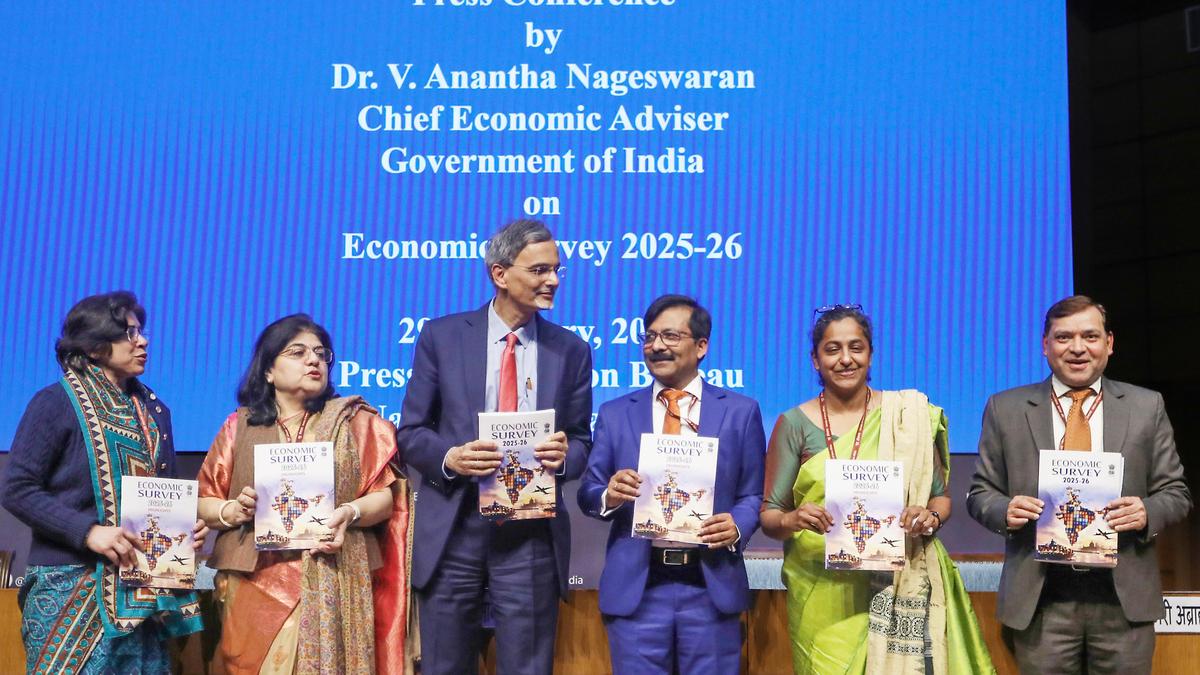
The Economic Survey stated that the Centre has substantially improved its fiscal deficit ratios.
GK and monthly revision
Economic Survey calls for fiscal flexibility for the Centre, cautions States against worsening finances
The Economic Survey noted that the Centre significantly improved its fiscal deficit post-COVID-19, while States' finances deteriorated due to falling revenue and increased spending on unconditional cash transfers. This highlights a critical divergence in fiscal health between the Union and State governments, crucial for understanding India's federal fiscal structure and policy implications for competitive exams.
Revision structure
Monthly events and exam calendar context
Static GK and one-liner notes
Quiz and mock-test revision path
Key points
Exam-ready takeaways
The Economic Survey cautioned that States have seen their finances worsen over the same period.
States' worsening finances are attributed to falling revenue and higher spending on unconditional cash transfers.
These fiscal trends for both Centre and States have been observed since the COVID-19 pandemic.
The Economic Survey called for fiscal flexibility for the Centre.
Detailed analysis
Full exam-oriented breakdown
The Economic Survey's observation regarding the divergent fiscal paths of the Union and State governments post-COVID-19 pandemic presents a critical lens through which to understand India's complex fiscal federalism. This analysis is crucial for aspirants preparing for competitive exams, as it touches upon core economic and governance principles. **Background Context: The COVID-19 Shock and Fiscal Response** Before the pandemic, both the Centre and States were generally striving towards fiscal consolidation, guided by the Fiscal Responsibility and Budget Management (FRBM) Act, 2003, which aimed to bring down fiscal deficits and public debt. However, the unprecedented health and economic crisis triggered by the COVID-19 pandemic from early 2020 necessitated a massive fiscal response. Both the Union and State governments ramped up spending on healthcare infrastructure, relief measures, and economic stimulus packages. This led to a temporary, but significant, deviation from FRBM targets, with the Centre's fiscal deficit soaring to 9.2% of GDP in FY21 and States' deficits also increasing. The immediate priority was to save lives and livelihoods, pushing fiscal prudence to the background. The Union government provided various forms of support, including enhanced borrowing limits for states and front-loading of tax devolution. **The Economic Survey's Findings: A Tale of Two Fiscals** The latest Economic Survey highlights a significant divergence in fiscal health since this period. The Centre has demonstrated a substantial improvement in its fiscal deficit ratios. This improvement can be attributed to robust tax buoyancy, particularly in direct taxes and GST, coupled with calibrated expenditure management. The Centre has actively pursued fiscal consolidation, aiming to bring its fiscal deficit down to 4.5% of GDP by FY26. Conversely, the Survey cautions that States have seen their finances worsen. This deterioration is primarily attributed to two factors: falling revenue and higher spending on unconditional cash transfers. While central transfers have increased, States' own tax revenues, especially from sources like excise on liquor and stamp duties, faced challenges during the economic slowdown. Moreover, the increasing adoption of unconditional cash transfer schemes by various State governments, often seen as direct benefit transfers or welfare handouts, has added considerable pressure on their revenue expenditure, without necessarily generating equivalent productive assets or long-term growth. **Key Stakeholders and Their Roles** Several key stakeholders are involved in this fiscal dynamic. The **Union Government**, through the Ministry of Finance, sets overall macroeconomic policy, manages central finances, and influences state finances through devolution of taxes and grants (as per the recommendations of the Finance Commission) and borrowing limits. **State Governments**, through their respective Finance Departments, are responsible for managing their own budgets, generating revenues, and delivering essential public services like health, education, and law and order. The **Finance Commission**, a constitutional body established under **Article 280**, plays a crucial role in recommending the distribution of tax revenues between the Centre and States and among States. The **Reserve Bank of India (RBI)**, as the government's banker, manages public debt and provides advice on fiscal policy. Finally, the **citizenry** are direct beneficiaries or affected parties of both central and state fiscal policies and welfare schemes. **Why This Matters for India: Implications for Fiscal Federalism and Development** The divergent fiscal paths have profound implications for India's federal structure and overall development. Firstly, it strains **fiscal federalism**. If states consistently face revenue shortfalls and increasing expenditure burdens, their autonomy and capacity to deliver public services are compromised, potentially leading to greater reliance on central grants and directives. This can shift the balance of power within the federal system. Secondly, it impacts **public service delivery**. Worsening state finances can lead to underinvestment in critical sectors like health, education, and infrastructure, which are primarily state subjects, thereby hindering human capital development and long-term economic growth. Thirdly, the sustainability of **welfare schemes** is at risk. While cash transfers can provide immediate relief, their long-term fiscal sustainability, especially if not adequately funded by robust revenue generation, becomes a concern. Lastly, the overall **national debt burden** and sovereign credit rating can be affected if sub-national debt becomes unsustainable, potentially increasing borrowing costs for both the Centre and States. **Constitutional and Policy Framework** India's Constitution lays down the framework for fiscal relations. **Articles 268 to 281** outline the distribution of taxing powers and revenue sharing. **Article 280** mandates the establishment of a Finance Commission every five years to recommend the distribution of net proceeds of taxes and grants-in-aid to states. **Article 293** deals with state borrowings, often requiring central consent for significant loans if a state is indebted to the Centre. The **FRBM Act, 2003**, provides a statutory framework for fiscal discipline. While its targets were temporarily relaxed during the pandemic, the push for fiscal consolidation implies a return to these principles. The **Goods and Services Tax (GST)**, implemented in 2017 through the 101st Constitutional Amendment Act, significantly altered state revenue autonomy by subsuming many state taxes. While GST compensation was provided for five years, its cessation has added to states' revenue challenges. **Future Implications and Way Forward** The Economic Survey's call for fiscal flexibility for the Centre, while cautioning States, suggests a nuanced approach. For the Centre, flexibility might imply strategic investments or counter-cyclical policies. For States, it necessitates a critical review of expenditure, particularly the efficiency and targeting of cash transfer schemes, and robust efforts to enhance their **own tax and non-tax revenues**. The recommendations of the upcoming Finance Commissions will be crucial in recalibrating Centre-State fiscal relations. A sustainable path forward requires continued **cooperative federalism**, where both levels of government work in tandem to achieve fiscal prudence without compromising essential public services and welfare. Rationalization of subsidies, improved tax administration, and reforms in public sector undertakings at the state level are essential steps to ensure long-term fiscal health and equitable development across the nation. **Conclusion** The divergent fiscal performance of the Centre and States is a significant challenge for India. While the Centre has shown resilience, the weakening finances of states pose a threat to their developmental autonomy and the overall federal balance. Addressing this requires a multi-pronged strategy involving fiscal reforms, expenditure rationalization, enhanced revenue mobilization by states, and a strong commitment to cooperative fiscal federalism, guided by the constitutional framework and expert recommendations.
How to study
Turn news into exam marks
Revise monthly events by exam family instead of reading random updates.
Pair one-liners with mock tests so mistakes become the next revision list.
Keep state job pages, calendar pages and GK packs connected in one path.