

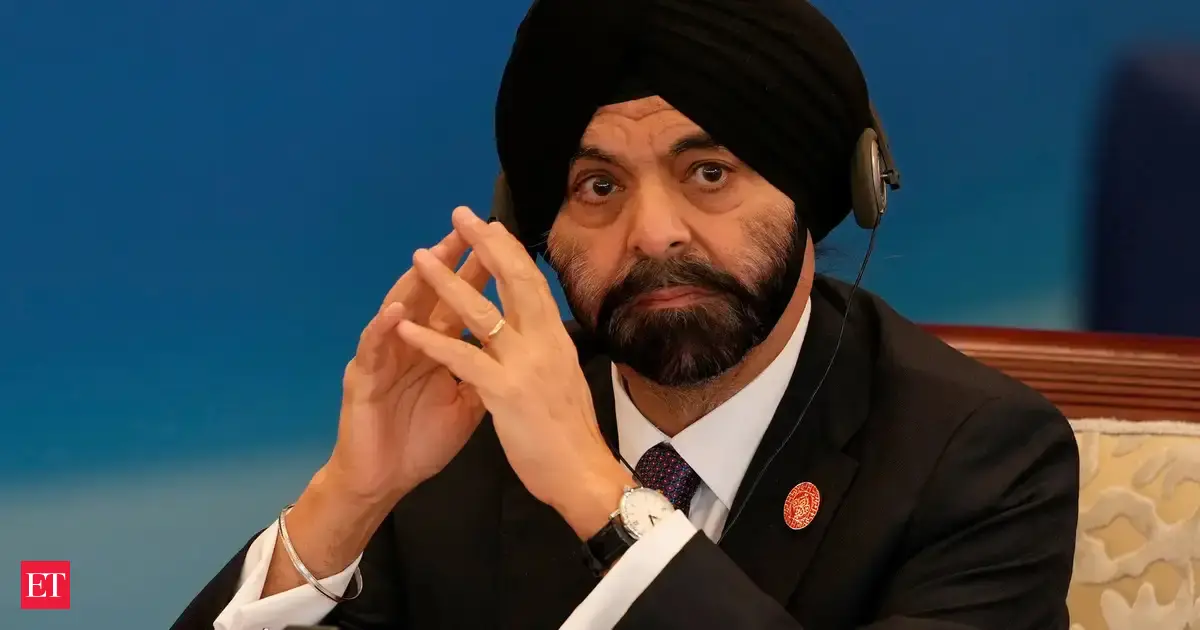
The statement was made by Ajay Banga, the current President of the World Bank.
GK and monthly revision
India should think less on tariffs, more on opportunities to boost trade: World Bank's Ajay Banga
World Bank President Ajay Banga urged India to prioritize trade opportunities over tariffs to boost its global trade presence. He highlighted India's extensive trade pacts, including the recent India-EU free trade agreement, as crucial for economic growth. This advice underscores the importance of liberalized trade policies and international cooperation for India's development, making it highly relevant for competitive exams focusing on economy and international relations.
Revision structure
Monthly events and exam calendar context
Static GK and one-liner notes
Quiz and mock-test revision path
Key points
Exam-ready takeaways
Banga urged India to prioritize trade opportunities over imposing tariffs to boost trade.
He specifically highlighted India's extensive trade pacts, including the India-EU free trade agreement.
Banga noted the significant growth of emerging markets in global trade.
This growth in emerging markets has occurred over the past two decades.
Detailed analysis
Full exam-oriented breakdown
The statement by World Bank President Ajay Banga urging India to prioritize trade opportunities over tariffs is a significant piece of advice, reflecting a broader global economic debate and India's evolving position in the international trade landscape. To truly grasp its implications, we must delve into the background, key players, and future trajectory. **Background Context and Historical Perspective:** India's trade policy has undergone a dramatic transformation since its independence. For decades post-1947, India largely pursued an import substitution industrialization (ISI) strategy, characterized by high tariffs, quantitative restrictions, and a focus on domestic production to reduce reliance on imports. This protectionist approach, while aiming to foster self-reliance, led to inefficiencies, lack of competitiveness, and limited integration with the global economy. The economic reforms of 1991 marked a watershed moment, liberalizing the economy, significantly reducing tariffs, and opening up to foreign investment and trade. India became a founding member of the World Trade Organization (WTO) in 1995, committing to a rules-based multilateral trading system. However, in recent years, especially with initiatives like 'Make in India' and 'Atmanirbhar Bharat' (Self-Reliant India), there has been a noticeable shift towards calibrated protectionism, with some sectors experiencing increased import duties to support domestic manufacturing. This current approach seeks to balance global integration with domestic industrial growth and job creation, often leading to a complex interplay of tariff and non-tariff measures. **What Happened and Key Stakeholders:** Ajay Banga, as the President of the World Bank, a global financial institution dedicated to reducing poverty and supporting development, brings a powerful voice to international economic policy discussions. His advice to India to focus on 'trade opportunities' rather than 'tariffs' is a direct recommendation for a more open, export-oriented trade strategy. He specifically highlighted India's growing network of trade pacts, including the recent India-EU free trade agreement (which is currently under negotiation and expected to be a comprehensive deal), as crucial for unlocking these opportunities. The World Bank's perspective generally favors free trade as a catalyst for economic growth, efficiency, and poverty reduction. Key stakeholders involved are: 1. **The World Bank (Ajay Banga):** As an international development institution, it advocates for policies that promote global economic integration, sustainable growth, and poverty alleviation. Its advice often steers developing nations towards liberalized trade regimes. 2. **The Indian Government (Ministry of Commerce & Industry, Ministry of Finance):** These ministries are responsible for formulating and implementing India's Foreign Trade Policy (FTP), negotiating trade agreements, and managing customs duties. They face the challenge of balancing the interests of domestic industries (which may seek protection) with the benefits of global trade (access to markets, technology, investment). 3. **Indian Industry and Businesses:** Exporters stand to benefit from reduced tariffs in partner countries and increased market access. Importers might benefit from lower input costs. Domestic manufacturers, particularly in nascent or vulnerable sectors, might lobby for tariffs to protect themselves from foreign competition. 4. **Global Trading Partners (e.g., European Union):** Countries or blocs like the EU seek reciprocal market access and a level playing field. Their willingness to engage in comprehensive trade agreements with India depends on India's commitment to reducing trade barriers. **Significance for India and Future Implications:** Banga's counsel holds immense significance for India's economic trajectory. Prioritizing trade opportunities means actively engaging in Free Trade Agreements (FTAs), reducing non-tariff barriers, and improving trade facilitation. This can lead to: * **Enhanced Economic Growth:** Increased exports can boost GDP, create jobs, and attract foreign direct investment (FDI). India's merchandise exports reached a record high of over USD 447 billion in FY 2022-23, demonstrating the potential of an outward-looking strategy. * **Global Competitiveness:** Exposure to international competition can force Indian industries to innovate, improve efficiency, and enhance product quality, making them globally competitive. * **Integration into Global Value Chains (GVCs):** Lower tariffs and easier trade facilitate India's integration into GVCs, allowing it to specialize in specific stages of production and enhance its role in global manufacturing. * **Diversification of Markets and Products:** FTAs open up new markets for Indian goods and services, reducing reliance on a few key partners and diversifying export baskets. * **Geopolitical Influence:** A robust trade policy and economic integration can bolster India's strategic partnerships and diplomatic leverage on the global stage. However, a complete dismantling of tariffs also poses challenges, particularly for nascent domestic industries that may struggle to compete immediately. The future implications involve India carefully calibrating its trade policy to leverage global opportunities while safeguarding strategic domestic interests. This might involve selective tariff reductions, strategic FTAs, and robust domestic support mechanisms like Production Linked Incentive (PLI) schemes to enhance manufacturing capabilities without resorting to broad protectionism. **Related Constitutional Articles, Acts, and Policies:** While there are no direct constitutional articles dictating specific tariff levels, several provisions and legislative frameworks underpin India's trade policy: * **Article 253:** Empowers Parliament to make any law for implementing any international treaty, agreement, or convention. This is crucial for enacting legislation to give effect to FTAs and WTO commitments. * **Foreign Trade (Development and Regulation) Act, 1992:** This is the primary legislation governing foreign trade in India, providing the framework for the government to formulate and implement the Foreign Trade Policy (FTP). * **Customs Act, 1962:** This Act deals with the levy and collection of customs duties on goods imported into or exported from India, directly addressing the 'tariffs' aspect of the debate. * **Foreign Trade Policy (FTP):** Announced periodically by the Ministry of Commerce & Industry, the FTP outlines the government's strategy for promoting exports, managing imports, and facilitating trade, incorporating objectives like 'Make in India' and 'Atmanirbhar Bharat'. The current FTP 2023 aims to make India a USD 2 trillion export economy by 2030. This debate underscores the ongoing challenge for India: how to harness the benefits of globalization and free trade while nurturing domestic industries and ensuring equitable growth. Banga's advice serves as a reminder of the potential gains from a proactive, opportunity-driven trade policy.
How to study
Turn news into exam marks
Revise monthly events by exam family instead of reading random updates.
Pair one-liners with mock tests so mistakes become the next revision list.
Keep state job pages, calendar pages and GK packs connected in one path.