

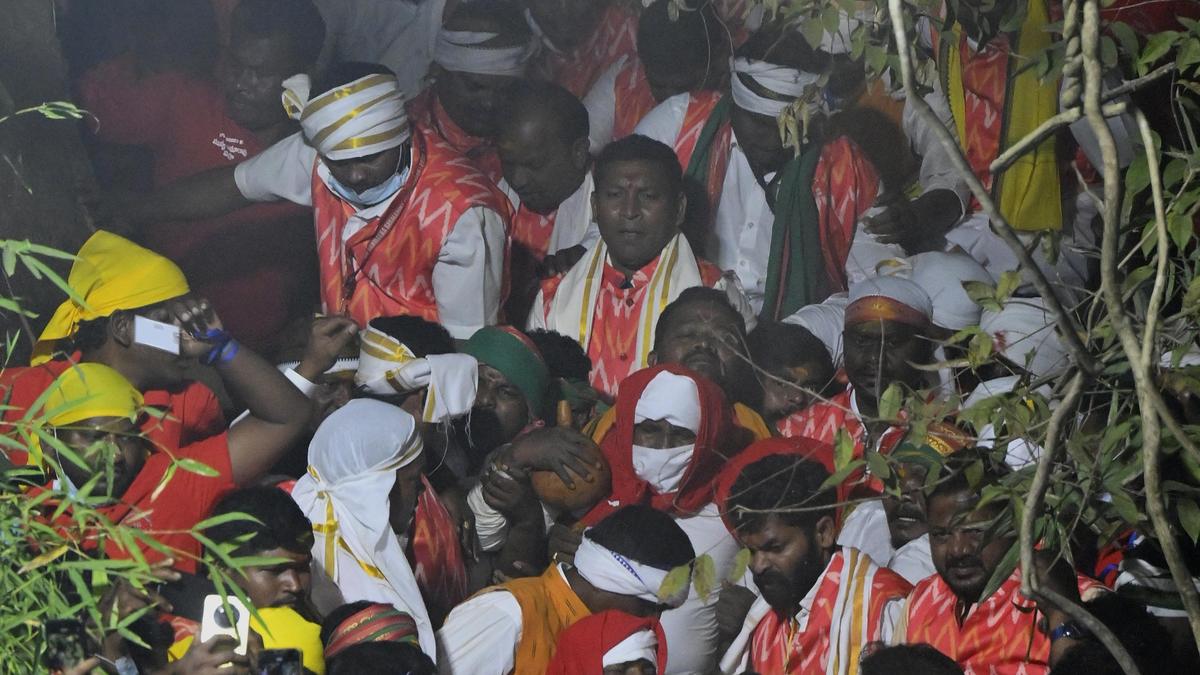
The presiding deity Sammakka was ceremonially placed on the 'Gadde' at the shrine.
GK and monthly revision
Religious fervour peaks as Sammakka ceremonially placed on Gadde at shrine, devotee influx set to surge
Religious fervor peaked as the presiding deity Sammakka was ceremonially placed on the 'Gadde' at a shrine in Mulugu district. This event, following traditional secret rituals led by Koya Chief Priest Kokkera Krishnaiah, marks a significant phase of the Sammakka Saralamma Jatara, one of India's largest tribal festivals. It highlights tribal culture and customs, crucial for competitive exams focusing on Art & Culture and Tribal Affairs.
Revision structure
Monthly events and exam calendar context
Static GK and one-liner notes
Quiz and mock-test revision path
Key points
Exam-ready takeaways
The rituals were led by Koya Chief Priest Kokkera Krishnaiah.
The deity was brought down from Chilakalagutta, a specific location within the shrine complex.
The ceremonies adhere to traditional secret rituals and Koya tribal customs.
The event takes place in the Mulugu district, a key geographical detail.
Detailed analysis
Full exam-oriented breakdown
The recent ceremonial placement of the presiding deity Sammakka on the 'Gadde' at the shrine in Mulugu district marks a pivotal moment in the Sammakka Saralamma Jatara, often referred to as Medaram Jatara. This event, steeped in Koya tribal customs and led by Chief Priest Kokkera Krishnaiah, is not merely a religious ritual but a profound cultural phenomenon with deep historical roots and significant implications for India's social fabric, tribal recognition, and cultural heritage. **Background Context and What Happened:** The Sammakka Saralamma Jatara is a biennial tribal festival celebrated in Medaram, Mulugu district of Telangana. It is one of the largest tribal gatherings in Asia, attracting millions of devotees. The festival commemorates the legendary fight of Sammakka and her daughter Saralamma, tribal deities, against an unjust Kakatiya ruler in the 13th century. According to legend, they sacrificed their lives protecting their community from drought and oppressive taxes. The festival is a tribute to their valor and sacrifice, symbolizing tribal resistance and resilience. The specific event described in the article – the ceremonial placement of Sammakka on the 'Gadde' – is a crucial phase of the four-day festival. It signifies the arrival of the goddess. The deity, represented by a casket of vermilion and other sacred items, is brought from Chilakalagutta, a nearby hillock, to the main shrine. The rituals are highly sacred and performed by Koya priests, adhering strictly to age-old tribal traditions and secret customs. The mention of the Mulugu Superintendent of Police firing rounds into the air highlights the official recognition and security arrangements provided by the state government for this massive gathering, underscoring the festival's importance beyond just the tribal community. **Key Stakeholders Involved:** Several key stakeholders are integral to the Sammakka Saralamma Jatara. The **Koya Tribe** are the primary custodians of the festival. Their priests conduct all rituals, and their traditions form the core of the celebrations. For them, it's a reaffirmation of their identity, history, and spiritual connection. The **Telangana State Government** is a major stakeholder, providing extensive logistical support, security, infrastructure development (roads, sanitation, water), and managing the massive influx of pilgrims. The presence of the police superintendent signifies governmental involvement in maintaining law and order. **Millions of devotees** from Telangana, Andhra Pradesh, Chhattisgarh, Maharashtra, and other states form the backbone of the festival, their faith and participation driving its scale. Local businesses and vendors also form a significant economic stakeholder group, benefiting from the massive footfall. **Significance for India:** This festival holds immense significance for India. Firstly, it is a powerful symbol of **India's rich cultural diversity and tribal heritage**. It showcases the vibrant traditions, beliefs, and social structures of indigenous communities, which are often overlooked. Secondly, it plays a vital role in **tribal identity and empowerment**. By celebrating their deities and customs on such a grand scale, the Koya tribe and other tribal communities assert their unique cultural space within the broader Indian society. Thirdly, the Jatara has a considerable **socio-economic impact**. It boosts the local economy, creating temporary employment and livelihood opportunities for thousands. It also promotes **cultural tourism**, drawing national and international attention to Telangana and its tribal culture. Furthermore, it reinforces **national integration** by bringing together diverse communities under a shared spiritual and cultural experience. **Historical Context and Future Implications:** The legend of Sammakka and Saralamma fighting the Kakatiya rulers places the festival in the historical context of medieval South India, highlighting instances of tribal resistance against established kingdoms. Over centuries, the festival has evolved from a local tribal gathering into a major regional and national event. This evolution brings both opportunities and challenges. Looking ahead, the Sammakka Saralamma Jatara has several future implications. There is an ongoing demand for it to be recognized as a **National Festival**, which would further elevate its status and potentially unlock more central government funding and support for infrastructure and cultural preservation. The massive scale necessitates robust **sustainable tourism management** to minimize environmental impact and preserve the sanctity of the site. Efforts will also continue towards **preserving Koya tribal language, customs, and art forms**, ensuring that modernization does not dilute their unique heritage. The festival serves as a crucial platform for dialogue on **tribal welfare, rights, and mainstreaming**, influencing policy decisions related to indigenous communities. **Related Constitutional Articles, Acts, and Policies:** The Sammakka Saralamma Jatara touches upon several constitutional provisions and government policies related to tribal welfare and cultural rights: * **Article 29 (Protection of interests of minorities):** While primarily referring to linguistic and religious minorities, the spirit extends to protecting the distinct culture of tribal groups. It ensures that any section of the citizens having a distinct language, script, or culture of its own shall have the right to conserve the same. * **Article 46 (Promotion of educational and economic interests of Scheduled Castes, Scheduled Tribes and other weaker sections):** This Directive Principle of State Policy mandates the State to promote with special care the educational and economic interests of the weaker sections of the people, and, in particular, of the Scheduled Castes and the Scheduled Tribes, and shall protect them from social injustice and all forms of exploitation. This indirectly supports the preservation of their cultural identity which is linked to their overall well-being. * **Fifth Schedule of the Constitution:** Deals with the administration and control of Scheduled Areas and Scheduled Tribes in states other than Assam, Meghalaya, Tripura, and Mizoram. Mulugu district falls under this framework, which mandates special governance mechanisms to protect tribal interests and customary laws. * **The Provisions of the Panchayats (Extension to Scheduled Areas) Act, 1996 (PESA Act):** This Act empowers Gram Sabhas in Scheduled Areas to safeguard and preserve the traditions and customs of the people, their cultural identity, community resources, and the customary mode of dispute resolution. The Koya tribe's control over their festival rituals aligns with the spirit of PESA. * **Ministry of Tribal Affairs:** Established in 1999, this central ministry is dedicated to the holistic development and welfare of tribal communities, including the promotion and preservation of their cultural heritage. Government schemes and grants for tribal arts and festivals often fall under its purview. * **Cultural Policies:** Various government policies and initiatives aimed at preserving India's intangible cultural heritage also support festivals like the Sammakka Saralamma Jatara, recognizing their role in national identity and cultural tourism.
How to study
Turn news into exam marks
Revise monthly events by exam family instead of reading random updates.
Pair one-liners with mock tests so mistakes become the next revision list.
Keep state job pages, calendar pages and GK packs connected in one path.