

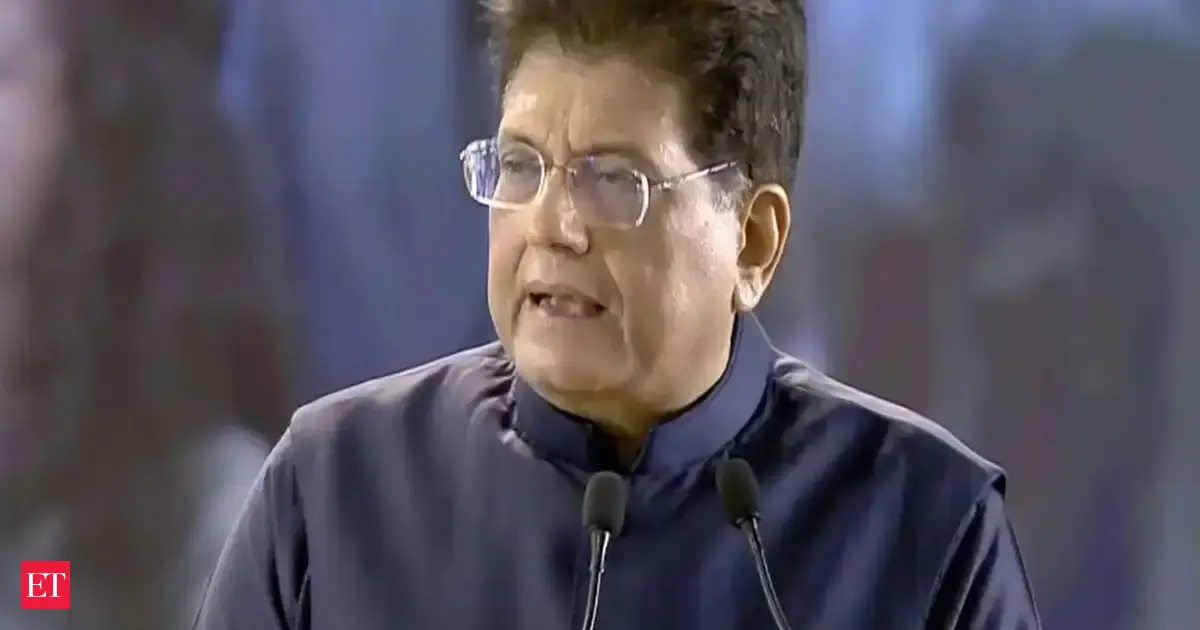
Commerce and Industry Minister Piyush Goyal stated healthy growth in India's goods and services exports up to January 21.
GK and monthly revision
Goods, services exports registered healthy growth until January 21: Piyush Goyal
Commerce and Industry Minister Piyush Goyal announced that India's goods and services exports showed healthy growth until January 21, despite global economic uncertainties. Merchandise exports recorded a 1.87% increase in December and a 2.44% rise from April-December. This performance is significant as the ministry anticipates total exports to surpass USD 850 billion by 2025-26, providing crucial data for competitive exams on India's economic indicators and trade policies.
Revision structure
Monthly events and exam calendar context
Static GK and one-liner notes
Quiz and mock-test revision path
Key points
Exam-ready takeaways
Merchandise exports recorded a 1.87% increase in December.
Merchandise exports registered a 2.44% rise during the April-December period.
The ministry projects India's total exports (goods and services) to exceed USD 850 billion.
The target year for achieving exports surpassing USD 850 billion is 2025-26.
Detailed analysis
Full exam-oriented breakdown
India's recent export performance, as highlighted by Commerce and Industry Minister Piyush Goyal, signals a resilient economic trajectory amidst a challenging global landscape. The announcement of healthy growth in goods and services exports until January 2021, with merchandise exports seeing a 1.87% increase in December and a 2.44% rise from April-December, is a crucial indicator of India's external sector strength. This positive momentum fuels the ambitious projection of surpassing USD 850 billion in total exports by 2025-26. **Background Context and Global Headwinds:** For several years, the global economy has navigated through a series of disruptions – from the lingering effects of the COVID-19 pandemic to geopolitical tensions, supply chain bottlenecks, and inflationary pressures. Major economies have experienced slowdowns, impacting global trade volumes. In this context, India, a significant player in global trade, has been strategically working to bolster its export capabilities. The government's 'Make in India' initiative, launched in 2014, and the more recent 'Atmanirbhar Bharat Abhiyan' (Self-Reliant India Campaign), introduced in 2020, aim to boost domestic manufacturing and reduce import dependence, while simultaneously promoting exports. These policies form the bedrock of India's current trade strategy, seeking to integrate India more deeply into global supply chains as a reliable and competitive supplier. **Key Stakeholders and Their Roles:** Several key stakeholders are instrumental in India's export journey. The **Ministry of Commerce and Industry**, led by Minister Piyush Goyal, is the primary policymaker, drafting and implementing the Foreign Trade Policy (FTP), offering incentives, and negotiating trade agreements. **Indian exporters**, ranging from large corporations to Micro, Small, and Medium Enterprises (MSMEs), are the direct drivers of export volumes. Their ability to innovate, maintain quality, and compete globally is paramount. The **Reserve Bank of India (RBI)** plays a critical role in managing currency exchange rates, maintaining foreign exchange reserves, and ensuring a stable financial environment conducive to trade. **Other government ministries**, such as Finance (providing budgetary support for export promotion schemes) and External Affairs (facilitating trade diplomacy), also contribute significantly. Furthermore, international bodies like the World Trade Organization (WTO) set the rules for global trade, impacting India's trade policies and market access. **Significance for India:** Robust export growth holds profound significance for India. Economically, it contributes directly to the **Gross Domestic Product (GDP)**, generates **employment** across various sectors (manufacturing, services, logistics), and helps improve the **Balance of Payments (BoP)** by earning foreign exchange. A healthy BoP is crucial for managing external debt and financing essential imports. Strategically, strong export performance enhances India's global standing, demonstrating its growing economic prowess and reliability as a trade partner. It aligns with the vision of making India a 'Vishwaguru' (world leader) and a key player in global supply chains, especially in a world seeking diversification away from traditional manufacturing hubs. The success of 'Make in India' and 'Atmanirbhar Bharat' is intrinsically linked to India's ability to export its manufactured goods and services. **Historical Context and Policy Evolution:** Historically, post-independence, India adopted an inward-looking, import-substitution industrialization strategy. The **economic reforms of 1991** marked a paradigm shift, liberalizing the economy and opening it up to global trade. Subsequent Foreign Trade Policies (FTPs) have aimed at simplifying procedures, reducing transaction costs, and providing incentives to exporters. The current **Foreign Trade Policy 2023** continues this trajectory, focusing on export promotion through schemes like the Remission of Duties and Taxes on Exported Products (RoDTEP) and the promotion of 'Districts as Export Hubs'. The **Production Linked Incentive (PLI) Scheme**, introduced across various sectors, is a recent game-changer designed to boost domestic manufacturing by offering incentives on incremental sales from products manufactured in India, thereby making Indian industries globally competitive and fostering export growth. **Constitutional and Legal Framework:** The constitutional framework empowers the Union government to regulate foreign trade. **Entry 41 of the Union List in the Seventh Schedule** explicitly grants the Parliament exclusive power over
How to study
Turn news into exam marks
Revise monthly events by exam family instead of reading random updates.
Pair one-liners with mock tests so mistakes become the next revision list.
Keep state job pages, calendar pages and GK packs connected in one path.