

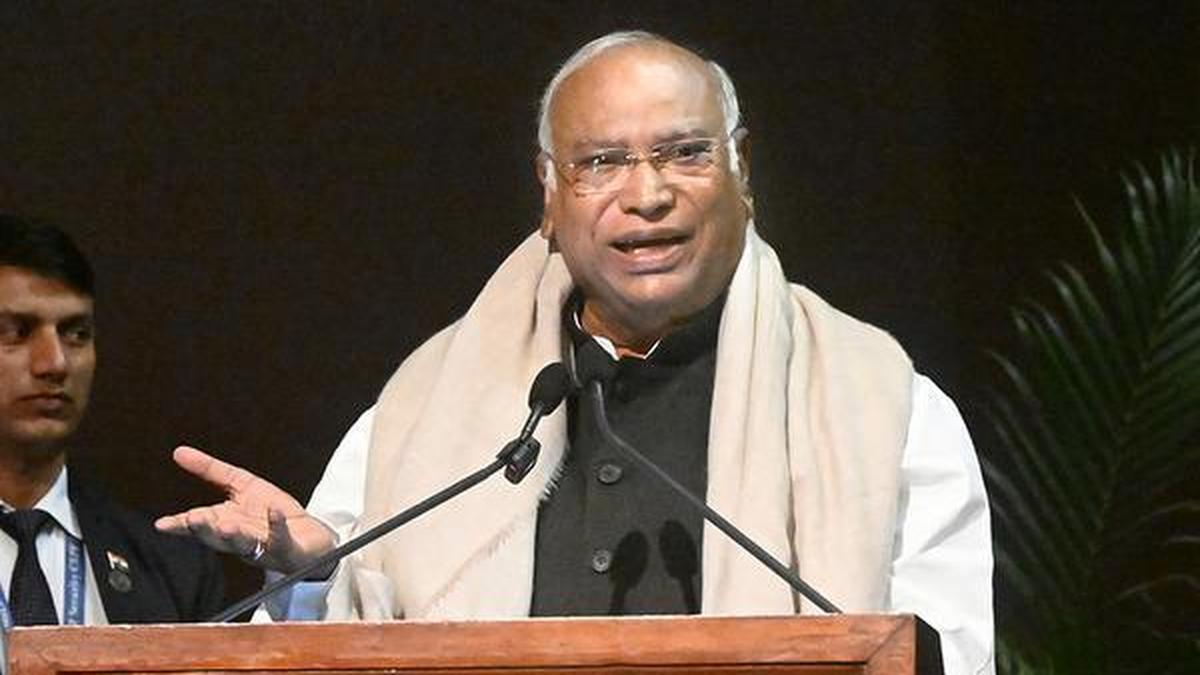
Congress chief Mallikarjun Kharge accused the Modi government of weakening the Right to Information (RTI) Act.
GK and monthly revision
Kharge targets Centre over RTI after Economic Survey flags ‘re-examination’
Congress chief Mallikarjun Kharge accused the Modi government of weakening the Right to Information (RTI) Act, citing concerns over rising pendency, vacancies in information commissions, and the safety of RTI activists. His criticism followed the Economic Survey's mention of a 're-examination' of the transparency law. This issue is significant for competitive exams as it pertains to governance, transparency, and the functioning of key democratic institutions.
Revision structure
Monthly events and exam calendar context
Static GK and one-liner notes
Quiz and mock-test revision path
Key points
Exam-ready takeaways
Kharge's criticism was prompted by the Economic Survey flagging a 're-examination' of the RTI Act.
Key concerns raised included increased pendency of RTI applications and numerous vacancies in information commissions.
The safety and security of RTI activists were also highlighted as a critical issue by the Congress chief.
The Right to Information Act, 2005, is India's primary legislation for ensuring transparency and accountability in governance.
Detailed analysis
Full exam-oriented breakdown
The recent criticism by Congress chief Mallikarjun Kharge regarding the alleged weakening of the Right to Information (RTI) Act, 2005, following the Economic Survey's mention of a 're-examination' of the law, highlights a critical debate concerning transparency and accountability in Indian governance. This issue is not merely a political slugfest but delves into the foundational principles of India's democratic framework. **Background Context and Historical Journey:** India's journey towards a robust Right to Information law was a long and arduous one, rooted in the constitutional guarantee of freedom of speech and expression under Article 19(1)(a). The Supreme Court of India, in several landmark judgments (e.g., *State of U.P. v. Raj Narain, 1975*; *S.P. Gupta v. Union of India, 1981*), interpreted the right to know as an integral part of Article 19(1)(a). Before the RTI Act, 2005, government functioning was largely shrouded in secrecy, governed by the archaic Official Secrets Act, 1923, a relic of the colonial era. The push for a transparency law gained significant momentum through the efforts of grassroots movements, most notably the Mazdoor Kisan Shakti Sangathan (MKSS) in Rajasthan in the 1990s, demanding accountability for public works. This led to the enactment of the Freedom of Information Act, 2002, which proved largely ineffective. The subsequent, more comprehensive, and proactive Right to Information Act, 2005, was a landmark legislation designed to empower citizens to secure access to information under the control of public authorities, thereby promoting transparency and accountability in the working of every public authority. **What Happened and Key Concerns:** Mallikarjun Kharge's accusations stem from two primary points: first, the Economic Survey's suggestion of a 're-examination' of the RTI Act, which the opposition perceives as a precursor to diluting the law; and second, existing operational challenges. His key concerns include the rising pendency of RTI applications, which indicates a backlog in information dissemination, and the significant number of vacancies in Central and State Information Commissions. These commissions are quasi-judicial bodies tasked with adjudicating appeals and complaints under the RTI Act. A lack of commissioners directly impacts their ability to function effectively, leading to delays and frustrating applicants. Furthermore, Kharge highlighted the critical issue of the safety and security of RTI activists, many of whom have faced threats, harassment, and even violence for seeking information, underscoring the dangers involved in upholding transparency. **Key Stakeholders Involved:** * **Government of India (Executive):** As the implementing authority, the government is responsible for ensuring the smooth functioning of the RTI Act, including making appointments to the Information Commissions. It is also the subject of RTI requests. * **Information Commissions (Central and State):** These statutory bodies are crucial for the Act's enforcement. Their independence, full strength, and efficient functioning are vital for timely disclosure of information and resolution of grievances. * **Political Opposition (Congress):** Acting as a watchdog, the opposition raises concerns about governance issues and challenges government policies or actions. * **RTI Activists and Civil Society Organizations:** These individuals and groups are the frontline users of the Act, often exposing corruption and demanding accountability. They are also vocal advocates for strengthening the law and protecting its integrity. * **Indian Citizens:** The ultimate beneficiaries of the Act, whose right to information is directly impacted by the law's strength or weakness. **Significance for India and Future Implications:** The health of the RTI Act is directly proportional to the health of India's democracy. A robust RTI framework is fundamental for good governance, fostering transparency, accountability, and participatory democracy. It serves as a vital anti-corruption tool, allowing citizens to scrutinize government decisions, expenditures, and policies. Weakening the Act, whether through legislative amendments, operational bottlenecks like vacancies, or threats to activists, could lead to a significant erosion of public trust, increased opacity in governance, and a potential rise in corruption. The RTI (Amendment) Act, 2019, which gave the Central Government the power to prescribe the terms of office and salaries of Information Commissioners, was already seen by many as a move to dilute the independence of these bodies, making them more susceptible to executive influence. Any further 're-examination' could potentially aim to restrict the scope of information, increase exemption clauses, or impose greater bureaucratic hurdles. Looking ahead, the debate surrounding the RTI Act's future has profound implications. If the law is indeed diluted, it could set a dangerous precedent for other accountability mechanisms. It could lead to a less informed citizenry, hindering their ability to make informed choices and hold elected representatives accountable. Conversely, if public pressure and judicial oversight lead to strengthening the Act, filling vacancies, and ensuring the safety of activists, it would reinforce India's commitment to democratic values and good governance. The efficacy of the RTI Act is a litmus test for India's commitment to transparency and its citizens' right to know.
How to study
Turn news into exam marks
Revise monthly events by exam family instead of reading random updates.
Pair one-liners with mock tests so mistakes become the next revision list.
Keep state job pages, calendar pages and GK packs connected in one path.