

Tamil Nadu's government was dismissed for the first time on February 1, 1976.
GK and monthly revision
50 years ago, on this day, for the first time a government was dismissed in Tamil Nadu
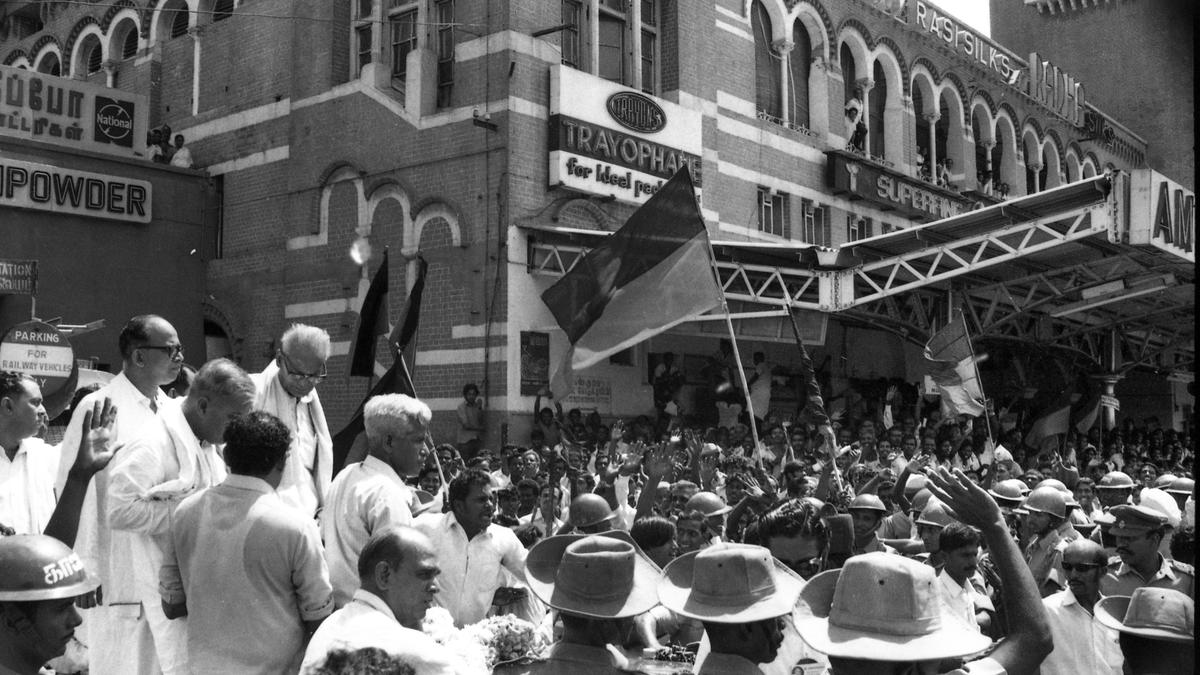
On February 1, 1976, Tamil Nadu's government was dismissed, marking the first imposition of President's Rule in the state. The Centre dissolved the State Assembly, which was due to expire on March 21, 1976, based on the Governor's report citing a "serious situation". This event is crucial for understanding the historical application of Article 356 and central-state relations in Indian constitutional history for competitive exams.
Revision structure
Monthly events and exam calendar context
Static GK and one-liner notes
Quiz and mock-test revision path
Key points
Exam-ready takeaways
This dismissal led to the imposition of President's Rule in the state.
The State Assembly's five-year term was originally due to expire on March 21, 1976.
The Centre dissolved the Assembly based on the Governor's report, citing a "serious situation".
The event highlights the application of Article 356 of the Indian Constitution.
Detailed analysis
Full exam-oriented breakdown
The dismissal of the Dravida Munnetra Kazhagam (DMK) government in Tamil Nadu on February 1, 1976, and the subsequent imposition of President's Rule, marks a pivotal and controversial moment in India's constitutional history. This event was not an isolated incident but a direct consequence of the National Emergency declared by Prime Minister Indira Gandhi on June 25, 1975, which fundamentally altered the political landscape of the country and severely tested India's federal structure. **Background Context: The Shadow of Emergency** The mid-1970s was a period of unprecedented political turmoil in India. The declaration of the National Emergency under Article 352 of the Constitution, citing internal disturbance, led to a severe curtailment of civil liberties, suspension of fundamental rights, and a significant centralization of power in the hands of the Union government. Many opposition leaders were arrested, press censorship was imposed, and non-Congress state governments found themselves under immense pressure. The DMK government in Tamil Nadu, led by Chief Minister M. Karunanidhi, stood out as one of the few vocal critics of the Emergency. The DMK, a strong regional party with a history of advocating for state autonomy, openly challenged the central government's authoritarian measures, passing resolutions against the Emergency and criticizing its excesses. This defiance put the DMK on a direct collision course with the powerful Central government. **What Happened: The Dismissal and President's Rule** On February 1, 1976, barely a month before its five-year term was naturally due to expire on March 21, the Tamil Nadu government was dismissed, and President's Rule was imposed. The official justification, as reported by The Hindu, was based on a report from the then Governor of Tamil Nadu, K.K. Shah, citing a “serious situation” arising from allegations of corruption and maladministration. However, the timing and the political climate strongly suggested that the dismissal was politically motivated, a punitive action against a dissenting state government during the Emergency. This was the first time President's Rule was imposed in Tamil Nadu, making it a significant historical event for the state. **Key Stakeholders Involved** 1. **The Central Government (Indira Gandhi-led Congress)**: The prime mover behind the dismissal, leveraging the powers vested during the Emergency to suppress political opposition and consolidate control. The Centre used the Governor as its agent to initiate the process. 2. **The DMK Government (M. Karunanidhi)**: The victim of the dismissal, representing a regional party that strongly opposed the Emergency and advocated for greater state autonomy. Their dismissal highlighted the vulnerability of state governments to central intervention. 3. **The Governor (K.K. Shah)**: His report formed the constitutional basis for the dismissal, demonstrating the pivotal, often controversial, role of the Governor as a link between the Centre and the state, particularly during times of political tension. 4. **The President of India**: Formally imposed President's Rule based on the Union Cabinet's advice and the Governor's report, as per Article 356. **Why This Matters for India: Federalism and Constitutionalism** This event holds immense significance for India's federal structure and democratic principles. It became a stark example of the potential misuse of Article 356 of the Constitution, which allows the Centre to take over a state's administration in case of a 'failure of constitutional machinery.' The dismissal of the DMK government, alongside several other non-Congress governments during the Emergency, underlined how this emergency provision could be weaponized for political ends, undermining the federal balance and the autonomy of elected state governments. It fueled the debate on the arbitrary powers of the Centre and the role of the Governor as an agent of the Union government. This period also saw the passage of the 42nd Amendment Act in 1976, which significantly curtailed the powers of the High Courts and further centralized power, though some of its provisions were later undone. **Historical Context and Future Implications** The 1976 dismissal was part of a broader pattern of frequent and often arbitrary impositions of President's Rule in India, particularly prominent during the decades following independence. This trend led to a strong demand for reforms to Article 356 to prevent its misuse. Subsequent commissions, such as the Sarkaria Commission (1983) and the Punchhi Commission (2007), made crucial recommendations to limit the arbitrary exercise of this power. The landmark Supreme Court judgment in the S.R. Bommai v. Union of India case (1994) proved to be a watershed moment. The judgment asserted that the imposition of President's Rule is subject to judicial review and mandated that the Central government must prove that the state government has lost the confidence of the Assembly. It also stipulated that the state assembly cannot be dissolved until Parliament approves the proclamation. This judgment significantly curbed the Centre's arbitrary power under Article 356, strengthening cooperative federalism. While instances of President's Rule have decreased since Bommai, the debate on Centre-state relations and the powers of the Governor remains a continuous theme in Indian polity, highlighting the enduring legacy of events like the 1976 Tamil Nadu dismissal.
How to study
Turn news into exam marks
Revise monthly events by exam family instead of reading random updates.
Pair one-liners with mock tests so mistakes become the next revision list.
Keep state job pages, calendar pages and GK packs connected in one path.