

India aims to achieve a USD 2 trillion export target.
GK and monthly revision
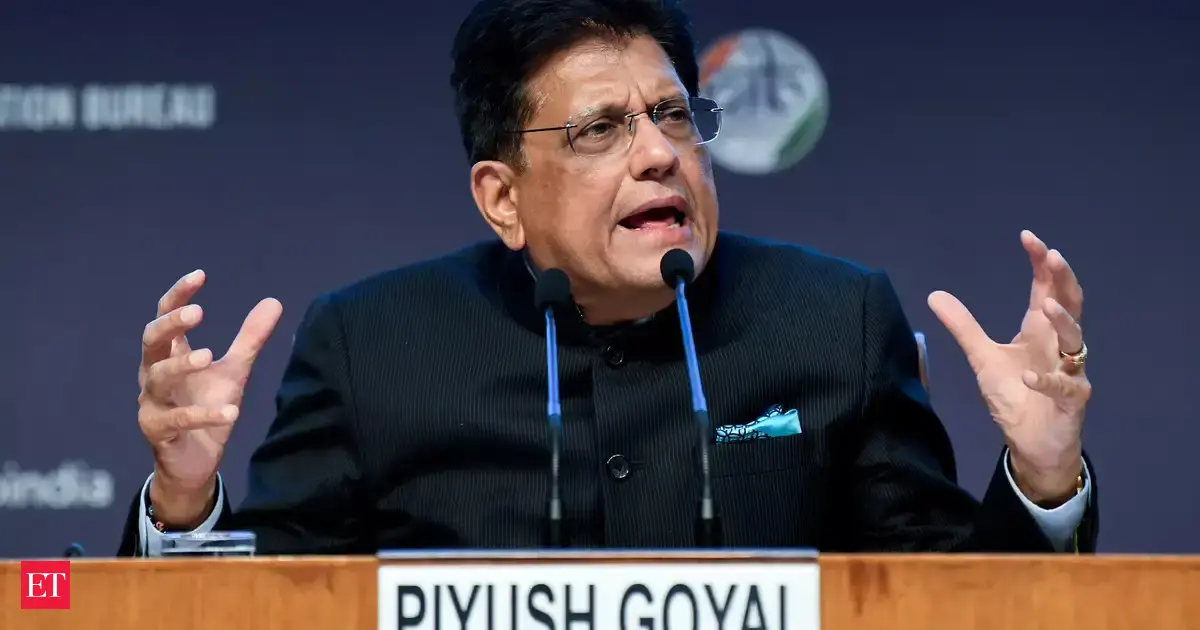
India may achieve USD 2 trillion exports target by 2032: Piyush Goyal
India's ambitious USD 2 trillion export target is now projected to be achieved around 2032, a revision from the initial 2030 goal. This timeline shift is attributed to global uncertainties and the impact of the COVID-19 pandemic. Union Minister Piyush Goyal expressed confidence in reaching this milestone, emphasizing the role of free trade agreements in bolstering exports and attracting investment, which is vital for understanding India's economic policy and trade outlook for competitive exams.
Revision structure
Monthly events and exam calendar context
Static GK and one-liner notes
Quiz and mock-test revision path
Key points
Exam-ready takeaways
The revised timeline for achieving the USD 2 trillion export target is around 2032.
The original target year for achieving USD 2 trillion in exports was 2030.
Union Minister Piyush Goyal expressed confidence in achieving the revised export milestone.
Free Trade Agreements (FTAs) are expected to significantly boost export opportunities for domestic exporters.
Detailed analysis
Full exam-oriented breakdown
India's ambition to achieve a USD 2 trillion export target by 2032 is a significant economic policy pronouncement, reflecting the nation's strategic pivot towards becoming a global manufacturing and trade hub. This revised timeline, initially set for 2030, underscores the profound impact of global economic uncertainties and the unprecedented challenges posed by the COVID-19 pandemic on international trade dynamics. **Background Context and What Happened:** Post-liberalization in 1991, India gradually shed its protectionist policies, embracing global trade. The early 2000s saw a steady rise in exports, but the 2008 global financial crisis and subsequent protectionist tendencies worldwide presented headwinds. In recent years, the Indian government has vigorously pushed for export-led growth, exemplified by initiatives like 'Make in India' and 'Atmanirbhar Bharat', which aim to enhance domestic manufacturing capabilities and integrate India into global supply chains. The initial target of USD 2 trillion in exports by 2030 was a bold statement of intent, building on India's merchandise and services exports, which crossed USD 770 billion in FY 2022-23. However, global supply chain disruptions, geopolitical tensions (like the Russia-Ukraine conflict), and inflationary pressures necessitated a recalibration. Union Minister Piyush Goyal's expression of confidence in achieving the revised 2032 target, despite these challenges, highlights the government's unwavering commitment and belief in the resilience of Indian exporters. A key pillar of this strategy is the aggressive pursuit of Free Trade Agreements (FTAs) with major economies, which are expected to unlock new markets and provide preferential access for Indian goods and services. **Key Stakeholders Involved:** Several entities play crucial roles in realizing this ambitious export goal. The **Ministry of Commerce & Industry**, along with its various departments like the Directorate General of Foreign Trade (DGFT), is the primary policy-making and implementing body. They formulate the Foreign Trade Policy (FTP), negotiate FTAs, and provide incentives. **Indian exporters**, ranging from large conglomerates to Micro, Small, and Medium Enterprises (MSMEs), are the ultimate drivers of this target. Their ability to innovate, maintain quality, and scale production is paramount. **Export Promotion Councils (EPCs)** and industry associations facilitate trade, provide market intelligence, and represent exporter interests. The **Reserve Bank of India (RBI)** manages foreign exchange reserves and implements monetary policies that impact export competitiveness. **NITI Aayog** provides strategic direction and policy recommendations. Internationally, **trading partners** and multilateral organizations like the **World Trade Organization (WTO)** shape the global trade environment that India operates within. **Why This Matters for India:** Achieving the USD 2 trillion export target holds immense significance for India. Economically, it would substantially boost **GDP growth**, create millions of **jobs** across manufacturing and services sectors, and enhance **foreign exchange reserves**, strengthening the rupee and improving the Balance of Payments. A robust export sector signifies a competitive and globally integrated economy, attracting further **Foreign Direct Investment (FDI)**. Strategically, it elevates India's standing in the global economic order, making it a more influential player in international trade negotiations and supply chain resilience. Socially, increased exports can lead to higher incomes, improved living standards, and greater opportunities for skill development. Furthermore, it reinforces the 'Make in India' and 'Atmanirbhar Bharat' initiatives by encouraging domestic value addition and self-reliance. **Historical Context and Broader Themes:** India's trade history has evolved from a largely closed economy post-independence, focused on import substitution, to a more open, export-oriented one after the 1991 reforms. Early Foreign Trade Policies (FTPs) aimed at simplifying procedures and offering incentives. The current emphasis on FTAs marks a strategic shift to secure market access in a world increasingly moving towards regional trade blocs. This export push aligns with broader themes of **economic liberalization**, **globalization**, and **geopolitical realignment**, where economic power is increasingly intertwined with diplomatic influence. It also reflects India's ambition to move up the global value chain from being primarily a raw material and low-value-added exporter to a producer of sophisticated goods and high-end services. **Future Implications:** Successfully reaching the USD 2 trillion export milestone by 2032 would cement India's position as a major global economic power. It would lead to significant investments in infrastructure, logistics, and technology to support increased trade volumes. The focus on FTAs suggests a more proactive and strategic engagement with key markets, potentially diversifying India's export basket and reducing reliance on traditional partners. However, challenges remain, including improving logistics costs (which are higher than global averages), enhancing product quality and competitiveness, addressing non-tariff barriers in destination markets, and navigating an increasingly fragmented global trade landscape. Failure to meet the target, or significant delays, could impact investor confidence and slow down India's economic ascent. **Related Constitutional Articles, Acts, or Policies:** While there isn't a single article directly mandating an export target, the constitutional framework empowers the Union Government to formulate and implement trade policies. **Article 246** of the Constitution places 'Trade and commerce with foreign countries; import and export across customs frontiers' under the Union List (Entry 41 of List I, Seventh Schedule), granting Parliament exclusive power to legislate on these matters. The **Foreign Trade (Development and Regulation) Act, 1992**, is the primary legislation governing foreign trade in India, empowering the central government to make provisions for the development and regulation of foreign trade. Subsequent **Foreign Trade Policies (FTPs)**, typically announced every five years (though often reviewed and updated), provide the operational framework, incentives (like Remission of Duties and Taxes on Exported Products – RoDTEP scheme), and procedural guidelines for exporters and importers. **Article 265** states that no tax shall be levied or collected except by authority of law, relevant for customs duties and trade-related taxes. India's commitments under the **WTO agreements** also heavily influence its trade policy decisions.
How to study
Turn news into exam marks
Revise monthly events by exam family instead of reading random updates.
Pair one-liners with mock tests so mistakes become the next revision list.
Keep state job pages, calendar pages and GK packs connected in one path.