

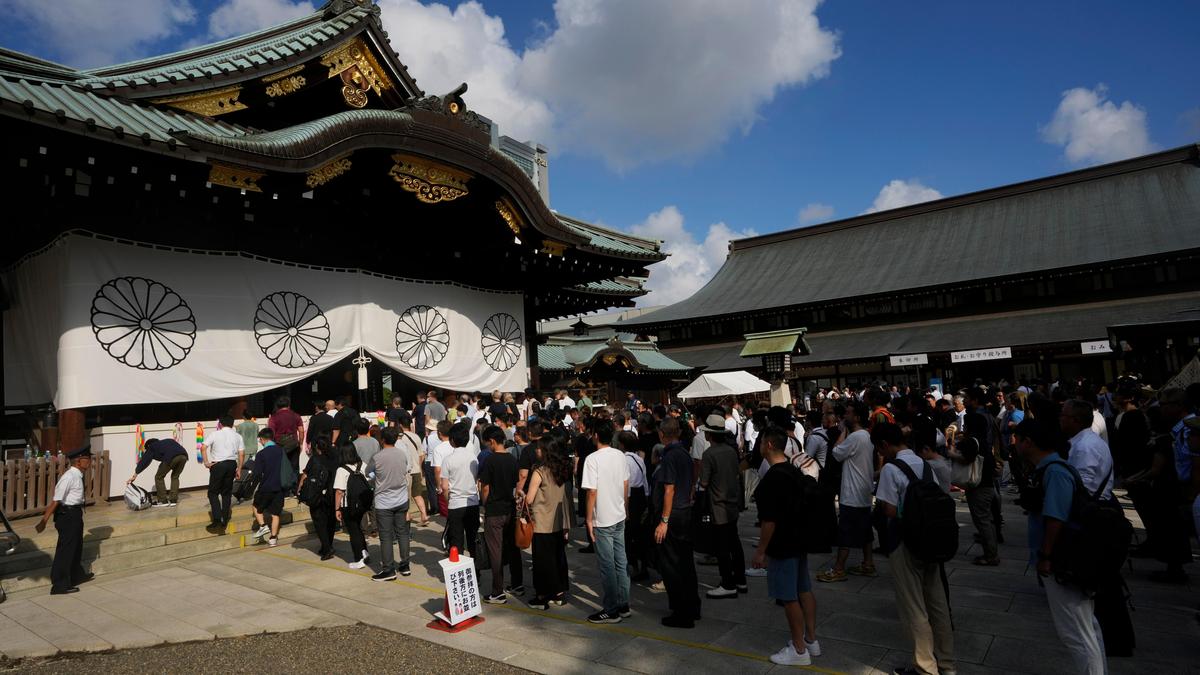
A Pokemon card event scheduled at Japan's Yasukuni Shrine was cancelled.
GK and monthly revision
Pokemon card event at controversial shrine to Japanese war dead cancelled after China protests
A Pokemon card event at Japan's Yasukuni Shrine was cancelled following protests from China. The shrine is controversial as it honors Japan's 2.5 million war dead, including convicted war criminals. This incident underscores persistent historical tensions in East Asia, particularly concerning Japan's wartime past, a key aspect for understanding regional geopolitics in competitive exams.
Revision structure
Monthly events and exam calendar context
Static GK and one-liner notes
Quiz and mock-test revision path
Key points
Exam-ready takeaways
The cancellation occurred due to official protests lodged by China.
The Yasukuni Shrine honors approximately 2.5 million Japanese war dead.
The controversy stems from the shrine also honoring convicted Japanese war criminals.
Nations like China and the Koreas perceive visits to Yasukuni Shrine as a lack of remorse for Japan's wartime aggression.
Detailed analysis
Full exam-oriented breakdown
The cancellation of a Pokémon card event at Japan's Yasukuni Shrine due to protests from China might seem like a minor incident involving popular culture, but it deeply underscores the persistent and sensitive historical tensions that continue to define East Asian geopolitics. This event serves as a potent reminder of the unresolved legacies of World War II and Japan's imperial past, particularly for nations like China and South Korea, which bore the brunt of Japanese aggression. The **background context** for this controversy lies in the very nature of the Yasukuni Shrine. Established in 1869, it is dedicated to honouring all those who died in service of the Emperor of Japan, primarily military personnel. While many of the 2.5 million enshrined individuals are considered national heroes by some Japanese, the shrine's contentious status stems from its inclusion of 1,068 individuals convicted as Class A war criminals by the Tokyo Trials (International Military Tribunal for the Far East) after World War II. These individuals, including wartime Prime Minister Hideki Tojo, were responsible for planning, initiating, and conducting wars of aggression. Their enshrinement in 1978 ignited widespread protests from neighbouring countries, particularly China and South Korea, which suffered immense atrocities under Japanese occupation and colonial rule. **What happened** was that the Pokémon Company, a global Japanese entertainment giant, had planned a card event at the Yasukuni Shrine. This immediately drew a strong diplomatic protest from China, which views any official or public association with the shrine as a glorification of Japan's militaristic past and a lack of remorse for its wartime actions. Given the significant market and political sensitivity in China, the Pokémon Company promptly cancelled the event, highlighting how even seemingly apolitical cultural events can become entangled in deep-seated historical disputes. **Key stakeholders involved** include: **Japan's government and right-wing groups**, who often defend visits to the shrine as a matter of national sovereignty and remembrance of the war dead, while some mainstream politicians and the Emperor avoid visits to prevent further diplomatic friction. **China's government and public** are staunch opponents, viewing the shrine as a symbol of Japanese militarism and unrepentance, using any related event to reiterate their demands for a sincere apology and historical recognition. **South Korea** shares a similar perspective with China, frequently protesting visits by Japanese officials. The **Pokémon Company**, as a global brand, found itself caught between cultural promotion and geopolitical sensitivities, ultimately prioritizing its commercial interests and avoiding further controversy. **Why this matters for India** is multifaceted. Firstly, India's "Act East Policy" places significant emphasis on strengthening strategic and economic ties with East Asian nations, including Japan, South Korea, and ASEAN countries. Stable regional relations are crucial for the success of this policy. While India itself does not share the same historical grievances with Japan, it has a vested interest in regional peace and stability. Tensions between Japan and China, two of Asia's largest economies and military powers, can disrupt supply chains, impact trade routes, and potentially escalate into broader conflicts that affect the entire Indo-Pacific region, an area of increasing strategic importance for India. India's own historical experience with colonialism and its commitment to international law and peace also align with the broader principles of historical accountability, even if its direct involvement in this specific issue is minimal. Furthermore, understanding the complexities of historical memory and national identity in international relations is vital for Indian diplomats and policymakers. **Historically**, Japan's post-World War II constitution, often called the "Pacifist Constitution" (promulgated on May 3, 1947), particularly **Article 9**, renounces war as a sovereign right and the threat or use of force as a means of settling international disputes. This constitutional framework was a direct response to its wartime aggression. However, the Yasukuni Shrine controversy demonstrates that while Japan may have constitutionally renounced war, the memory and interpretation of its wartime past remain intensely divisive, both domestically and internationally. India, as a nation that achieved independence post-WWII, has historically advocated for peaceful resolution of disputes and respect for international law, principles that are challenged by unresolved historical grievances in other regions. The **future implications** are that these historical tensions are unlikely to disappear soon. The Yasukuni Shrine will likely remain a flashpoint, triggering diplomatic protests whenever high-profile visits or events occur. This ongoing friction can hinder deeper regional integration and cooperation, even on critical issues like climate change or economic development. It also highlights the growing influence of cultural industries and "soft power" in international relations, demonstrating how global brands must navigate complex geopolitical landscapes. For India, this means carefully balancing its strategic partnerships, particularly with Japan, while being mindful of the broader regional dynamics. India's role in multilateral forums like the Quad or the East Asia Summit might involve subtly encouraging dialogue and reconciliation to foster greater regional stability, without directly interfering in bilateral historical disputes. While no direct Indian constitutional articles apply to the Yasukuni Shrine specifically, the broader principles of India's foreign policy, enshrined implicitly in its democratic values and commitment to international peace and security, are relevant. India's foreign policy, guided by the Ministry of External Affairs, seeks to promote friendly relations, peace, and cooperation globally, which is impacted by regional tensions like those surrounding the Yasukuni Shrine. India's "Act East Policy" (launched in 2014, succeeding the "Look East Policy" from 1991) is a key policy framework that necessitates an understanding of these regional sensitivities to ensure effective diplomatic and economic engagement with East Asian partners.
How to study
Turn news into exam marks
Revise monthly events by exam family instead of reading random updates.
Pair one-liners with mock tests so mistakes become the next revision list.
Keep state job pages, calendar pages and GK packs connected in one path.