

Ram temple construction is expected to conclude by April 30.
GK and monthly revision
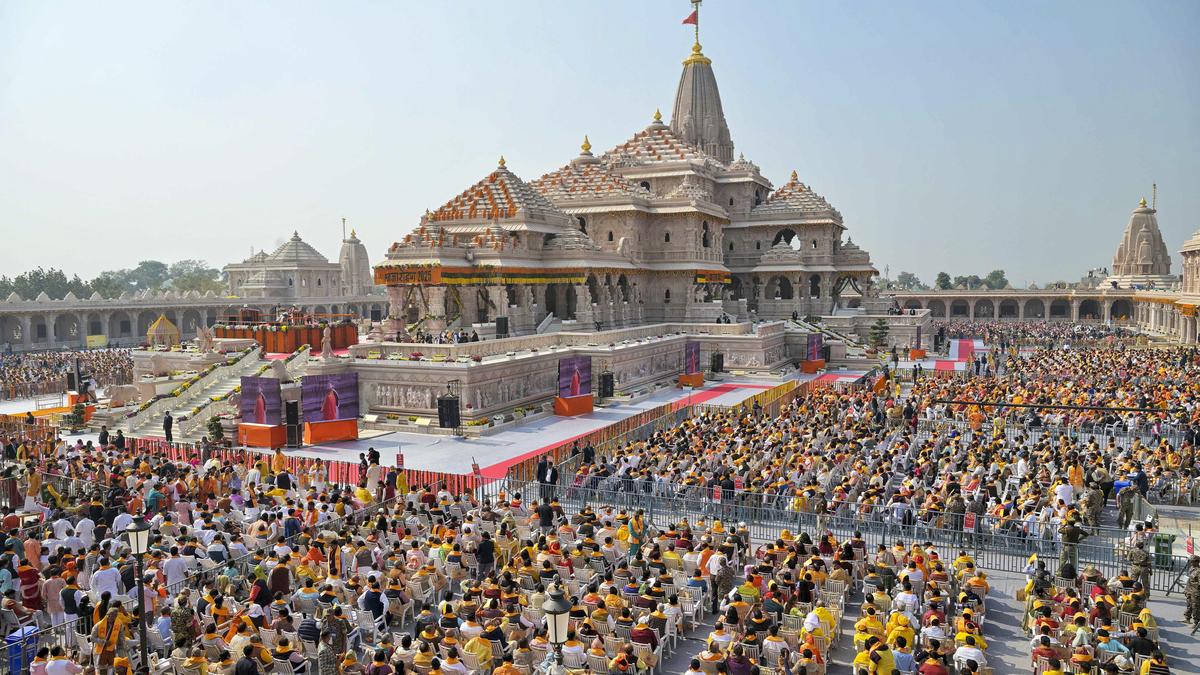
Ram temple construction expected to end by April 30; overall estimated cost ₹1,900 crore
The construction of the Ram temple in Ayodhya is projected to conclude by April 30, with an estimated overall cost of ₹1,900 crore. This marks a significant milestone for the project, as the Shri Ram Janmabhoomi Teerth Kshetra Trust will assume control of all agreements with contractors like L&T and Tata Consultancy thereafter. This news is crucial for competitive exams due to its national significance, financial implications, and involvement of a prominent trust.
Revision structure
Monthly events and exam calendar context
Static GK and one-liner notes
Quiz and mock-test revision path
Key points
Exam-ready takeaways
The overall estimated cost for the Ram temple project is ₹1,900 crore.
Post-April 30, all agreements will be taken over by the Shri Ram Janmabhoomi Teerth Kshetra Trust.
Key contractors involved include L&T and Tata Consultancy.
State Construction Corporation is also among the entities with agreements for the project.
Detailed analysis
Full exam-oriented breakdown
The news regarding the imminent completion of the Ram temple construction in Ayodhya by April 30, with an estimated cost of ₹1,900 crore, marks a significant milestone in a saga deeply entrenched in India's socio-political and historical landscape. This development is not merely about a construction project; it symbolizes the culmination of decades of legal battles, political movements, and profound religious sentiments. **Background Context and What Happened:** The Ram Janmabhoomi-Babri Masjid dispute is one of the longest-standing and most contentious issues in modern Indian history. The core of the dispute revolved around the claim that the site was the birthplace of Lord Rama, on which a mosque, the Babri Masjid, was constructed in 1528-29 by Mir Baqi, a general of the Mughal emperor Babur. The conflict escalated dramatically with the demolition of the Babri Masjid on December 6, 1992, by a large crowd of Hindu karsevaks, leading to widespread communal riots across the country. Following this, multiple legal suits were filed, seeking ownership of the disputed land. The Allahabad High Court, in 2010, divided the land into three parts, a verdict challenged by all parties. Finally, on November 9, 2019, the Supreme Court of India delivered a unanimous verdict, awarding the entire 2.77 acres of disputed land to the Hindu parties for the construction of a Ram temple. The court also directed the government to allot a 5-acre plot to the Sunni Waqf Board for the construction of a mosque. Crucially, the Supreme Court mandated the formation of a trust, the 'Shri Ram Janmabhoomi Teerth Kshetra Trust,' to oversee the construction and management of the temple. The current news indicates that the physical construction phase, managed by prominent contractors like Larsen & Toubro (L&T) and Tata Consultancy, along with the State Construction Corporation, is drawing to a close, with the Trust set to assume full control of all agreements post-April 30. **Key Stakeholders Involved:** At the forefront is the **Shri Ram Janmabhoomi Teerth Kshetra Trust**, a body constituted by the Government of India as per the Supreme Court's directive, responsible for the temple's construction and future management. The **Government of India** played a crucial role in implementing the Supreme Court's judgment and facilitating the formation of the Trust. **Construction giants like L&T and Tata Consultancy** have been instrumental in providing the engineering, design, and project management expertise to bring the temple to fruition. The **State Construction Corporation** also has agreements, indicating broader governmental or semi-governmental involvement in certain aspects. Millions of **Hindu devotees** across India and globally are primary stakeholders, for whom the temple represents a deep spiritual and cultural aspiration. **Political parties**, especially the Bharatiya Janata Party (BJP), have historically championed the temple's construction as a core electoral promise, making them significant political stakeholders. **Significance for India:** This development holds multifaceted significance for India. **Socially and Culturally**, the completion of the Ram temple is seen by many as the fulfillment of a long-cherished dream and a moment of cultural resurgence. Ayodhya is poised to become a major pilgrimage and tourist hub, potentially attracting millions of visitors annually. **Economically**, this will lead to a significant boost in tourism, hospitality, and infrastructure development in Ayodhya and the surrounding regions, generating employment and local economic growth. The estimated ₹1,900 crore cost reflects a substantial investment, much of which has come from public donations. **Politically**, the temple's completion marks a monumental achievement for the ruling BJP, resonating deeply with its core voter base and ideological tenets. It also re-ignites discussions around secularism and the separation of religion and state, especially in the context of the **Places of Worship (Special Provisions) Act, 1991**, which generally prohibits the conversion of any place of worship and maintains its religious character as it existed on August 15, 1947. The Supreme Court in its 2019 verdict had upheld the constitutionality of this Act, while making an exception for the Ayodhya dispute due to its unique historical context and legal specifics, emphasizing that the Act embodies the secular features of the Indian polity. **Historical Context and Constitutional Provisions:** The journey from dispute to construction is a testament to the Indian judicial system's capacity to address complex historical grievances. The Supreme Court's verdict invoked **Article 142** of the Constitution, which grants it extraordinary powers to pass any decree or order necessary for doing 'complete justice' in any cause or matter. This article was crucial in formulating the comprehensive solution, including the directive for the mosque's construction. The principles of **secularism**, enshrined in the Preamble of the Constitution and guaranteed through **Articles 25-28** (Right to Freedom of Religion), were central to the arguments and the Court's deliberations, which sought to balance religious freedoms with the rule of law. The 1991 Act, though not directly applied to the disputed site in Ayodhya, remains a critical piece of legislation governing other religious sites. **Future Implications:** The completion of the Ram temple is expected to transform Ayodhya into a global religious and cultural center, necessitating further infrastructure development, including improved connectivity, accommodation, and civic amenities. This could serve as a model for faith-based tourism development. However, it also has implications for inter-community relations, with continued debates on India's secular fabric. The successful resolution and implementation of the Supreme Court's verdict could potentially set a precedent for future handling of religiously sensitive matters, though the unique nature of the Ayodhya case makes direct comparisons challenging. The focus will now shift to the management and long-term development of the temple complex and Ayodhya as a whole, under the stewardship of the Shri Ram Janmabhoomi Teerth Kshetra Trust, potentially influencing policies related to cultural heritage, urban planning, and religious endowments.
How to study
Turn news into exam marks
Revise monthly events by exam family instead of reading random updates.
Pair one-liners with mock tests so mistakes become the next revision list.
Keep state job pages, calendar pages and GK packs connected in one path.