

The arms sales were approved by the Trump administration.
GK and monthly revision
Trump administration approves $6.67 billion worth arms sales to Israel, $9 billion worth sales to Saudi Arabia
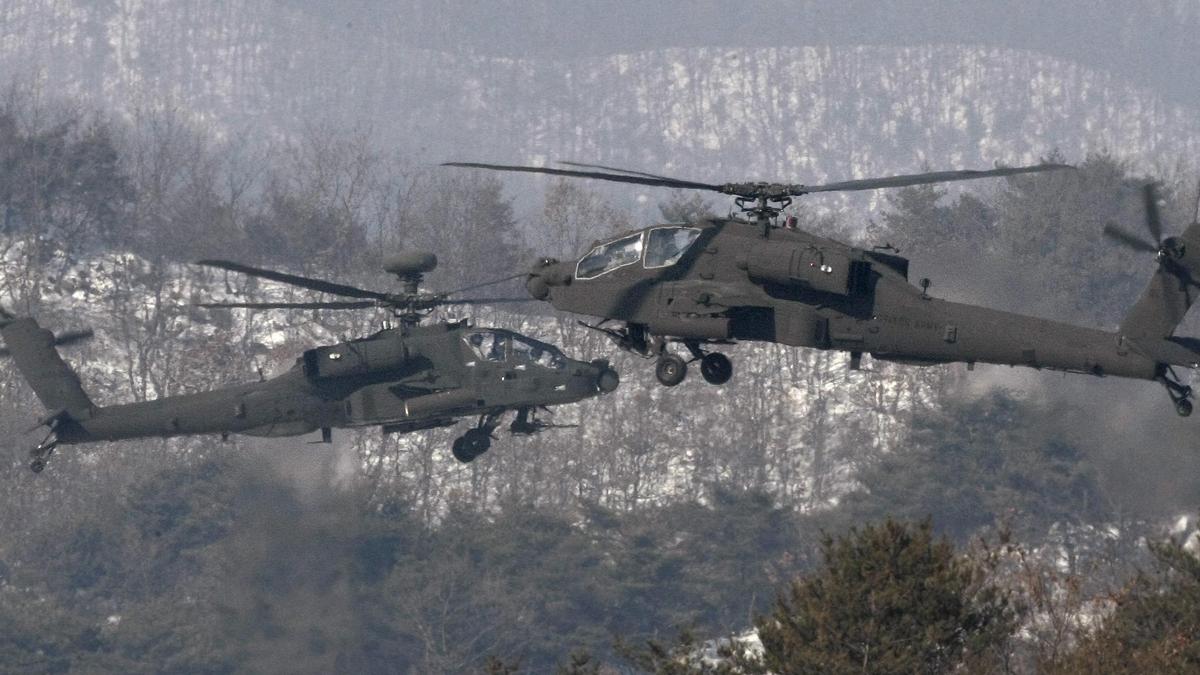
The Trump administration approved significant arms sales, totaling $6.67 billion to Israel and $9 billion to Saudi Arabia. These deals, particularly the Apache helicopters worth $3.8 billion, bolster the military capabilities of key US allies in the volatile Middle East. This is crucial for competitive exams focusing on international relations, defence policies, and geopolitical dynamics in the region.
Revision structure
Monthly events and exam calendar context
Static GK and one-liner notes
Quiz and mock-test revision path
Key points
Exam-ready takeaways
The total value of arms sales approved for Israel was $6.67 billion.
The total value of arms sales approved for Saudi Arabia was $9 billion.
Apache helicopters were the biggest part of the package, valued at $3.8 billion.
Apache helicopters will be equipped with rocket launchers and advanced targeting gear.
Detailed analysis
Full exam-oriented breakdown
The Trump administration's approval of significant arms sales to Israel ($6.67 billion) and Saudi Arabia ($9 billion), with Apache helicopters forming a major component, represents a critical development in the complex geopolitics of the Middle East. Understanding this event requires delving into the historical context, the motivations of key stakeholders, and its far-reaching implications, particularly for a nation like India. **Background Context:** The United States has historically played a pivotal role in the security architecture of the Middle East. Its foreign policy objectives have revolved around ensuring the free flow of oil, countering terrorism, maintaining regional stability, and supporting key allies. Post-World War II, the US fostered strong strategic alliances with both Israel and Saudi Arabia. For Israel, this alliance has been central to its security doctrine, providing advanced military technology to maintain a 'Qualitative Military Edge' (QME) over potential adversaries. For Saudi Arabia, the alliance has been vital for its defence against regional threats, particularly from Iran, and for modernizing its military capabilities. The Trump administration, with its 'America First' approach, often prioritized arms sales as a means of boosting the US economy, strengthening alliances, and projecting power, sometimes overriding traditional human rights concerns or regional stability assessments. **What Happened:** In the specific instance, the Trump administration cleared arms deals worth $6.67 billion for Israel and $9 billion for Saudi Arabia. A substantial part of this, $3.8 billion, was allocated for Apache helicopters equipped with advanced targeting gear and rocket launchers. These sales were part of a larger ongoing pattern of military assistance and sales designed to bolster the defence capabilities of these two critical US allies in a volatile region characterized by numerous conflicts, including the civil war in Yemen, the ongoing Israeli-Palestinian conflict, and the broader Saudi-Iran rivalry. **Key Stakeholders Involved:** * **United States (Trump Administration):** The seller, driven by strategic interests to maintain influence, support allies, generate economic benefits for its defence industry, and counter perceived threats like Iran. * **Israel:** The buyer, seeking to maintain its qualitative military edge, deter regional adversaries, and enhance its security capabilities amidst a challenging neighbourhood. * **Saudi Arabia:** The buyer, aiming to modernize its armed forces, project power in the region, counter Iranian influence, and address security threats, notably from Houthi rebels in Yemen. * **Regional Adversaries (e.g., Iran, Houthi rebels):** While not direct stakeholders in the sales, their actions and perceived threats often drive the demand for such military hardware, contributing to an arms race dynamic. **Why This Matters for India:** These arms sales and the resulting regional dynamics have significant implications for India. Firstly, **Energy Security** is paramount; India imports a substantial portion of its oil and gas from the Middle East. Instability in the region, fueled by an arms race or conflict, directly threatens India's energy supply lines and economic stability. Secondly, **Diaspora Concerns** are critical. Millions of Indian expatriates reside in the Gulf countries, contributing significantly to India's remittances. Their safety and well-being are directly linked to regional peace. Thirdly, **Geopolitical Balancing Act** is crucial. India maintains strong strategic partnerships with the US, Israel, and Saudi Arabia. It needs to navigate these relationships carefully, promoting stability without taking sides in regional rivalries. India's "Look West" policy, focusing on enhanced engagement with the Gulf and Israel, underscores the importance of this region for its economic and strategic interests. While there are no direct Indian constitutional articles governing US arms sales, India's foreign policy, guided by principles enshrined in Article 51 of the Directive Principles of State Policy (promotion of international peace and security), emphasizes strategic autonomy and a multi-aligned approach, which is vital in responding to such complex international developments. **Historical Context:** US military aid to Israel dates back decades, solidified after the 1967 Six-Day War. Similarly, US-Saudi defence cooperation strengthened significantly after the 1973 oil crisis and subsequent regional conflicts. The rationale has consistently been rooted in shared security interests and regional stability, albeit with evolving threats and strategic priorities. The Trump administration, in particular, adopted a more confrontational stance towards Iran, which further incentivized arms sales to its regional rivals. **Future Implications:** These arms sales could have several future implications. They might contribute to an **arms race** in the Middle East, potentially exacerbating existing conflicts like the one in Yemen or intensifying the proxy rivalry between Saudi Arabia and Iran. While intended to stabilize, they can also raise the risk of miscalculation. The long-term **balance of power** in the region will be impacted, potentially solidifying the military superiority of US allies. Furthermore, the sales signify the continued **US commitment and influence** in the Middle East, though this influence is constantly being re-evaluated by successive administrations. For India, the challenge will be to continue its diplomatic efforts to foster peace and stability in the region, diversify its energy sources, and strengthen its own defence capabilities to ensure strategic autonomy amidst evolving global power dynamics. In essence, these arms sales are not merely commercial transactions; they are deeply intertwined with the geopolitical fabric of the Middle East, carrying significant security, economic, and strategic ramifications for all involved, including India.
How to study
Turn news into exam marks
Revise monthly events by exam family instead of reading random updates.
Pair one-liners with mock tests so mistakes become the next revision list.
Keep state job pages, calendar pages and GK packs connected in one path.