

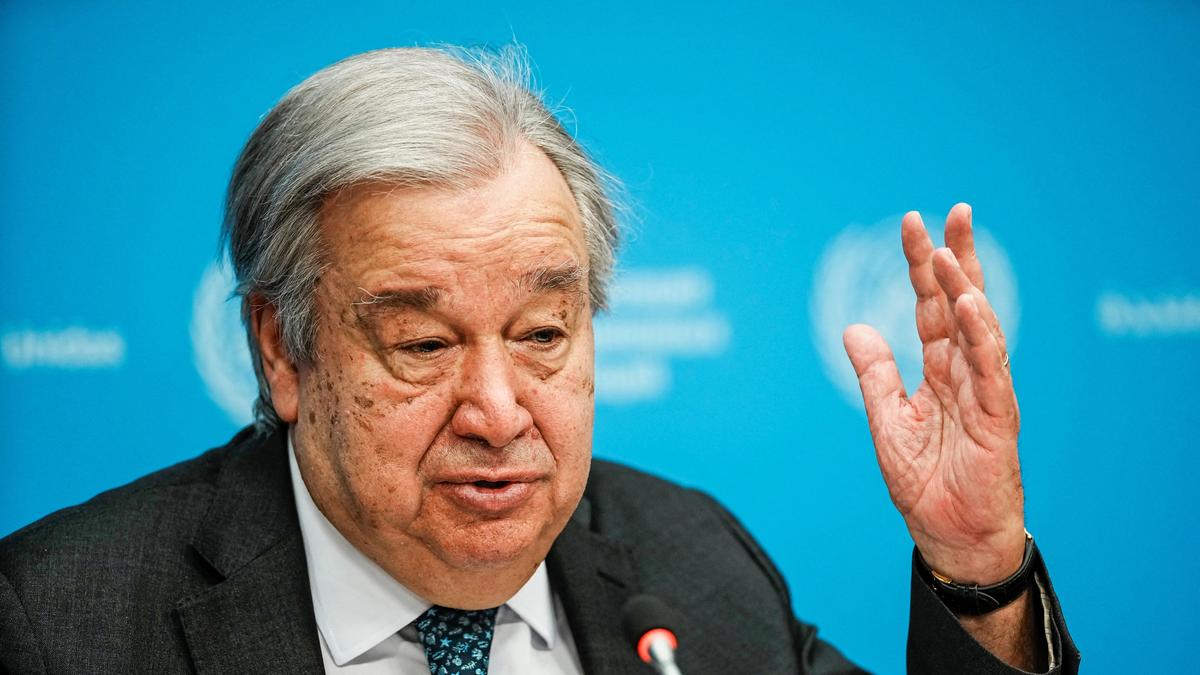
The UN chief stated that the United Nations faces an 'imminent financial collapse' without urgent action.
GK and monthly revision
United Nations faces 'imminent financial collapse' without urgent action, says UN chief
The United Nations faces an 'imminent financial collapse' due to member states' non-payment of dues, as stated by the UN chief. The United States alone owes a significant $2.196 billion to the UN's regular budget, with an additional $767 million projected for the current year. This financial instability hampers the UN's operations and international peace efforts, making it a crucial topic for competitive exams focusing on international organizations and global affairs.
Revision structure
Monthly events and exam calendar context
Static GK and one-liner notes
Quiz and mock-test revision path
Key points
Exam-ready takeaways
The United States currently owes $2.196 billion to the UN's regular budget.
The U.S. is projected to owe an additional $767 million for the current year.
The combined outstanding and projected debt from the U.S. to the UN totals approximately $2.963 billion.
The financial crisis is primarily attributed to the non-payment of dues by member states, with the U.S. highlighted as a major debtor.
Detailed analysis
Full exam-oriented breakdown
The United Nations, an organization born from the ashes of World War II with the noble aim of fostering international peace and cooperation, is facing an 'imminent financial collapse.' This stark warning from the UN Chief highlights a critical vulnerability: its reliance on member states for funding, a system currently under severe strain. Understanding this crisis is crucial for competitive exam aspirants, as it touches upon global governance, international relations, and India's foreign policy. **Background Context: The UN's Funding Mechanism** Established in 1945, the UN operates on a system of assessed contributions from its 193 member states. These contributions are mandatory and are calculated based on a complex formula that considers each country's capacity to pay, primarily its Gross National Income (GNI), adjusted for factors like external debt and population. The UN Charter obligates member states to pay their dues in full, on time, and without conditions. This system is designed to ensure equitable burden-sharing and provide the UN with a stable financial base to carry out its diverse mandates, from peacekeeping and humanitarian aid to development programs and human rights protection. **The Current Crisis: What Happened?** At the heart of the current crisis is the chronic non-payment of dues by several member states, with the United States being the most significant debtor. According to the UN official, the U.S. currently owes a staggering $2.196 billion to the UN's regular budget, with an additional $767 million projected for the current year. This combined outstanding and projected debt of nearly $3 billion from a single member state severely cripples the UN's ability to operate effectively. This isn't a new phenomenon; the UN has faced similar financial shortfalls historically, often due to political disagreements, domestic budget priorities, or a perceived lack of accountability within the organization by some member states. These arrears directly impact the UN's cash flow, forcing it to delay payments to staff, vendors, and even peacekeeping operations. **Key Stakeholders Involved** 1. **The United Nations Secretariat:** Led by the Secretary-General, it is the primary victim of the financial crunch, as its ability to execute mandates is directly hampered. It is also responsible for managing the budget and advocating for timely payments. 2. **Member States (especially the United States):** As the largest economy, the U.S. is the biggest contributor to the UN budget. Its non-payment has the most significant impact. Historically, U.S. administrations have used withholding of dues as a tool to express dissatisfaction with UN policies or to push for reforms. Other major contributors like Japan, Germany, the UK, and China, along with other debtor nations, also play a role. 3. **Developing Nations:** These countries often rely heavily on UN agencies for development assistance, humanitarian aid, and peacekeeping support. They are disproportionately affected by budget cuts and operational slowdowns. 4. **Global Civil Society and Beneficiaries:** People in conflict zones, refugees, and communities benefiting from UN development programs are the ultimate sufferers when the UN's capacity is diminished. **Why This Matters for India** India, a founding member of the UN and a staunch advocate for multilateralism, has a significant stake in the UN's financial health. India consistently pays its dues on time and in full, reflecting its commitment to global cooperation. This crisis matters for India for several reasons: * **Multilateralism and Foreign Policy:** India's foreign policy, enshrined in **Article 51 of the Directive Principles of State Policy**, advocates for the promotion of international peace and security, maintenance of just and honourable relations between nations, and respect for international law. A financially weak UN undermines these principles and India's vision for a rules-based global order. * **Peacekeeping Operations:** India is one of the largest troop-contributing countries to UN peacekeeping missions. Financial instability can jeopardize these missions, putting Indian peacekeepers at risk and undermining global security efforts. * **Development and Humanitarian Aid:** UN agencies like UNDP, UNICEF, WHO, and WFP play crucial roles in supporting India's development goals and responding to humanitarian crises. A cash-strapped UN means reduced support for these vital programs. * **India's Global Aspirations:** India seeks a permanent seat in the UN Security Council. A robust and effective UN is essential for India to assert its rightful place on the global stage and contribute more effectively to global governance. **Historical Context and Future Implications** The UN has faced financial crises before, notably in the 1980s and early 2000s, often linked to U.S. arrears. These crises have led to calls for administrative reforms and alternative funding mechanisms. The current situation could force a re-evaluation of the contribution scale, greater emphasis on voluntary contributions, or exploring innovative financing solutions. If the crisis persists, it could severely cripple the UN's ability to address pressing global challenges like climate change, pandemics, and escalating conflicts. This would not only weaken the institution but also potentially lead to a more fragmented and less cooperative international system, where unilateralism or regional blocs gain prominence, challenging the very idea of collective security and global problem-solving. Ultimately, the UN's financial health is a barometer of member states' commitment to multilateralism. Urgent action, including timely payment of dues and potential reforms, is essential to ensure the UN remains a credible and effective platform for addressing the world's most complex challenges.
How to study
Turn news into exam marks
Revise monthly events by exam family instead of reading random updates.
Pair one-liners with mock tests so mistakes become the next revision list.
Keep state job pages, calendar pages and GK packs connected in one path.