

Union Budget 2026-27 introduced new support for the 'Orange Economy'.
GK and monthly revision
Budget 2026: Sitharaman backs ‘Orange Economy’, shifts focus on animation, visual effects, gaming & comics sector
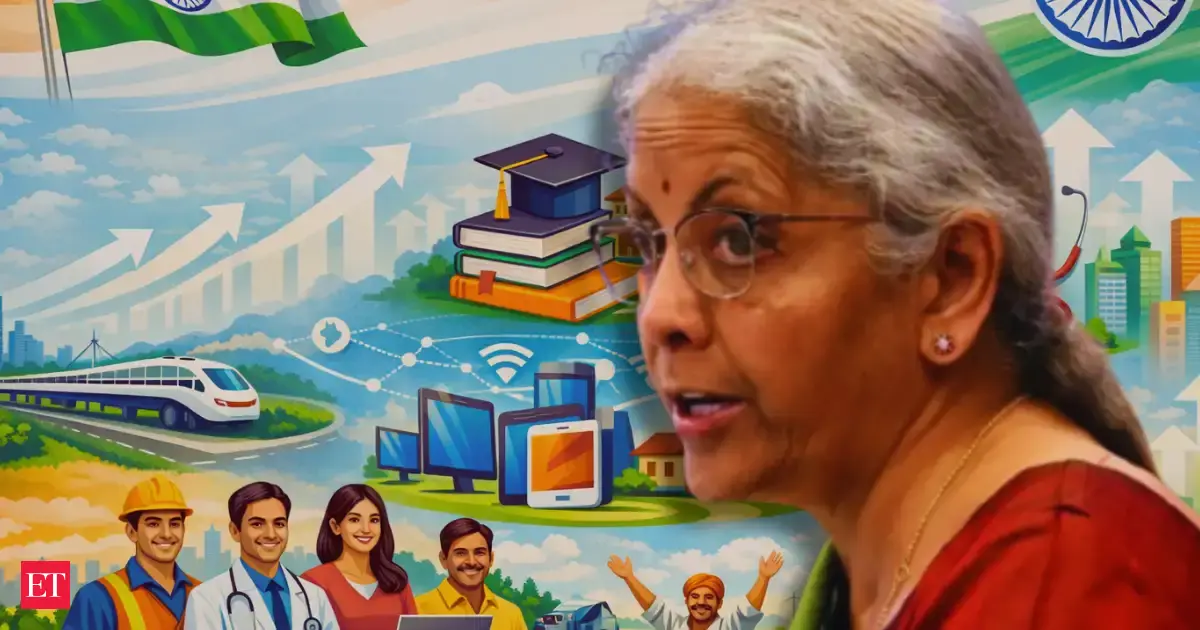
Finance Minister Nirmala Sitharaman, in Union Budget 2026-27, announced new support for the 'Orange Economy'. This initiative focuses on boosting the Animation, Visual Effects, Gaming, and Comics (AVGC) sector by establishing content creator labs in schools and colleges. This policy aims to drive employment and economic growth through creativity-led industries, making it crucial for understanding government economic strategies and sector-specific development.
Revision structure
Monthly events and exam calendar context
Static GK and one-liner notes
Quiz and mock-test revision path
Key points
Exam-ready takeaways
The announcement was made by India's Finance Minister, Nirmala Sitharaman.
The 'Orange Economy' initiative specifically targets the Animation, Visual Effects, Gaming, and Comics (AVGC) sector.
A key measure includes setting up content creator labs in schools and colleges.
The government views creativity-led sectors as crucial drivers for employment and economic growth.
Detailed analysis
Full exam-oriented breakdown
The Union Budget 2026-27, presented by Finance Minister Nirmala Sitharaman, signaled a strategic pivot towards nurturing India's 'Orange Economy', with a specific focus on the Animation, Visual Effects, Gaming, and Comics (AVGC) sector. This move is not merely an allocation of funds but a recognition of the immense potential held by creativity-led industries in driving economic growth and employment generation, especially among the youth. To truly grasp the significance of this announcement, it's essential to understand the background. The 'Orange Economy', also known as the creative economy, encompasses industries that generate intellectual capital. Globally, it's a rapidly expanding sector, fueled by digital transformation and increasing demand for diverse content. India, with its vast talent pool, rich cultural heritage, and burgeoning digital penetration, is uniquely positioned to become a global hub in this domain. The global AVGC market is projected to reach hundreds of billions of dollars, and India, despite having a significant workforce in IT and related services, has historically lagged in fully harnessing its creative potential in this niche. The government's push, therefore, is a timely intervention to capitalize on this global trend and India's demographic dividend. The core of the Budget 2026-27 announcement for the 'Orange Economy' is the establishment of 'content creator labs' in schools and colleges. This direct intervention aims to build a robust talent pipeline from the grassroots level. By integrating practical, industry-relevant training into academic curricula, these labs will equip students with the necessary skills in animation, visual effects, game design, and comic creation. This initiative moves beyond traditional vocational training, fostering a culture of innovation and entrepreneurship within educational institutions. Several key stakeholders are involved in this ambitious undertaking. The **Ministry of Finance** provides the budgetary allocation and policy direction. The **Ministry of Information & Broadcasting**, which has been a proponent of the AVGC sector, will likely play a crucial role in implementation, given its previous efforts, such as the formation of the AVGC Promotion Task Force in 2022. The **Ministry of Education** and its associated bodies will be instrumental in integrating these labs into school and college ecosystems, developing curricula, and training educators. **Educational institutions** themselves (schools, colleges, universities) are direct implementers and beneficiaries, responsible for housing and operating these labs. **Industry players** – including major AVGC studios, gaming companies, startups, and independent content creators – are critical beneficiaries who will absorb the skilled workforce and provide crucial feedback for curriculum development. Finally, **students and youth** are the ultimate beneficiaries, gaining access to cutting-edge skills and new career pathways. This policy holds immense significance for India. Economically, it promises to boost the country's GDP by diversifying its service sector exports and attracting foreign investment into the creative industries. It is a major step towards addressing youth unemployment by creating high-skill, future-ready jobs, aligning with the broader objectives of the 'Skill India Mission'. Socially, it empowers young individuals with creative skills, fostering self-expression and entrepreneurship. Strategically, by promoting Indian narratives and content globally through AVGC, it enhances India's 'soft power' and cultural diplomacy on the international stage. This initiative also reinforces the 'Digital India' vision by promoting digital content creation and consumption. Historically, the groundwork for this initiative was laid with the announcement of an AVGC Promotion Task Force in the Union Budget 2022-23. Chaired by the Secretary, Ministry of I&B, this task force submitted its report in December 2022, recommending a national AVGC policy to establish India as a global AVGC hub. The Budget 2026-27 announcement can be seen as a direct implementation of these recommendations, moving from policy formulation to concrete action. This demonstrates a sustained governmental focus on recognizing and developing specific sunrise sectors. Looking ahead, the future implications are vast. India could emerge as a leading global talent pool and outsourcing destination for AVGC services, similar to its success in the IT sector. This could lead to a thriving startup ecosystem focused on creative technologies, attracting venture capital and fostering innovation. However, challenges remain, including ensuring adequate infrastructure, protecting intellectual property rights (governed by the Copyright Act, 1957), and retaining top talent against global competition. The success of this policy will depend on effective collaboration between government, academia, and industry. From a constitutional perspective, while there isn't a direct article on the 'Orange Economy', the initiative aligns with the **Directive Principles of State Policy (DPSP)**, particularly **Article 39** (securing adequate means of livelihood), **Article 41** (right to work, to education, and to public assistance in certain cases), and **Article 43** (securing a living wage and conditions of work ensuring a decent standard of life). These articles underscore the state's role in promoting economic opportunities and improving the standard of living. Furthermore, the initiative is deeply integrated with the spirit of the **National Education Policy (NEP) 2020**, which emphasizes vocational education, skill development, multidisciplinary learning, and the integration of technology into education. The content creator labs perfectly embody NEP's vision of preparing students for the demands of the 21st-century job market and fostering creativity and critical thinking.
How to study
Turn news into exam marks
Revise monthly events by exam family instead of reading random updates.
Pair one-liners with mock tests so mistakes become the next revision list.
Keep state job pages, calendar pages and GK packs connected in one path.