

Union Budget presented was for the year 2026.
GK and monthly revision
Budget 2026: Sitharaman sets 3 ‘Kartavya’ agenda for India's growth, inclusion and reform push
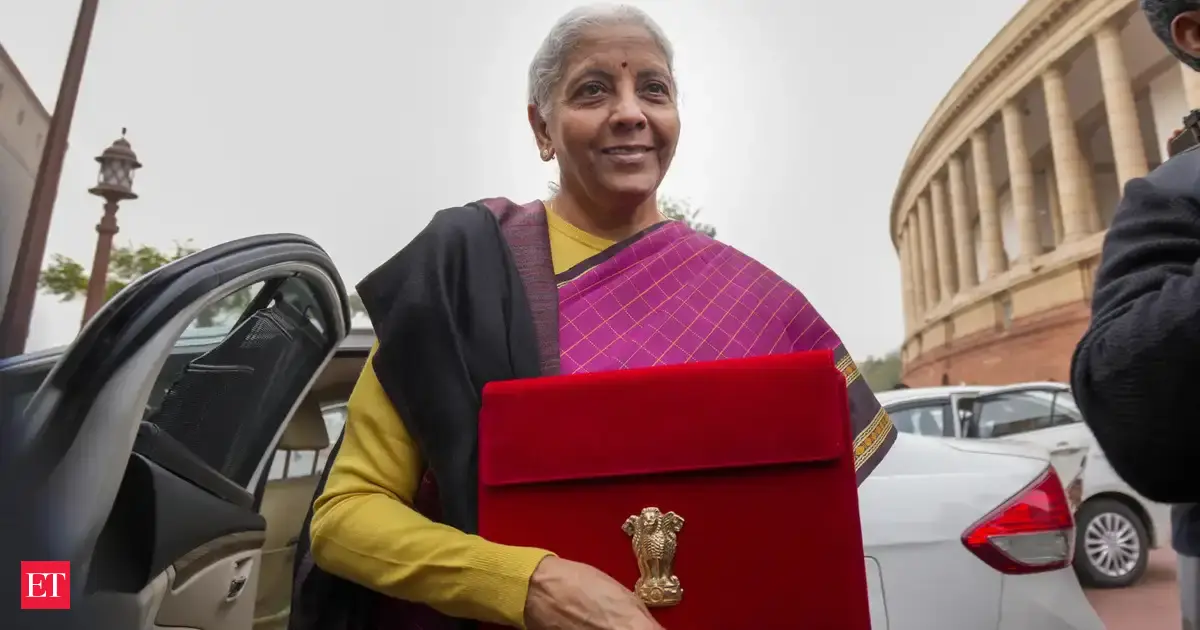
Finance Minister Nirmala Sitharaman presented the Union Budget 2026, outlining a vision focused on the poor and underprivileged. This budget introduces a three-pronged 'Kartavya' framework to guide policy, emphasizing economic growth, people-centric development, and inclusive access to opportunities. This framework is crucial for understanding the government's long-term strategy for India's economic and social development, making it a key topic for competitive exam preparation.
Revision structure
Monthly events and exam calendar context
Static GK and one-liner notes
Quiz and mock-test revision path
Key points
Exam-ready takeaways
The Union Budget 2026 was presented by Finance Minister Nirmala Sitharaman.
The guiding policy framework introduced is named 'Kartavya'.
The 'Kartavya' framework comprises three distinct prongs or aims.
The three prongs of 'Kartavya' focus on accelerating economic growth, people-centric development/capacity building, and ensuring inclusive access to opportunities.
Detailed analysis
Full exam-oriented breakdown
The Union Budget, presented annually by the Finance Minister, serves as the government's comprehensive financial statement for the upcoming fiscal year. It outlines revenue and expenditure, fiscal policies, and strategic priorities. The Union Budget 2026, presented by Finance Minister Nirmala Sitharaman, is particularly significant due to its introduction of a 'Kartavya' (duty) framework, signaling a focused and principled approach to India's economic and social development. Historically, Indian budgets have evolved significantly since independence. From the initial focus on planned development and state-led industrialization during the Nehruvian era, through the economic liberalization of 1991, to the recent emphasis on inclusive growth and digital transformation, each budget reflects the prevailing economic philosophy and challenges. The 'Kartavya' framework, meaning 'duty' or 'responsibility', marks a conceptual shift, aiming to institutionalize a sense of commitment and accountability in policy formulation, particularly towards the poor and underprivileged, as highlighted by the Finance Minister. This approach resonates with the broader 'Amrit Kaal' vision, aiming for a developed India by 2047, the centenary of its independence. What precisely is this three-pronged 'Kartavya' framework? The first 'Kartavya' is dedicated to **accelerating economic growth**. This involves continued emphasis on capital expenditure, infrastructure development (e.g., roads, railways, ports, digital infrastructure), promoting manufacturing through schemes like the Production Linked Incentive (PLI) scheme, fostering innovation, and enhancing the ease of doing business. The goal is to create a robust economic foundation that can generate wealth and employment opportunities at scale. The second 'Kartavya' focuses on **people-centric development and capacity building**. This prong emphasizes human capital formation through investments in education (aligned with the National Education Policy 2020), skill development (e.g., Skill India Mission), healthcare infrastructure, and social security nets. The objective is to empower individuals, enhance their productivity, and ensure they are active participants and beneficiaries of economic progress. The third 'Kartavya' is to ensure **inclusive access to opportunities for all**. This is crucial for addressing socio-economic disparities and ensuring that the benefits of growth reach the last mile. It involves targeted interventions for marginalized sections, women, youth, farmers, and the poor, through schemes promoting financial inclusion (e.g., Jan Dhan Yojana), housing (e.g., PM Awas Yojana), clean water (e.g., Jal Jeevan Mission), and direct benefit transfers. Key stakeholders in this budgetary process include the **Finance Ministry**, which spearheads the formulation and presentation of the budget, and other **Union Ministries** whose departmental allocations and schemes are integrated. The **NITI Aayog** plays a crucial advisory role in long-term policy formulation. **State governments** are also significant stakeholders, as central schemes often require state implementation, and fiscal federalism dictates the sharing of resources and responsibilities (as per Articles 268-281 of the Constitution, pertaining to the distribution of legislative powers and financial relations between the Union and the States, guided by the Finance Commission under Article 280). Ultimately, the **citizens of India**, particularly the poor and underprivileged, are the primary beneficiaries, and their welfare is the stated objective of this framework. Businesses, investors, and international organizations also closely watch the budget for policy direction and economic stability. This 'Kartavya' framework matters immensely for India. Economically, it aims to sustain India's position as one of the fastest-growing major economies, attracting investments and creating jobs. Socially, by focusing on people-centric development and inclusive access, it seeks to reduce poverty, improve human development indicators, and foster a more equitable society, aligning with the Directive Principles of State Policy (DPSP) in Part IV of the Constitution, particularly Articles 38 (promoting social order and minimizing inequalities), 39 (principles of policy to be followed by the State), and 41 (right to work, education, and public assistance). Politically, it reinforces the government's commitment to its welfare agenda and inclusive development. The long-term implications are profound: if successfully implemented, this framework could lay the groundwork for India to achieve its aspirational goal of becoming a developed nation by 2047, characterized by high growth, equitable distribution of wealth, and a skilled, healthy populace. Challenges will include effective implementation, inter-ministerial coordination, fiscal prudence, and adapting to global economic uncertainties. In essence, the 'Kartavya' framework is not merely a set of budgetary allocations but a guiding philosophy, aiming to instill a sense of mission and accountability in governance, thereby shaping India's socio-economic trajectory for years to come.
How to study
Turn news into exam marks
Revise monthly events by exam family instead of reading random updates.
Pair one-liners with mock tests so mistakes become the next revision list.
Keep state job pages, calendar pages and GK packs connected in one path.