

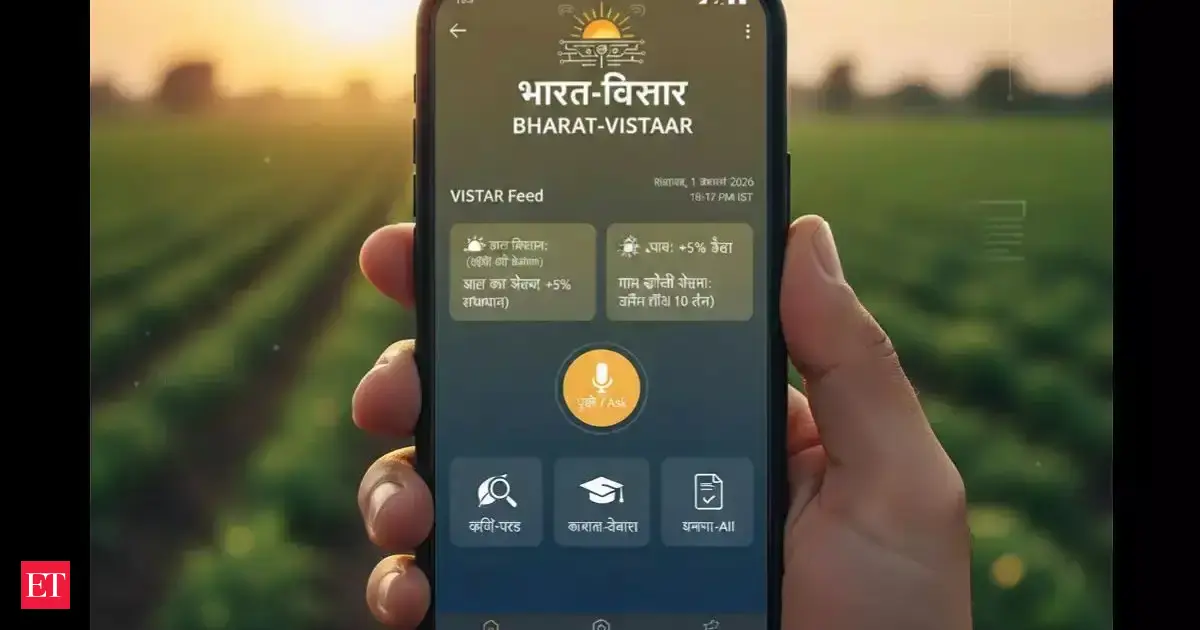
The government is launching a new initiative named 'Bharat-VISTAAR' for the agriculture sector.
GK and monthly revision
Government to launch multi-lingual AI tool Bharat-VISTAAR for agriculture sector
The Indian government is set to launch 'Bharat-VISTAAR', a multilingual AI tool designed for the agriculture sector. This initiative aims to integrate existing agricultural portals and ICAR practices to provide farmers with customized advisory support. It is significant for enhancing farm productivity, improving decision-making, reducing risks, and accelerating the adoption of precision farming, making it a crucial development for the rural economy and technological integration in agriculture.
Revision structure
Monthly events and exam calendar context
Static GK and one-liner notes
Quiz and mock-test revision path
Key points
Exam-ready takeaways
'Bharat-VISTAAR' is a multilingual Artificial Intelligence (AI) tool.
Its primary objective is to integrate various agricultural portals and practices from ICAR (Indian Council of Agricultural Research).
The tool aims to provide farmers with customized advisory support and data-driven guidance.
Expected benefits include enhanced farm productivity, better decision-making, reduced risks, and accelerated precision farming adoption.
Detailed analysis
Full exam-oriented breakdown
The Indian government's announcement of 'Bharat-VISTAAR', a multilingual AI tool for the agriculture sector, marks a significant step towards modernizing and empowering the country's vast farming community. This initiative is designed to integrate various existing agricultural portals and leverage the extensive research and best practices developed by the Indian Council of Agricultural Research (ICAR). Its core objective is to provide farmers with customized, data-driven advisory support, thereby enhancing farm productivity, improving decision-making, reducing risks, and accelerating the adoption of precision farming techniques. **Background Context:** Indian agriculture, a cornerstone of the national economy, employs over half of the country's workforce and contributes approximately 18-20% to the GDP. Despite its vital role, the sector faces myriad challenges, including climate change, fragmented landholdings, limited access to timely and accurate information, market volatility, and low productivity compared to global standards. For decades, traditional agricultural extension services have struggled to reach every farmer effectively, leading to information asymmetry. While various digital initiatives like the Kisan Suvidha app, e-NAM (National Agriculture Market), and the Soil Health Card Scheme have been launched, their impact has often been limited by lack of integration, language barriers, and limited outreach. There has been a pressing need for a unified, accessible, and intelligent platform that can synthesize information and deliver it to farmers in a personalized manner. 'Bharat-VISTAAR' emerges from this necessity, aiming to fill the gaps in information dissemination and leverage cutting-edge technology to address these long-standing issues. **Key Stakeholders Involved:** Several key players are central to the success of 'Bharat-VISTAAR'. The **Government of India**, particularly the Ministry of Agriculture & Farmers Welfare and the Ministry of Electronics & Information Technology, is the primary driver, responsible for policy formulation, funding, and overall implementation. The **Indian Council of Agricultural Research (ICAR)** is a critical knowledge partner, contributing its vast repository of scientific research, crop-specific advisories, and best practices. **Farmers** are the ultimate beneficiaries and end-users, whose adoption and feedback will determine the tool's effectiveness. **Agricultural scientists and experts** will continuously feed the AI model with updated knowledge and validate its recommendations. **Technology providers and developers** are crucial for building, maintaining, and scaling the AI platform. Additionally, **rural cooperatives and NGOs** could play a significant role in promoting awareness and facilitating the adoption of the tool among local communities. **Significance for India:** The launch of 'Bharat-VISTAAR' holds profound significance for India across economic, social, and technological dimensions. **Economically**, by providing customized advisories on crop selection, pest management, weather forecasts, and market prices, the tool can significantly boost farm productivity and profitability. This aligns with the government's long-term goal of enhancing farmers' income. It can reduce input costs through optimized resource use and mitigate risks associated with crop failure. For a sector that significantly impacts rural livelihoods, this translates into reduced rural distress and improved economic stability. **Socially**, the multilingual nature of the tool will ensure inclusivity, bridging the information gap for farmers across diverse linguistic regions. It empowers small and marginal farmers, who often lack access to expert advice, enabling them to make informed decisions. This contributes to greater food security for the nation. **Technologically**, it represents a major stride in the adoption of Artificial Intelligence in governance and public service delivery, reinforcing the 'Digital India' vision. It will accelerate the adoption of precision farming, which involves using technology to manage farms more efficiently. **Historical Context and Constitutional Provisions:** India's agricultural journey has seen transformative phases, from the Green Revolution of the 1960s and 70s, which focused on increasing production through high-yielding varieties and fertilizers, to the current emphasis on sustainable, information-driven, and farmer-centric approaches. The evolution of agricultural extension services from traditional village-level workers to digital platforms reflects this journey. Constitutionally, **Article 48** under the Directive Principles of State Policy (DPSP) mandates the State to 'organize agriculture and animal husbandry on modern and scientific lines'. 'Bharat-VISTAAR' directly aligns with this directive by promoting scientific and modern agricultural practices through AI. Furthermore, **Article 38** and **Article 39** of the DPSP, which emphasize securing a social order for the welfare of the people and equitable distribution of resources, are also relevant, as the tool aims to reduce inequalities in access to information. In the **Seventh Schedule**, 'Agriculture' falls under the State List (Entry 14), while 'Economic and social planning' is in the Concurrent List (Entry 20), highlighting the joint responsibility of central and state governments in agricultural development. Policies like the National e-Governance Plan in Agriculture (NeGPA) and the National Policy for Farmers 2007 have laid the groundwork for such digital interventions. **Future Implications:** The successful implementation of 'Bharat-VISTAAR' could pave the way for a more robust digital ecosystem in Indian agriculture. Future enhancements might include integration with IoT devices for real-time farm monitoring, drone technology for crop health assessment, and advanced remote sensing data. This could lead to hyper-localized advisories and predictive analytics, further optimizing farm management. However, challenges like ensuring digital literacy among farmers, addressing the digital divide, ensuring data privacy and security, and continuously updating the AI model with relevant, accurate data will be crucial. If successful, 'Bharat-VISTAAR' could serve as a model for other developing nations seeking to leverage AI for agricultural transformation, potentially boosting India's soft power and promoting its expertise in agri-tech innovation.
How to study
Turn news into exam marks
Revise monthly events by exam family instead of reading random updates.
Pair one-liners with mock tests so mistakes become the next revision list.
Keep state job pages, calendar pages and GK packs connected in one path.