

The Congress party launched a statewide yatra in Andhra Pradesh.
GK and monthly revision
Congress launches statewide yatra to defend MNREGA from Centre’s ‘dilution’
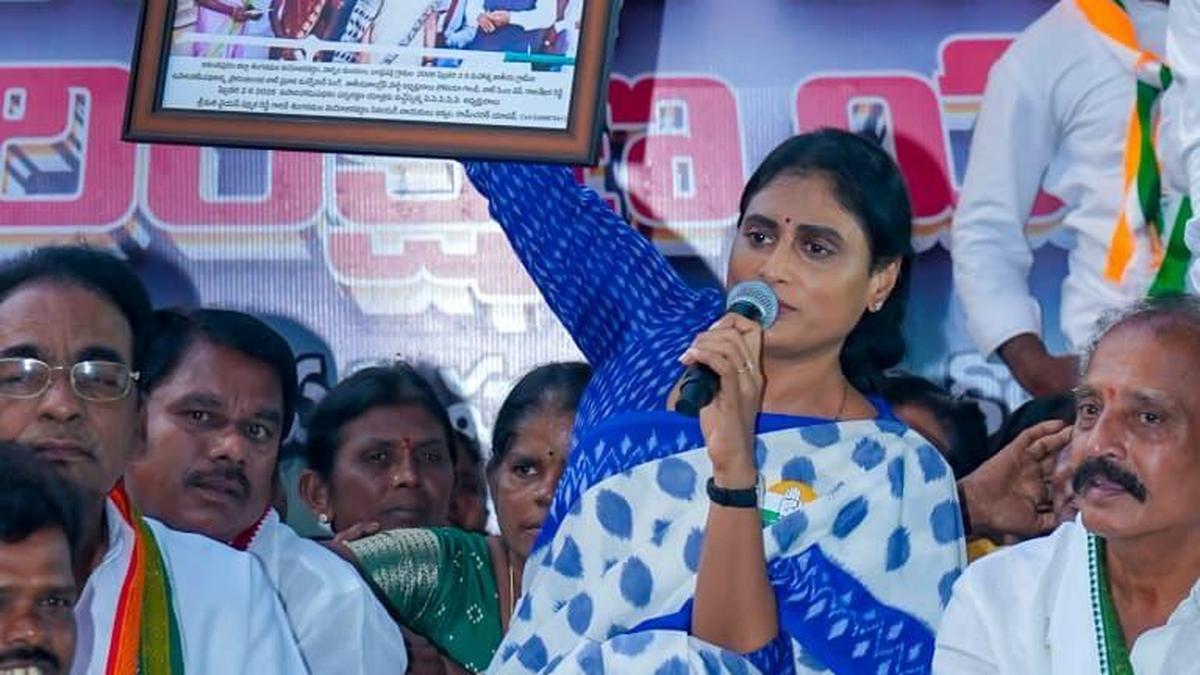
The Congress party has launched a statewide yatra in Andhra Pradesh, led by APCC president Y.S. Sharmila, to protest the alleged dilution of the Mahatma Gandhi National Rural Employment Guarantee Act (MNREGA) by the Centre. This initiative, coinciding with the 20th anniversary of the rural employment guarantee law, aims to highlight concerns that the 'VB Gram G' initiative undermines legally assured job security for millions, making it crucial for understanding social welfare policies and federal relations for competitive exams.
Revision structure
Monthly events and exam calendar context
Static GK and one-liner notes
Quiz and mock-test revision path
Key points
Exam-ready takeaways
The yatra aims to defend the Mahatma Gandhi National Rural Employment Guarantee Act (MNREGA).
APCC president Y.S. Sharmila is leading the yatra.
The protest coincides with the 20th anniversary of the rural employment guarantee law.
The 'VB Gram G' initiative is cited as weakening legally assured job security under MNREGA.
Detailed analysis
Full exam-oriented breakdown
The Mahatma Gandhi National Rural Employment Guarantee Act (MNREGA), enacted in 2005, stands as a landmark piece of social welfare legislation in India, promising a legal guarantee of 100 days of wage employment in a financial year to every rural household whose adult members volunteer to do unskilled manual work. This revolutionary act aimed to address rural poverty, mitigate distress migration, and create durable assets in rural areas. The recent statewide yatra launched by the Congress party in Andhra Pradesh, led by APCC president Y.S. Sharmila, to protest the alleged 'dilution' of MNREGA by the Centre, coinciding with the 20th anniversary of the law, brings to the forefront critical issues concerning social security, federalism, and the implementation of welfare policies. **Background Context and What Happened:** MNREGA, initially called NREGA, was notified on September 7, 2005, and launched on February 2, 2006, in 200 districts, eventually covering all rural districts of India by 2008. It is a demand-driven scheme, meaning employment must be provided within 15 days of demand, failing which unemployment allowance is payable. This legal entitlement transformed the landscape of rural employment and poverty alleviation. The current protest by the Congress party in Andhra Pradesh stems from concerns that the Central government's policies, specifically citing the 'VB Gram G' initiative (the specifics of which are not fully detailed in the article but are alleged to weaken job security), are undermining the core principles and effectiveness of MNREGA. The yatra is a political move to highlight these perceived threats to the legally assured job security of millions of rural workers, particularly in a state like Andhra Pradesh where agrarian distress can be significant. **Key Stakeholders Involved:** * **Congress Party (and APCC President Y.S. Sharmila):** As the primary opposition, they are leveraging this issue to criticize the Central government, advocate for the rural poor, and potentially strengthen their political base in Andhra Pradesh. Y.S. Sharmila's leadership indicates a strategic move to connect with grassroots issues. * **Central Government:** Accused of 'dilution,' the Centre's actions, whether through budgetary allocations, administrative changes, or new policy directives (like linking Aadhar for wage payments, delayed wage payments, or reduced person-day generation targets), are under scrutiny. The Centre's perspective is often to improve efficiency, reduce leakages, and ensure judicious use of funds. * **State Government of Andhra Pradesh:** As the implementing agency, the state government plays a crucial role. Its cooperation with the Centre and its own initiatives influence the scheme's on-ground effectiveness. The 'VB Gram G' initiative, if it's a state-level program or a central directive implemented by the state, would involve the state government directly. * **Rural Workers/Beneficiaries:** These are the most critical stakeholders. Their access to guaranteed employment, timely wage payments, and overall livelihood security is directly impacted by any changes or 'dilution' of MNREGA. Their plight forms the moral core of such protests. * **Civil Society Organizations and Activists:** Historically, these groups have been instrumental in advocating for MNREGA's proper implementation, conducting social audits, and raising concerns about any attempts to weaken the act. **Why This Matters for India:** MNREGA is more than just an employment scheme; it's a lifeline for millions. Its proper functioning is vital for: * **Poverty Alleviation and Livelihood Security:** It acts as a crucial safety net, especially during agricultural lean seasons or economic shocks, preventing distress migration and ensuring basic income. * **Rural Development:** The assets created under MNREGA (water harvesting structures, rural roads, afforestation) contribute significantly to rural infrastructure and environmental sustainability. * **Women's Empowerment:** The act mandates 33% participation for women, often exceeding this target, providing financial independence and social standing. * **Decentralization and Participatory Governance:** Gram Sabhas have a significant role in planning and monitoring works, fostering grassroots democracy. * **Federal Relations:** MNREGA is a Centrally Sponsored Scheme, where the Centre provides a significant portion of the funding (100% of unskilled wage cost and 75% of material cost) and states are responsible for implementation. Disputes over fund releases, administrative guidelines, and alleged dilutions often strain Centre-State relations, impacting cooperative federalism. **Constitutional and Policy References:** MNREGA is a legislative step towards realizing the **Directive Principles of State Policy (DPSP)** enshrined in Part IV of the Indian Constitution. Specifically: * **Article 38:** Mandates the state to secure a social order for the promotion of the welfare of the people. * **Article 39(a):** Directs the state to ensure that citizens, men and women equally, have the right to an adequate means of livelihood. * **Article 41:** Enjoins the state, within the limits of its economic capacity and development, to make effective provision for securing the right to work, to education, and to public assistance in cases of unemployment, old age, sickness, and disablement. MNREGA is a direct embodiment of the spirit of Article 41, creating a legal right to work in rural areas. While the 'Right to Work' is not a fundamental right, MNREGA, through legislation, provides a statutory guarantee for a certain number of days of work, making it a powerful tool for social justice. **Future Implications:** The ongoing protests could have several implications. Politically, they might galvanize opposition parties and put pressure on the Central government to re-evaluate its policies concerning MNREGA. If the alleged 'dilution' continues, it could lead to increased rural distress, a decline in asset creation, and a weakening of the social safety net. Conversely, if the protests compel a re-strengthening of the scheme, it could reaffirm India's commitment to social welfare and inclusive growth. The debate around MNREGA also ties into broader discussions about fiscal prudence versus social spending, the efficacy of direct benefit transfers, and the role of government in ensuring basic livelihoods. The success or failure of such a vital scheme has direct bearings on India's progress towards Sustainable Development Goals, particularly those related to poverty eradication and decent work.
How to study
Turn news into exam marks
Revise monthly events by exam family instead of reading random updates.
Pair one-liners with mock tests so mistakes become the next revision list.
Keep state job pages, calendar pages and GK packs connected in one path.