

Solicitor General Tushar Mehta presented arguments before the Supreme Court Bench.
GK and monthly revision
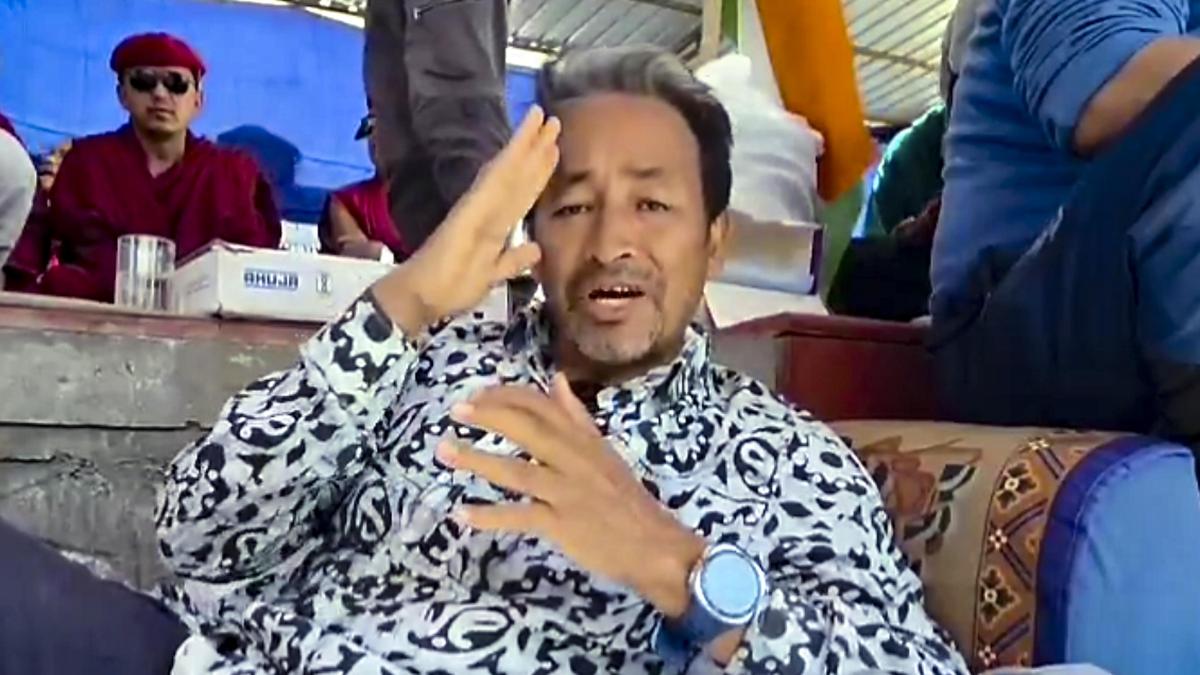
Sonam Wangchuk incited violence by referring to Nepal, Bangladesh and Arab Spring: Centre tells SC
The Centre, represented by Solicitor General Tushar Mehta, informed the Supreme Court that activist Sonam Wangchuk incited violence. The allegations include references to Nepal, Bangladesh, and the Arab Spring, alongside instigation for self-immolation and non-cooperation during external aggression. This case is crucial for competitive exams as it touches upon fundamental rights, specifically freedom of speech (Article 19), and its reasonable restrictions in the context of public order and national security, highlighting significant legal proceedings.
Revision structure
Monthly events and exam calendar context
Static GK and one-liner notes
Quiz and mock-test revision path
Key points
Exam-ready takeaways
The arguments were made against activist Sonam Wangchuk.
Wangchuk was accused of inciting violence by referring to Nepal, Bangladesh, and the Arab Spring.
Allegations also included instigation for self-immolation.
He was further accused of promoting non-cooperation in case of an external aggression.
Detailed analysis
Full exam-oriented breakdown
The Supreme Court's hearing on the allegations against activist Sonam Wangchuk, where the Centre accused him of inciting violence, brings to the forefront critical aspects of India's democratic framework, particularly the delicate balance between freedom of speech and national security. This case is not merely about an individual but reflects broader tensions regarding dissent, regional aspirations, and the limits of expression in a robust democracy. **Background Context:** Sonam Wangchuk, a renowned education reformist and environmental activist, has been at the forefront of a movement demanding constitutional safeguards for Ladakh, specifically its inclusion under the Sixth Schedule. Following the abrogation of Article 370 and Article 35A on August 5, 2019, the erstwhile state of Jammu and Kashmir was bifurcated into two Union Territories: Jammu and Kashmir, and Ladakh. While the move was aimed at better governance and integration, it triggered concerns in Ladakh about the preservation of its unique ecological, cultural, and demographic identity. Activists like Wangchuk fear that without constitutional protection, the region's fragile environment and indigenous population could be vulnerable to exploitation and demographic change. His recent protests, including hunger strikes, were specifically aimed at pressuring the government to grant Ladakh Sixth Schedule status, which provides for autonomous administrative divisions for tribal areas in certain states, allowing for greater control over land, forests, and cultural practices. **What Happened:** During a Supreme Court hearing, Solicitor General Tushar Mehta, representing the Central Government, argued that Sonam Wangchuk's statements constituted incitement to violence. The specific allegations include references to events in Nepal, Bangladesh, and the 'Arab Spring' – historical instances of significant political upheaval and social unrest. Furthermore, Wangchuk was accused of instigating self-immolation and advocating non-cooperation in the event of external aggression. These charges suggest that the government perceives his rhetoric as crossing the line from legitimate protest to a call for unlawful actions that could destabilize public order and potentially jeopardize national security. **Key Stakeholders Involved:** 1. **Sonam Wangchuk:** The primary figure, an acclaimed innovator and activist, advocating for Ladakh's environmental protection and constitutional safeguards. His actions represent the voice of regional aspirations and environmental concerns. His role highlights the power of individual activism in a democracy. 2. **The Central Government:** Represented by the Solicitor General, the government's stance reflects its responsibility to maintain public order, national security, and territorial integrity. Their argument underscores the state's prerogative to impose reasonable restrictions on fundamental rights. 3. **The Supreme Court of India:** As the guardian of the Constitution, the apex court's role is crucial in interpreting the law, balancing fundamental rights (like freedom of speech under Article 19(1)(a)) against the reasonable restrictions permitted under Article 19(2) (such as public order, morality, national security, and incitement to an offense). The court's judgment will set an important precedent. 4. **People of Ladakh:** The ultimate beneficiaries or affected parties of the ongoing debate regarding Ladakh's future and constitutional status. Their collective aspirations are being voiced by activists like Wangchuk. **Why This Matters for India:** This case has profound implications for Indian democracy. Firstly, it tests the limits of **freedom of speech and expression (Article 19(1)(a))**. Where does legitimate dissent end and incitement to violence begin? The Supreme Court's interpretation will clarify the boundaries of permissible speech, especially when it touches upon sensitive issues like national security and public order. Secondly, it highlights the ongoing debate surrounding **federalism and regional aspirations**. The demand for Sixth Schedule status for Ladakh reflects a broader trend of regions seeking greater autonomy and protection of their distinct identities within the Indian Union. Thirdly, it underscores the **role of activism and civil society** in holding the government accountable and advocating for policy changes. Any adverse ruling could have a chilling effect on legitimate protest and dissent. Lastly, the references to external events like the 'Arab Spring' indicate the government's concern about narratives that could potentially be perceived as destabilizing or encouraging secessionist tendencies, thereby touching upon **national security and internal cohesion**. **Historical Context:** The historical context is rooted in the unique administrative and cultural status of Jammu and Kashmir. For decades, Article 370 granted special status to J&K, which included Ladakh. The abrogation of Article 370 and 35A in 2019, and the subsequent reorganisation into two Union Territories, was a monumental constitutional change. While the government argued it would foster development and integration, many in Ladakh felt a loss of constitutional protection that existed previously and now seek new safeguards, leading to the demand for the Sixth Schedule. The Sixth Schedule, originally designed for tribal areas in Northeast India (Assam, Meghalaya, Tripura, Mizoram), provides for Autonomous District Councils and Regional Councils with powers over land, forest, water, agriculture, and local customs, aiming to preserve tribal identity and self-governance. **Future Implications:** 1. **Judicial Precedent:** The Supreme Court's ruling will establish a significant precedent regarding the interpretation of 'incitement' and the reasonable restrictions on freedom of speech. This will guide future cases involving activism and protest. 2. **Space for Dissent:** The outcome could either reaffirm or curtail the space available for activists to voice strong dissent without fear of severe legal repercussions. 3. **Ladakh's Future:** The ongoing legal and political pressure might influence the government's decision regarding Ladakh's Sixth Schedule demand, impacting the region's governance and development trajectory. 4. **National Security Doctrine:** The government's emphasis on external references and non-cooperation might signal a stricter approach to narratives perceived as detrimental to national security, potentially influencing future policy and legal frameworks related to dissent. **Related Constitutional Articles, Acts, or Policies:** * **Article 19(1)(a):** Guarantees the right to freedom of speech and expression to all citizens. * **Article 19(2):** Lays down the reasonable restrictions on freedom of speech and expression, including in the interests of the sovereignty and integrity of India, security of the State, friendly relations with foreign States, public order, decency or morality, or in relation to contempt of court, defamation or incitement to an offence. * **Sixth Schedule:** Deals with the administration of tribal areas in the states of Assam, Meghalaya, Tripura, and Mizoram, providing for Autonomous District Councils (ADCs). * **Jammu and Kashmir Reorganisation Act, 2019:** The parliamentary act that bifurcated the state of J&K into two Union Territories. * **Unlawful Activities (Prevention) Act (UAPA), 1967:** While not explicitly mentioned as a charge, discussions around 'inciting violence' and 'national security' often invoke the principles behind UAPA, which deals with terrorist and unlawful activities. The broad interpretation of 'unlawful activity' under UAPA has been a subject of debate regarding its impact on civil liberties.
How to study
Turn news into exam marks
Revise monthly events by exam family instead of reading random updates.
Pair one-liners with mock tests so mistakes become the next revision list.
Keep state job pages, calendar pages and GK packs connected in one path.