

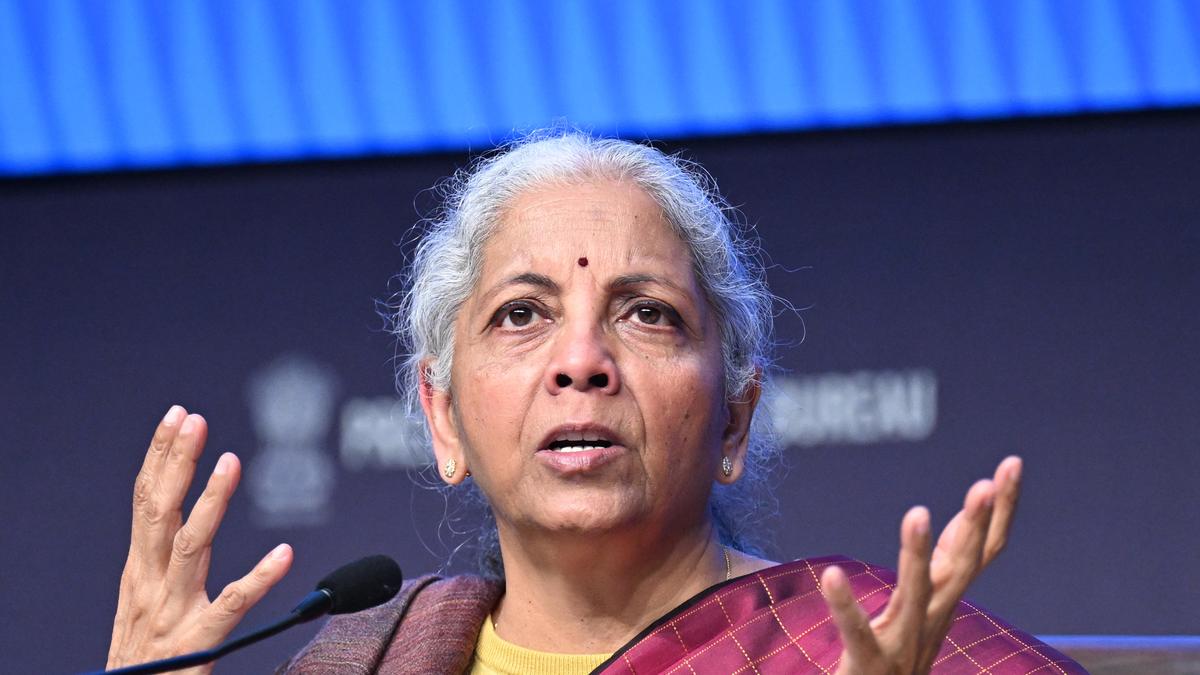
Union Finance Minister Nirmala Sitharaman made the statement regarding cess utilization.
GK and monthly revision
Union Budget 2026: No influence of issues with U.S. in customs duty cuts, says Nirmala Sitharaman
The Finance Minister, Nirmala Sitharaman, stated that the Centre is now utilizing cess proceeds, traditionally an exclusive central domain, for subjects falling under the States' list of responsibilities. This marks a significant development in fiscal federalism and resource distribution. It enables central funds to address state-specific issues, which is crucial for understanding inter-governmental financial relations for competitive exams, particularly concerning public finance and Centre-State fiscal autonomy.
Revision structure
Monthly events and exam calendar context
Static GK and one-liner notes
Quiz and mock-test revision path
Key points
Exam-ready takeaways
The Centre has begun using cess proceeds for matters on the States’ List of responsibilities.
Cess proceeds are traditionally considered the exclusive domain of the Central government.
This development signifies a shift in India's fiscal federalism and resource allocation.
The statement was made in the context of discussions related to the Union Budget 2026.
Detailed analysis
Full exam-oriented breakdown
The statement by Union Finance Minister Nirmala Sitharaman, indicating the Centre's decision to utilize cess proceeds for subjects falling under the States' List of responsibilities, marks a significant juncture in India's fiscal federalism. Traditionally, cesses are levied for specific purposes and are not part of the divisible pool of taxes that the Union government shares with the states, as mandated by the Finance Commission under Article 280 of the Constitution. This distinct characteristic has often led to debates, with states arguing that an increased reliance on cesses reduces their share in central tax revenues, thereby impacting their fiscal autonomy. To understand the gravity of this development, let's first delve into the background. Indian fiscal federalism is a complex system outlined primarily in Part XII of the Constitution (Articles 264-300A), detailing the distribution of financial powers between the Centre and states. Taxes are broadly categorized into those exclusively levied by the Centre (Union List), states (State List), and those where the Centre levies but states collect and appropriate (Article 268) or where the Centre levies and collects but assigns to states (Article 269). Cesses and surcharges, however, fall under Article 271, allowing the Parliament to increase duties or taxes for specific purposes, and crucially, the proceeds of such cesses are not shared with the states. This has historically been a point of contention, especially since the 14th Finance Commission (2015-2020) significantly increased the states' share in the divisible pool to 42%, making the Centre's reliance on non-shareable cesses a mechanism to maintain its fiscal space. The current announcement signifies a departure from this traditional approach. The Centre is now actively deciding to channel these traditionally exclusive funds towards areas that are constitutionally under the purview of state governments, such as public health, sanitation, agriculture, education, and law and order. This move has several key stakeholders. The **Central Government**, particularly the Ministry of Finance, is the primary driver, aiming to address specific national priorities that often require state-level implementation. **State Governments** are the direct beneficiaries and implementers of schemes funded by these cess proceeds. Their cooperation and capacity for efficient utilization will be crucial. The **Finance Commission**, though not directly involved in this specific allocation, plays a foundational role by shaping the overall framework of Centre-State financial relations through its recommendations on tax devolution. Finally, **Parliament** approves the Union Budget and the imposition of cesses, thus providing the legislative backing for these financial mechanisms. This development holds profound significance for India. Firstly, it represents a new dimension of **cooperative federalism**. While cesses are not shared, their utilization for state subjects can be seen as the Centre taking direct responsibility to fund critical areas that might otherwise struggle with adequate state funding. This could lead to better-resourced programs in vital sectors like health (e.g., Ayushman Bharat) or education (e.g., Sarva Shiksha Abhiyan), which are primarily state subjects but have national implications. Secondly, it could potentially address the **fiscal imbalances** faced by some states, allowing for targeted financial assistance without altering the overall tax devolution formula. However, it also raises questions about **state autonomy**. While receiving funds is beneficial, the Centre's decision to allocate cess proceeds to specific state subjects might be perceived by some states as an encroachment on their decision-making power regarding their own priorities and spending. It could influence state policy choices to align with central funding objectives, potentially leading to a 'conditionality' of funds, even if indirect. Historically, the debate around the Centre's use of cesses has been ongoing. Various Finance Commissions have commented on the need for transparency and the eventual merger of cesses into the general tax pool to enhance the divisible pool. The 15th Finance Commission also highlighted the rising share of cesses and surcharges in the gross tax revenue, advocating for a reduction. This new policy, while still utilizing cesses, redirects their benefit to state-level responsibilities, potentially mitigating some of the previous criticisms about states being deprived of funds. Looking ahead, this move could lead to a more direct and perhaps more efficient funding mechanism for national priority programs implemented by states. However, it will necessitate robust mechanisms for consultation between the Centre and states, transparent allocation criteria, and stringent accountability frameworks to ensure optimal utilization of funds and prevent any perception of central overreach. The success of this approach will depend on fostering genuine partnership rather than a top-down allocation, ensuring that the spirit of cooperative federalism is truly upheld. Relevant constitutional articles include **Article 270**, which deals with the taxes levied and collected by the Union and distributed between the Union and the States, and **Article 271**, which explicitly states that surcharges and cesses are not part of this distribution. The **Seventh Schedule** of the Constitution clearly delineates subjects into Union, State, and Concurrent Lists, making the distinction between central and state responsibilities clear. This announcement impacts the financial dynamics related to subjects primarily listed under the State List.
How to study
Turn news into exam marks
Revise monthly events by exam family instead of reading random updates.
Pair one-liners with mock tests so mistakes become the next revision list.
Keep state job pages, calendar pages and GK packs connected in one path.