

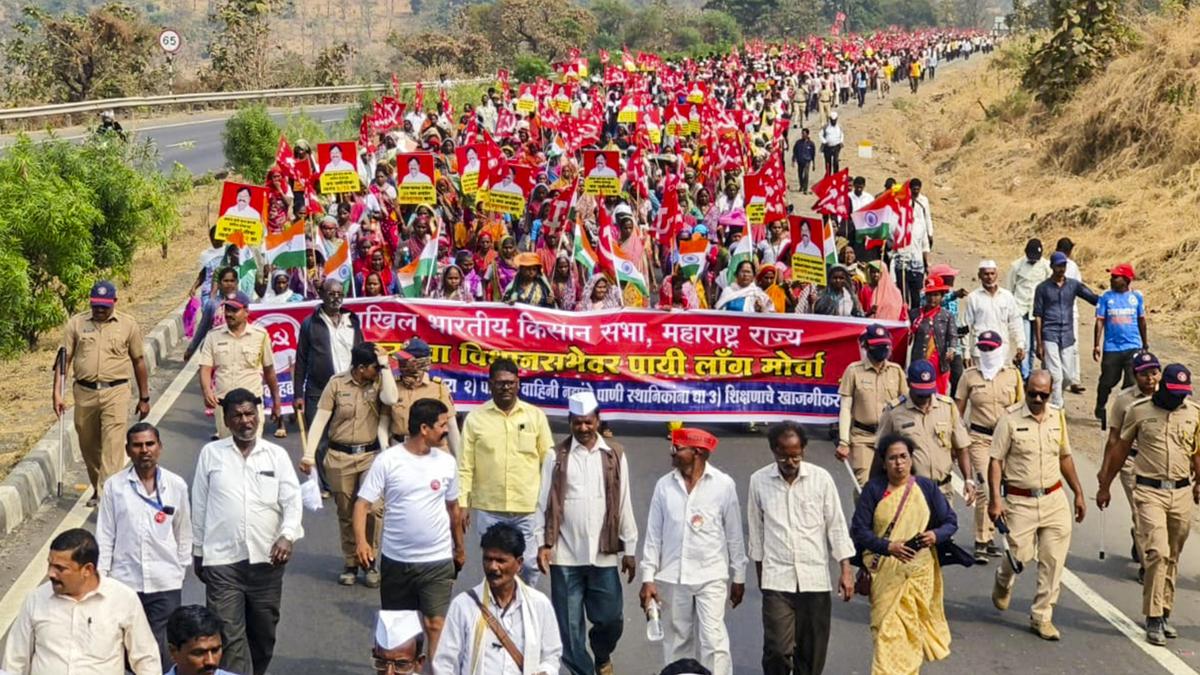
Thousands of tribals are protesting in Maharashtra regarding their land rights.
GK and monthly revision
Why are tribals protesting in Maharashtra? | Explained
Thousands of tribals in Maharashtra are protesting over long-pending land rights issues and concerns regarding the implementation of the Forest Rights Act (FRA), 2006. These protests highlight the ongoing struggle for statutory rights of indigenous communities over forest land and resources. This issue is crucial for competitive exams, covering social justice, governance, and tribal rights.
Revision structure
Monthly events and exam calendar context
Static GK and one-liner notes
Quiz and mock-test revision path
Key points
Exam-ready takeaways
The primary concern is the inadequate implementation of the Forest Rights Act (FRA), officially known as The Scheduled Tribes and Other Traditional Forest Dwellers (Recognition of Forest Rights) Act, 2006.
A central demand of the protesting tribal communities is the recognition and securing of their long-pending land rights.
Concerns include delays and deficiencies in processing claims and granting titles under the Forest Rights Act, 2006.
These protests underscore the broader struggle of indigenous communities for their statutory rights over forest land and resources.
Detailed analysis
Full exam-oriented breakdown
The recent protests by thousands of tribal communities in Maharashtra over land rights and the implementation of the Forest Rights Act (FRA), 2006, underscore a deep-seated historical injustice and ongoing struggle for statutory recognition. These demonstrations are not isolated incidents but reflect a nationwide pattern of tribal grievances concerning their ancestral lands and traditional livelihoods. Historically, tribal communities in India have lived in harmony with forests, depending on them for sustenance, culture, and economic activities. However, colonial forest policies, notably the Indian Forest Act of 1927, dispossessed them of their traditional rights, declaring forests as state property and tribals as 'encroachers.' Post-independence, despite constitutional safeguards, this legacy largely continued, with conservation efforts often leading to further displacement and marginalization of forest dwellers. This historical context of alienation and lack of formal recognition for their rights laid the groundwork for continuous struggles. What happened in Maharashtra is a manifestation of the inadequate and often flawed implementation of a landmark legislation designed to correct these historical wrongs: The Scheduled Tribes and Other Traditional Forest Dwellers (Recognition of Forest Rights) Act, 2006, commonly known as the FRA. The Act aims to recognize and vest forest rights and occupation in forest land to forest-dwelling Scheduled Tribes and Other Traditional Forest Dwellers (OTFDs) who have been residing in such forests for generations. It grants both Individual Forest Rights (IFR) for cultivation and habitation, and Community Forest Rights (CFR) over common forest resources, including Minor Forest Produce (MFP), grazing, and traditional intellectual property. Crucially, the Act empowers the Gram Sabha (village assembly) to initiate the process of determining the nature and extent of forest rights. The protests in Maharashtra highlight several critical concerns: delays in processing claims, arbitrary rejection of valid claims, lack of awareness and capacity among implementing agencies, and the continued harassment by forest department officials. Tribal communities demand the swift and proper recognition of their IFRs and CFRs, ensuring their control over forest resources and participation in forest governance. They also seek the implementation of habitat rights for Particularly Vulnerable Tribal Groups (PVTGs), a special provision under the FRA. Key stakeholders in this issue include the tribal communities themselves, who are the primary rights holders and beneficiaries. The State Government of Maharashtra, through its various departments (Tribal Development, Forest, Revenue), is responsible for the ground-level implementation of the FRA. The Central Government, particularly the Ministry of Tribal Affairs, oversees the Act's implementation and provides guidelines. The Forest Department, often operating under an outdated conservation paradigm, sometimes clashes with the rights-based approach of the FRA. Civil society organizations and NGOs play a vital role in mobilizing, educating, and advocating for tribal rights. This issue holds immense significance for India. Firstly, it is a matter of social justice, addressing the historical marginalization of indigenous communities. Secure land rights are fundamental to tribal dignity, livelihood, and cultural preservation. Secondly, it is critical for environmental conservation; studies show that communities with secure forest rights often prove to be the most effective custodians of forests. Thirdly, it impacts governance and federalism, testing the capacity of state governments to implement central legislation effectively and the extent of local self-governance envisioned by the PESA Act, 1996, which empowers Gram Sabhas in Scheduled Areas. Unresolved land disputes and denial of rights can also fuel social unrest and, in some regions, contribute to the roots of Naxalism. Several constitutional provisions underpin tribal rights. Article 244 deals with the administration of Scheduled Areas and tribal areas, while the Fifth Schedule provides for the administration and control of Scheduled Areas and Scheduled Tribes, granting special powers to states and the Governor. Article 46 mandates the state to promote the educational and economic interests of Scheduled Castes, Scheduled Tribes, and other weaker sections and to protect them from social injustice and all forms of exploitation. Furthermore, the broader interpretation of Article 21 (Right to Life and Personal Liberty) by the Supreme Court often includes the right to livelihood, dignity, and a clean environment, all of which are intrinsically linked to tribal land rights. Looking ahead, the future implications are significant. Effective implementation of the FRA could empower millions, reduce poverty, and strengthen democratic decentralization at the grassroots level. It could also lead to more sustainable forest management practices through community participation. Conversely, continued neglect could exacerbate social inequalities, lead to increased conflicts over natural resources, and undermine the state's legitimacy among its most vulnerable citizens. The resolution of these protests will depend on a concerted effort by state and central governments to fast-track claims, address systemic bottlenecks, and ensure the spirit of the FRA is upheld, not just its letter.
How to study
Turn news into exam marks
Revise monthly events by exam family instead of reading random updates.
Pair one-liners with mock tests so mistakes become the next revision list.
Keep state job pages, calendar pages and GK packs connected in one path.