

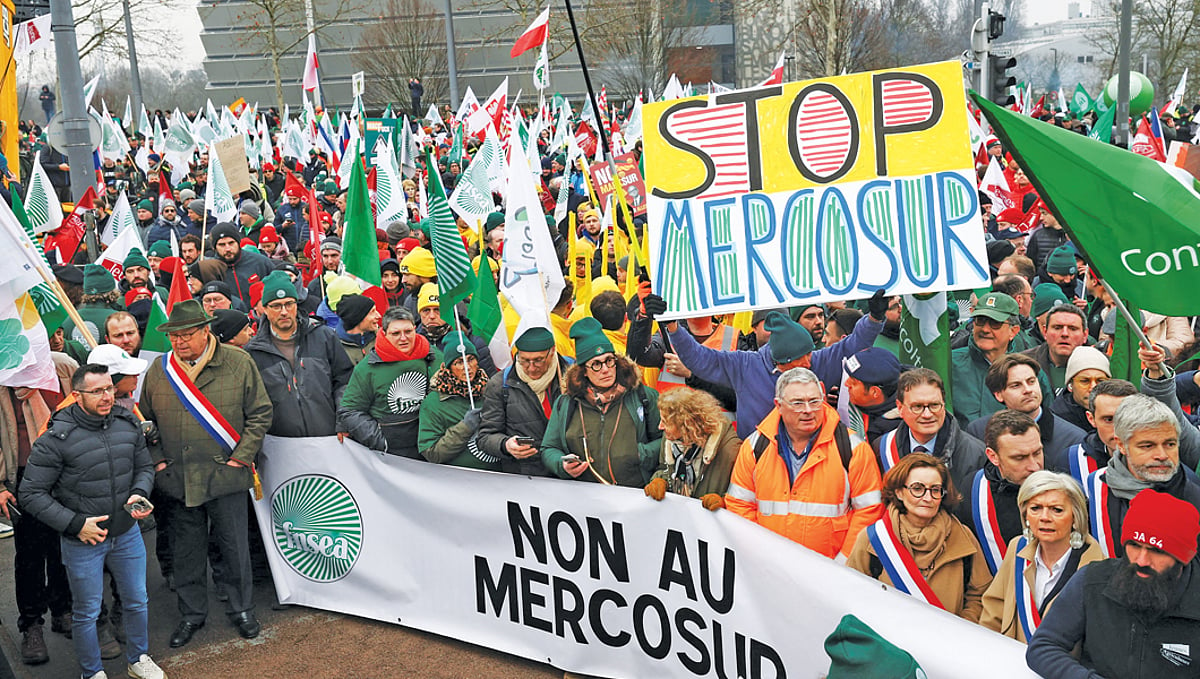
European farmers are protesting the EU-Mercosur free trade agreement due to fears of increased competition from cheaper agricultural imports.
GK and monthly revision
Competing concerns
The EU-Mercosur free trade agreement has sparked widespread protests among European farmers. Farmers are concerned about the potential influx of cheaper agricultural products, particularly beef and poultry, from Mercosur countries (Argentina, Brazil, Paraguay, and Uruguay). They fear that these imports will undermine their livelihoods, as Mercosur producers often operate under less stringent environmental and animal welfare regulations and have lower production costs. The agreement, which aims to boost trade and investment between the two blocs, is seen by farmers as a threat to their economic stability and a potential rollback of environmental standards within the EU. The protests highlight a significant conflict between the EU's trade liberalization goals and the concerns of its agricultural sector regarding fair competition and the preservation of European farming standards.
Revision structure
Monthly events and exam calendar context
Static GK and one-liner notes
Quiz and mock-test revision path
Key points
Exam-ready takeaways
Concerns include the potential impact on livelihoods, lower production costs in Mercosur countries, and differing environmental/animal welfare standards.
The agreement aims to boost trade but faces significant opposition from the EU's agricultural sector.
Protests highlight the tension between trade liberalization and the protection of domestic agricultural interests.
Detailed analysis
Full exam-oriented breakdown
The EU-Mercosur Free Trade Agreement (FTA), an ambitious pact between two major economic blocs, has been in the making for over two decades, reaching an agreement in principle in June 2019. This agreement aims to create one of the world's largest free trade areas, covering a population of nearly 780 million people and a quarter of global GDP. The European Union, a 27-member bloc, sought access to Mercosur's raw materials, agricultural products, and a growing market for its industrial goods and services. Mercosur, comprising Argentina, Brazil, Paraguay, and Uruguay (with Bolivia in accession), conversely sought access to the EU's vast consumer market for its agricultural exports, particularly beef, poultry, sugar, and ethanol, alongside industrial goods and technology. The agreement, however, has faced significant hurdles to ratification, primarily due to intense opposition from European farmers and environmental groups. European farmers fear a deluge of cheaper agricultural imports from Mercosur countries, arguing that these products are often produced under less stringent environmental, social, and food safety standards. This perceived 'unfair' competition threatens to undermine the EU's own Common Agricultural Policy (CAP) and the livelihoods of European farmers, who adhere to some of the highest standards globally. Countries like France, Ireland, and Austria, with strong agricultural lobbies, have been particularly vocal in their opposition, threatening to veto the deal. Environmental organizations have raised alarms about the potential for the agreement to exacerbate deforestation in the Amazon rainforest, particularly driven by increased demand for beef and soy cultivation in Mercosur nations. They also point to the use of pesticides and production methods in some Mercosur countries that are banned in the EU, raising concerns about consumer health and environmental degradation. The EU's own ambitious climate goals, enshrined in its European Green Deal and Farm to Fork strategy, appear to be at odds with the potential environmental impact of the trade deal, creating a significant policy dilemma for the EU Commission and member states. For India, the EU-Mercosur pact offers crucial lessons and implications. As India actively pursues its own set of Free Trade Agreements (FTAs) with major economies like the UK, EU, and Australia, the challenges faced by the EU-Mercosur deal highlight the complexities of balancing trade liberalization with domestic sensitivities, particularly in the agricultural sector. India's agricultural sector, a significant employer and contributor to its GDP, is often vulnerable to import surges. The concerns of European farmers about cheaper imports and differing standards resonate with potential challenges for Indian farmers in future FTAs. India’s trade policy, therefore, must meticulously navigate the protection of its domestic agricultural interests while seeking market access for its goods and services globally. Furthermore, the increasing emphasis on environmental, social, and governance (ESG) standards in international trade agreements, as seen in the EU-Mercosur negotiations, will undoubtedly influence India's own trade negotiations and its commitment to sustainable development goals. Historically, the evolution of FTAs has moved beyond mere tariff reductions to encompass broader areas like services, intellectual property, labor, and environment. The EU-Mercosur pact signifies this shift, where 'responsible trade' with robust sustainability clauses is increasingly demanded. This is a departure from the earlier 'free trade at all costs' approach. The future of the EU-Mercosur agreement remains uncertain. Its ratification hinges on addressing the concerns of various stakeholders, possibly through additional protocols or stronger enforcement mechanisms for environmental and social standards. The outcome could set a significant precedent for future EU trade deals, potentially making environmental and climate conditionalities a non-negotiable aspect. Globally, this reflects a growing protectionist sentiment and the difficulty of forging comprehensive trade deals in an era of heightened geopolitical complexities and climate urgency. From an Indian constitutional perspective, while the EU-Mercosur pact is an international agreement, its implications for India relate to how similar trade agreements would be handled domestically. **Article 253** of the Indian Constitution empowers Parliament to make laws for implementing international treaties, agreements, and conventions. Any major trade agreement India enters into, especially one impacting agriculture or other sensitive sectors, would require careful parliamentary scrutiny and potentially enabling legislation. Furthermore, **Entry 14 of the Union List (Seventh Schedule)** grants the Union government exclusive power over 'entering into treaties and agreements with foreign countries and implementing of treaties, agreements and conventions with foreign countries.' India's Foreign Trade Policy, governed by the Foreign Trade (Development and Regulation) Act, 1992, would be the operational framework for implementing such agreements, always keeping in mind the welfare of its vast agricultural population and national food security objectives.
How to study
Turn news into exam marks
Revise monthly events by exam family instead of reading random updates.
Pair one-liners with mock tests so mistakes become the next revision list.
Keep state job pages, calendar pages and GK packs connected in one path.