

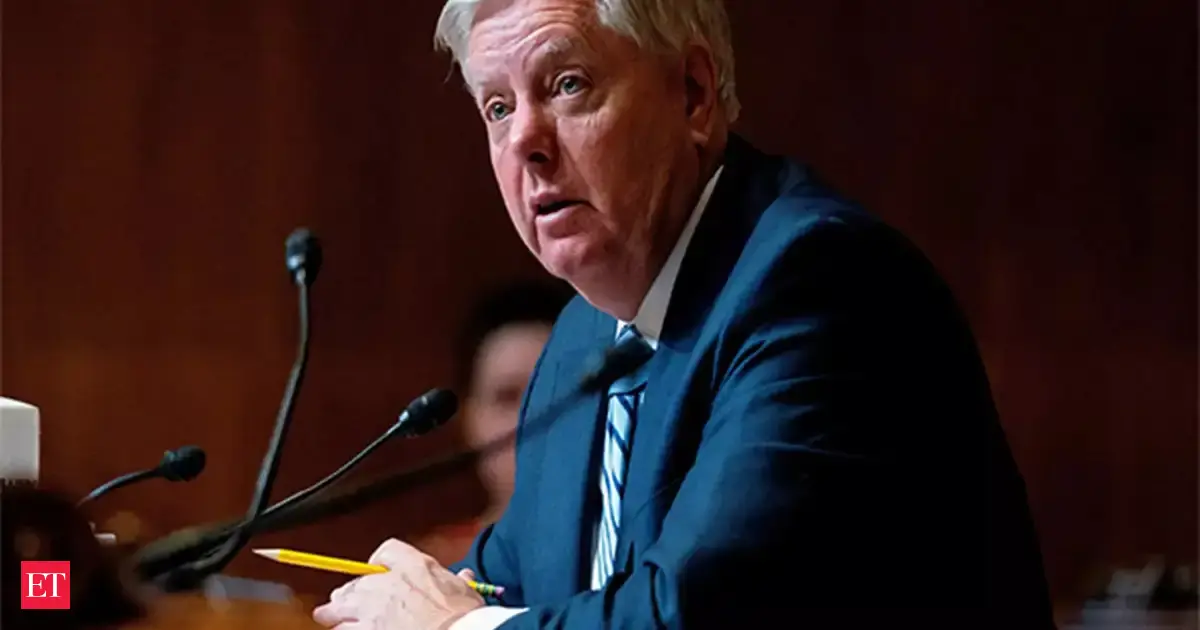
US Senator Lindsey Graham claimed India "earned" a reduction in tariffs.
GK and monthly revision
India "earned" tariff relief by recalibrating Russian oil purchases, claims US Senator Graham
US Senator Lindsey Graham claimed India "earned" tariff relief under a new India-US trade deal, attributing it to New Delhi's decreased Russian oil purchases amidst the Ukraine war. This statement underscores the intricate link between geopolitical events, energy policy, and international trade negotiations. It is significant for competitive exams to understand evolving global power dynamics, India's strategic autonomy, and its economic diplomacy.
Revision structure
Monthly events and exam calendar context
Static GK and one-liner notes
Quiz and mock-test revision path
Key points
Exam-ready takeaways
The tariff reduction is under a newly announced India-US trade deal.
Senator Graham linked this relief to India's decrease in Russian oil purchases.
The context for the decrease in Russian oil purchases is the ongoing war in Ukraine.
This development highlights the geopolitical implications of India's energy and trade policies.
Detailed analysis
Full exam-oriented breakdown
The statement by US Senator Lindsey Graham, linking India's tariff relief to its recalibration of Russian oil purchases, unveils a fascinating intersection of geopolitics, energy security, and international trade. To truly grasp its significance, one must delve into the intricate layers of background, key players, and future implications. **Background Context: The Geopolitics of Energy and Conflict** The genesis of this discussion lies in the Russia-Ukraine conflict, which escalated dramatically in February 2022. Following Russia's invasion, Western nations, led by the United States and the European Union, imposed stringent sanctions on Russia, aiming to cripple its economy and limit its war-fighting capabilities. A key component of these sanctions was targeting Russia's lucrative energy exports, particularly oil and gas. The G7 nations, alongside the EU and Australia, introduced a price cap mechanism on Russian seaborne crude oil in December 2022, aiming to reduce Russia's oil revenues while ensuring a stable global supply. India, a major energy importer, found itself in a unique position. With Western sanctions creating a surplus of discounted Russian crude oil, India significantly increased its purchases. This move was driven primarily by economic considerations and national energy security, as discounted oil helped cushion India from rising global energy prices and inflation. India maintained its stance that its energy purchases were based on its national interest and not in violation of any international laws, simultaneously advocating for dialogue and peace in Ukraine. This strategic autonomy, however, was not without scrutiny from Western powers, especially the US, which sought a united front against Russia. **What Happened: A Diplomatic Acknowledgment of Strategic Shifts** Senator Graham's statement suggests a shift in perception, if not policy, from the US side. He claimed that India "earned" tariff relief under a "newly announced India-US trade deal" because of a decrease in Russian oil purchases. While the specific "trade deal" he refers to might be a series of targeted tariff reductions or an outcome of ongoing trade negotiations rather than a comprehensive Free Trade Agreement (FTA), the underlying message is clear: the US is acknowledging India's efforts to diversify its energy sources and potentially reduce its reliance on Russian oil. Data from various sources, including commodity trackers, has indeed shown some fluctuations and, at times, a decrease in the share of Russian oil in India's import basket, although Russia remains a significant supplier. This could be due to various factors, including logistical challenges, pricing dynamics, or indeed, a conscious effort by India to balance its energy portfolio and geopolitical considerations. **Key Stakeholders Involved:** 1. **India:** As a rapidly growing economy and the world's third-largest oil consumer, India's primary interest is energy security, diversification of supply, and affordable imports. It also seeks to maintain its strategic autonomy in foreign policy, balancing relations with both the US and Russia. 2. **United States:** The US aims to isolate Russia, strengthen its alliances (including with India as a Quad partner), and promote a rules-based international order. It also seeks to deepen economic ties with India and encourage alignment on key geopolitical issues. 3. **Russia:** A major global energy supplier, Russia is keen to find alternative markets for its oil and gas amidst Western sanctions, and India has emerged as a crucial buyer. 4. **European Union/G7 Nations:** These nations are united in sanctioning Russia and implementing measures like the price cap, while also navigating their own energy transitions and economic stability. **Why This Matters for India: Economic, Political, and Geopolitical Significance** This development holds multifaceted significance for India: * **Economic Benefits:** Tariff relief on Indian exports to the US, a major trading partner, can significantly boost various sectors, including steel, aluminum, textiles, and agricultural products. This can enhance India's export competitiveness, improve its balance of trade, and support domestic industries, ultimately contributing to economic growth and job creation. The US is India's largest trading partner, with bilateral trade exceeding USD 120 billion in goods in FY 2022-23. * **Strategic Autonomy and Balancing Act:** Senator Graham's statement, irrespective of its immediate policy implications, underscores India's delicate balancing act. India has historically pursued a policy of strategic autonomy, best exemplified by its non-aligned movement (NAM) roots. In the current multipolar world, India continues to navigate complex relationships, maintaining robust defense ties with Russia while deepening strategic partnerships with the US and its allies. This situation highlights India's ability to leverage its economic heft and geopolitical importance to secure national interests. * **Energy Security and Diversification:** While India's purchases of Russian oil were primarily economic, the perceived 'recalibration' signals a continuous effort to diversify its energy basket. This is crucial for long-term energy security, reducing over-reliance on any single source or region, and mitigating risks from geopolitical shocks. * **Strengthening India-US Ties:** Any move that leads to tariff reductions signals a positive trajectory in India-US trade relations. This aligns with the broader India-US strategic partnership, which encompasses defense cooperation, technology transfer, and collaboration in critical and emerging technologies. **Historical Context and Broader Themes:** India-US trade relations have seen their share of ups and downs, including past disputes over intellectual property rights and market access, and the US withdrawal of GSP (Generalized System of Preferences) benefits for India in 2019. However, in recent years, both nations have worked towards strengthening their economic ties, recognizing mutual strategic interests. India's foreign policy, as enshrined in **Article 51 of the Constitution**, aims for the promotion of international peace and security, fostering respect for international law, and encouraging settlement of international disputes by arbitration. This constitutional directive guides India's approach to global conflicts and its economic engagements. **Future Implications:** This development could pave the way for further deepening of India-US trade and strategic ties. It might encourage India to further diversify its energy imports, potentially reducing the share of Russian oil over time, while still prioritizing affordability and supply security. For competitive exams, understanding this nuanced relationship is crucial. It reflects how global events directly influence national economic policies and international relations, showcasing India's growing influence on the world stage and its pragmatic approach to foreign policy and energy security. Furthermore, this incident highlights the increasing weaponization of trade and economic levers in international diplomacy. Countries like India, with their significant economic footprints, are increasingly subject to pressures and incentives from major global powers. India's ability to navigate these pressures while safeguarding its national interests will be a defining feature of its foreign policy in the coming decades. The **Foreign Trade (Development and Regulation) Act, 1992**, provides the legal framework for India's foreign trade policy, allowing the government to implement such strategic trade decisions.
How to study
Turn news into exam marks
Revise monthly events by exam family instead of reading random updates.
Pair one-liners with mock tests so mistakes become the next revision list.
Keep state job pages, calendar pages and GK packs connected in one path.