

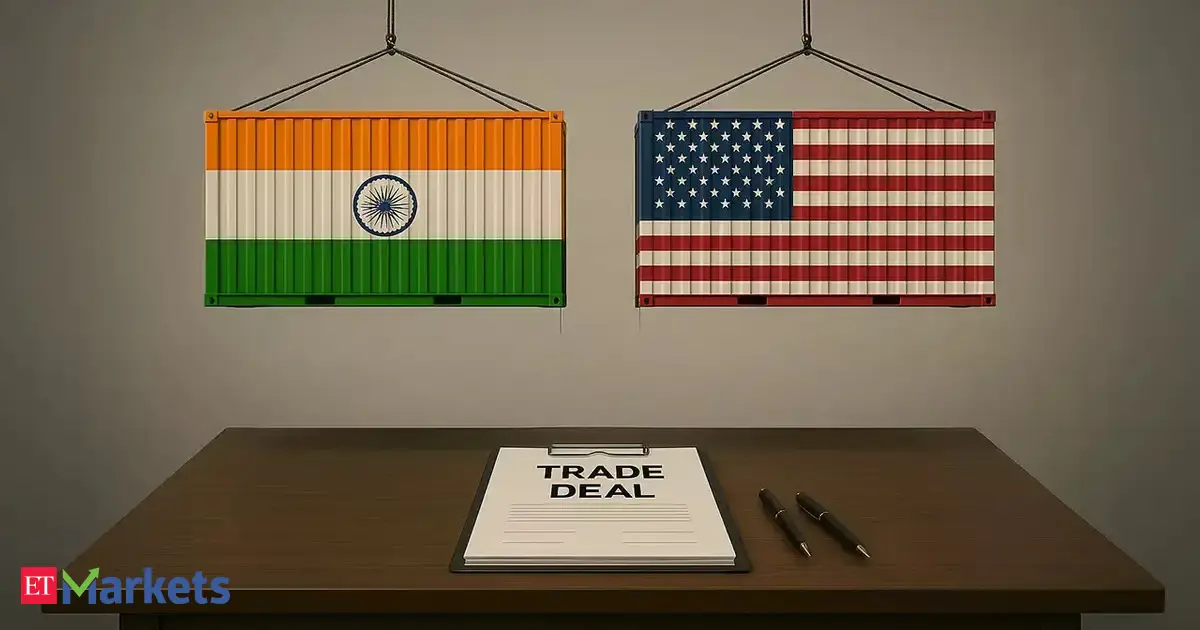
India achieved a 'trade truce' with the United States.
GK and monthly revision
India-US Trade Deal: Jefferies tweaks model stock portfolio, lists gainers
India's recent trade truce with the US is a significant economic development, leading to lower US tariffs on Indian exports. This move is expected to boost the competitiveness of Indian goods in sectors like autos, chemicals, textiles, and solar, making it crucial for understanding international trade relations and their domestic economic impact. Financial firms like Jefferies are already adjusting investment portfolios, highlighting the immediate market reaction and sector-specific implications for competitive exams.
Revision structure
Monthly events and exam calendar context
Static GK and one-liner notes
Quiz and mock-test revision path
Key points
Exam-ready takeaways
The truce results in 'lower US tariffs' on Indian exports, enhancing their competitiveness.
Key Indian export sectors expected to benefit include 'autos, chemicals, textiles, and solar'.
Jefferies rejigged its India model portfolio, boosting 'metals' and paring 'IT' exposure.
Specific companies identified as potential gainers include 'Hindustan Zinc, JSW Steel, Eternal, and Adani Group companies'.
Detailed analysis
Full exam-oriented breakdown
The recent 'trade truce' between India and the United States marks a significant de-escalation of trade tensions that have characterized their economic relationship in recent years. This development is not merely a technical adjustment but a strategic move with profound implications for India's economy, trade policy, and geopolitical standing, making it a crucial topic for competitive exam aspirants. **Background Context and What Happened:** For several years, India and the US, despite being strategic partners, have engaged in a series of trade disputes. A major flashpoint occurred in June 2019 when the US, under the Trump administration, revoked India's designation as a beneficiary of the Generalized System of Preferences (GSP) program. The GSP, established in 1976, allowed duty-free entry for thousands of products from developing countries into the US market, aimed at promoting economic growth. The US cited India's failure to provide 'equitable and reasonable access' to its markets across sectors, including dairy and medical devices, as the reason for the withdrawal. In retaliation, India imposed higher tariffs on 28 US products, including almonds, apples, and walnuts, effective June 16, 2019. This tit-for-tat measure led to a period of strained trade relations, even as overall bilateral trade continued to grow. The recent truce, announced in September 2023 during Prime Minister Modi's visit to the US, saw India agree to remove these retaliatory tariffs on US products. In return, the US agreed to terminate six outstanding disputes against India at the World Trade Organization (WTO). These disputes primarily concerned India's export subsidy measures and import duties on specific products. Furthermore, India agreed not to impose new tariffs on eight specific US products. The immediate impact is that lower US tariffs will make Indian exports more competitive, particularly in sectors like automobiles, chemicals, textiles, and solar products, by reducing the cost burden on Indian goods entering the American market. **Key Stakeholders Involved:** * **Indian Government:** Primarily the Ministry of Commerce and Industry, which formulates and implements India's foreign trade policy, and the Ministry of External Affairs, which handles diplomatic negotiations. Their objective is to boost exports, attract foreign investment, and strengthen strategic partnerships. * **US Government:** Represented by the Office of the United States Trade Representative (USTR), which negotiates trade agreements and resolves disputes. Their goals include opening foreign markets for US products and ensuring fair trade practices. * **Indian Exporters:** Companies in the autos, chemicals, textiles, and solar sectors stand to gain from reduced tariffs, leading to increased market access and potentially higher revenues. Companies like Hindustan Zinc, JSW Steel, and specific Adani Group companies are identified as potential beneficiaries due to their export-oriented nature or exposure to these sectors. The IT sector, however, might see some reallocation of investment as per Jefferies' model. * **Indian Consumers:** May benefit from lower prices for certain US imports if the removal of retaliatory tariffs translates into cost savings passed on by importers. * **Financial Markets and Investors:** Institutions like Jefferies play a crucial role by analyzing policy changes and adjusting investment portfolios. Their actions reflect market sentiment and direct capital towards sectors expected to benefit. * **World Trade Organization (WTO):** Though not directly involved in the bilateral truce, the WTO served as the forum for the six disputes that are now being terminated, highlighting its role in global trade governance. **Significance for India:** This trade truce holds immense significance for India. Economically, it provides a much-needed boost to export-oriented industries, aligning with India's 'Make in India' and 'Atmanirbhar Bharat' initiatives aimed at enhancing domestic manufacturing and global competitiveness. Increased exports contribute to higher foreign exchange earnings, improved balance of payments, and job creation. Politically, it signifies a strengthening of the India-US strategic partnership, which is vital in the current geopolitical landscape, especially concerning regional stability and countering global challenges. It sends a positive signal to international investors about India's commitment to predictable trade policies and reducing trade barriers. **Historical Context and Future Implications:** India-US trade relations have evolved significantly since India's economic liberalization in 1991. While the US has consistently been one of India's largest trading partners, trade imbalances and market access issues have frequently surfaced. Despite these, the overall trajectory has been one of increasing engagement and cooperation, driven by shared democratic values and strategic interests. The GSP withdrawal in 2019 was a setback, but the current truce indicates a renewed commitment to resolving differences through dialogue. Looking ahead, this truce could pave the way for a more comprehensive bilateral trade agreement or a limited trade package. It sets a positive precedent for resolving other lingering trade issues and could deepen economic integration. India's ability to leverage this improved relationship to attract more foreign direct investment (FDI) and integrate further into global supply chains will be critical. The focus will now shift to how India's Foreign Trade Policy (FTP 2023) can capitalize on these improved market access conditions to achieve its ambitious export targets. **Related Constitutional Articles, Acts, or Policies:** * **Constitutional Article 253:** This article empowers the Parliament to make any law for implementing any treaty, agreement, or convention with any other country or any decision made at any international conference, association, or other body. This provides the constitutional backing for implementing international trade agreements and changes in trade policy resulting from such truces. * **Foreign Trade (Development and Regulation) Act, 1992 (FTDR Act):** This Act governs India's import and export policy. It empowers the Central Government to make provisions for the development and regulation of foreign trade and for matters connected therewith or incidental thereto. Any changes in tariffs or trade rules resulting from the truce would be implemented under the framework of this Act. * **Customs Act, 1962:** This Act provides for the levy and collection of customs duties on goods imported into or exported from India. The changes in tariffs, whether imposed by India or the US, directly relate to the provisions of this Act. * **Foreign Trade Policy (FTP) of India:** The current FTP 2023, launched on March 31, 2023, aims to boost India's exports to $2 trillion by 2030. The improved trade relations with the US are expected to significantly contribute to achieving these targets by providing stable market access for Indian goods. Policies like 'Make in India' and 'Production Linked Incentive (PLI) schemes' are also intertwined, aiming to enhance domestic manufacturing capabilities and export competitiveness, which directly benefit from reduced trade barriers.
How to study
Turn news into exam marks
Revise monthly events by exam family instead of reading random updates.
Pair one-liners with mock tests so mistakes become the next revision list.
Keep state job pages, calendar pages and GK packs connected in one path.