

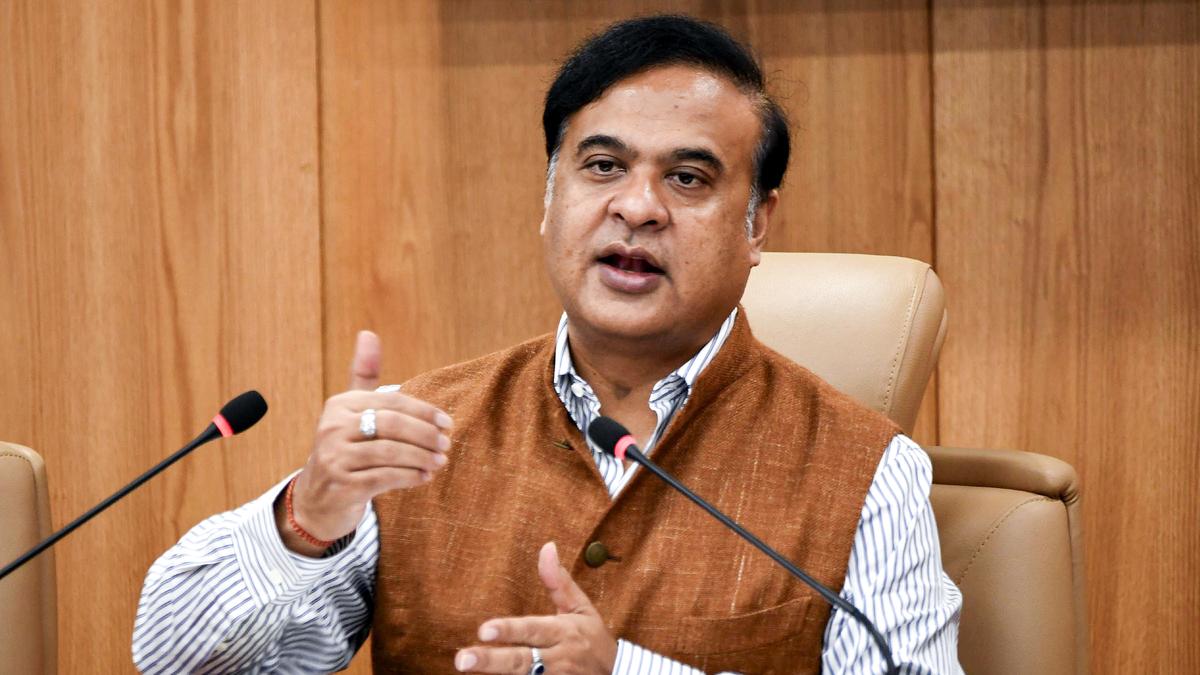
Assam Chief Minister Himanta Biswa Sarma proposed an underground rail link project.
GK and monthly revision
Underground rail link along 'Chicken's Neck' corridor will ensure secure route to Northeast: Assam CM Himanta Biswa Sarma
Assam Chief Minister Himanta Biswa Sarma has proposed an underground rail link along the strategically vital 'Chicken's Neck' corridor, also known as the Siliguri Corridor. This initiative aims to address the region's long-standing strategic vulnerability, a concern highlighted since the 1971 Bangladesh Liberation War. For competitive exams, this underscores India's focus on national security, infrastructure development, and connectivity to the Northeast, making it relevant for questions on geography, internal security, and government policy.
Revision structure
Monthly events and exam calendar context
Static GK and one-liner notes
Quiz and mock-test revision path
Key points
Exam-ready takeaways
The proposed rail link is along the 'Chicken's Neck' corridor, also known as the Siliguri Corridor.
The primary objective is to ensure a secure and robust route to India's Northeast region.
CM Sarma emphasized the strategic vulnerability of this narrow strip of land.
The need for such a link was highlighted by the CM in the context of the aftermath of the 1971 war.
Detailed analysis
Full exam-oriented breakdown
The proposal by Assam Chief Minister Himanta Biswa Sarma for an underground rail link along the 'Chicken's Neck' corridor, also known as the Siliguri Corridor, is a significant development underscoring India's persistent focus on national security and connectivity to its strategically vital Northeast region. This initiative, highlighted as a necessary step to address long-standing strategic vulnerabilities, particularly in the aftermath of the 1971 Bangladesh Liberation War, has profound implications for India's geopolitical standing, economic integration, and defense preparedness. **Background Context and What Happened:** Geographically, the Siliguri Corridor is a narrow stretch of land, approximately 22 kilometers wide at its narrowest point, connecting India's mainland to its eight northeastern states. Flanked by Nepal to the north, Bangladesh to the south, and Bhutan to the northeast, its strategic importance cannot be overstated. This precarious strip, aptly nicknamed the 'Chicken's Neck,' serves as the sole land bridge for all road and rail traffic into the Northeast. Its vulnerability was acutely felt during the 1971 war, when the possibility of its severance by hostile forces posed a grave threat, potentially isolating the entire region. Despite the passage of decades, this strategic fragility has remained a critical concern for Indian policymakers and defense strategists. Chief Minister Sarma's recent proposal for an underground rail link is a direct response to this historical and ongoing vulnerability, aiming to create a more secure and resilient transportation artery. **Key Stakeholders Involved:** The primary stakeholders in this ambitious project include the **Government of India**, particularly the Ministry of Railways, Ministry of Defence, and Ministry of Road Transport and Highways, which would be responsible for planning, funding, and executing such a massive infrastructure undertaking. The **Assam State Government**, led by CM Sarma, is a key proponent, advocating for the project's necessity. Other **Northeastern states** are also crucial stakeholders, as their economic and social integration heavily depends on the corridor's reliability. **Security agencies**, including the Indian Army and various paramilitary forces, would be deeply involved in assessing the security implications and benefits. Finally, the **local populace** residing along the corridor would be impacted by land acquisition, construction activities, and the long-term benefits of enhanced connectivity. **Why This Matters for India:** This project carries immense significance for India across multiple dimensions. From a **national security** perspective, an underground rail link would significantly de-risk the primary access route to the Northeast. In the event of a conventional conflict, particularly with China along the Line of Actual Control (LAC) or any other adversary attempting to cut off the corridor, an underground link offers enhanced protection against aerial attacks, artillery fire, and sabotage, ensuring uninterrupted logistical support and troop movement. This aligns with India's broader defense strategy to fortify its borders and enhance rapid deployment capabilities. Economically, improved and secure connectivity will unlock the vast potential of the Northeast. It will facilitate faster movement of goods, boost trade, encourage investment, and integrate the region more effectively into the national economy. This is crucial for the success of the **Act East Policy**, which seeks to deepen India's engagement with Southeast Asian nations, with the Northeast serving as the land bridge. Socially, enhanced connectivity will improve access to essential services, foster cultural exchange, and reduce the sense of isolation often felt by the people of the region, contributing to national cohesion. **Historical Context:** The strategic importance of the Siliguri Corridor has been acknowledged since India's independence. Post-1971, with the creation of Bangladesh, the land access situation somewhat improved compared to the pre-1971 scenario when East Pakistan (now Bangladesh) bordered the corridor. However, the inherent geographical narrowness remained a concern. India's successive governments have invested in various infrastructure projects to bolster connectivity, including road widening, new rail lines, and bridge constructions. The proposal for an underground link represents an escalation in the approach to mitigate this vulnerability, moving beyond surface-level solutions to a more robust, long-term strategic fix. **Future Implications and Related Policies:** If realized, an underground rail link would be a game-changer for the Northeast. It would not only enhance security and economic activity but also serve as a powerful symbol of India's commitment to the development and integration of its peripheral regions. It could spur further infrastructure development, including specialized freight corridors and logistics hubs. This project would align perfectly with the **Pradhan Mantri Gati Shakti National Master Plan**, launched in 2021, which aims for integrated planning and coordinated implementation of infrastructure connectivity projects. The legal framework for such projects draws from the **Seventh Schedule of the Constitution**, where 'Railways' falls under the Union List (Entry 22), granting the central government legislative and executive power over such projects, while 'Land' (Entry 18) is a State List subject, necessitating cooperation with the state governments for land acquisition. The project's strategic nature also invokes principles related to national defense, which is unequivocally a Union subject. The successful implementation would necessitate significant technological prowess, financial commitment, and inter-ministerial coordination, setting a precedent for future large-scale strategic infrastructure projects in challenging terrains.
How to study
Turn news into exam marks
Revise monthly events by exam family instead of reading random updates.
Pair one-liners with mock tests so mistakes become the next revision list.
Keep state job pages, calendar pages and GK packs connected in one path.