

The Union Budget for the financial year 2026-27 was presented in Parliament.
GK and monthly revision
Union budget 2026-27, Economic Survey, India-EU trade agreement and more: The week in 5 charts
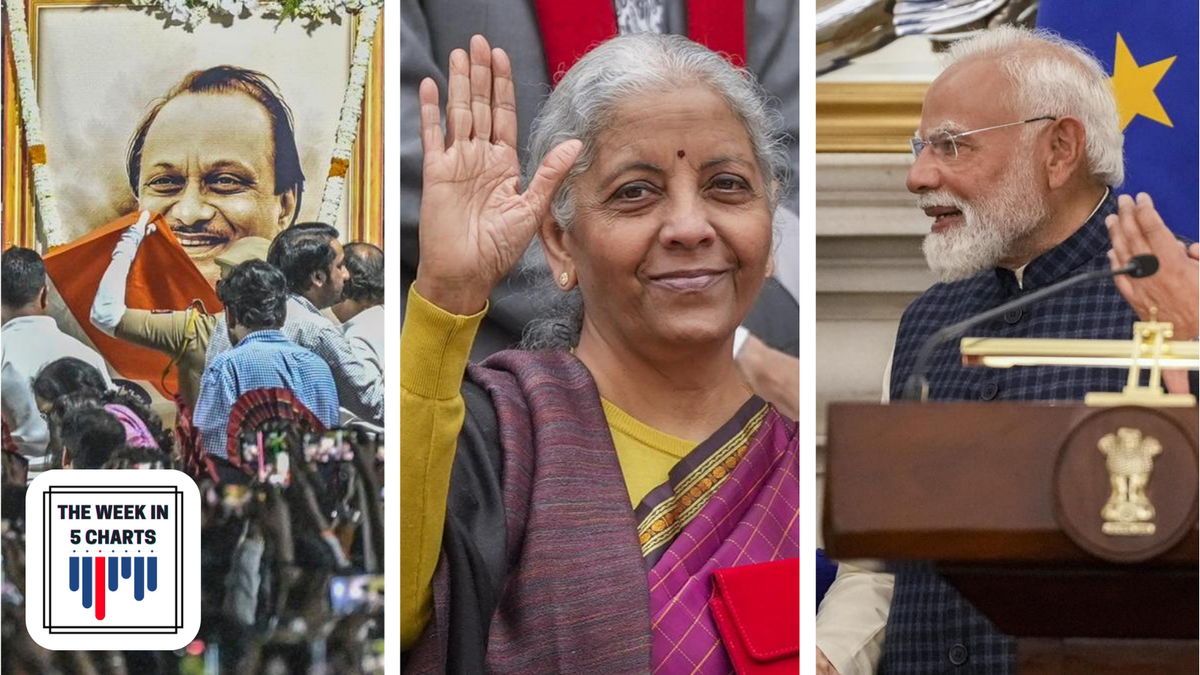
The Union Budget for the financial year 2026-27 was presented in Parliament, alongside the publication of the Economic Survey. Concurrently, Maharashtra Deputy Chief Minister Ajit Pawar tragically died in a helicopter crash. These events are crucial for competitive exams, covering national economic policy, governmental financial planning, and significant political developments, making them essential current affairs topics.
Revision structure
Monthly events and exam calendar context
Static GK and one-liner notes
Quiz and mock-test revision path
Key points
Exam-ready takeaways
The Economic Survey, reviewing the previous year, was published.
Maharashtra Deputy Chief Minister Ajit Pawar passed away.
Ajit Pawar's death occurred due to a helicopter crash.
These major national events transpired over the last week.
Detailed analysis
Full exam-oriented breakdown
The past week presented a confluence of significant national events, ranging from the meticulous unveiling of India's economic roadmap to a sudden and tragic political loss. These occurrences – the presentation of the Union Budget for 2026-27, the publication of the Economic Survey, and the untimely demise of Maharashtra Deputy Chief Minister Ajit Pawar – are not isolated incidents but rather interconnected threads that collectively shape India's governance, economy, and political landscape. The Union Budget is arguably the most critical annual financial statement of the Government of India. As mandated by **Article 112 of the Indian Constitution**, which refers to it as the 'Annual Financial Statement,' the Budget details the government's estimated receipts and expenditures for the upcoming fiscal year (April 1 to March 31). Its background lies in the need for financial accountability and strategic allocation of national resources. Historically, India's budget presentation has evolved significantly, from a simple statement to a comprehensive document reflecting complex economic policies. The key stakeholders include the Ministry of Finance, led by the Finance Minister who presents it in Parliament; the Parliament itself, which debates and approves it; and ultimately, every citizen, industry, and investor, whose lives and livelihoods are directly impacted by its provisions. The Budget serves as the government's fiscal policy tool, influencing everything from taxation and subsidies to infrastructure development and social welfare schemes. For India, the 2026-27 Budget's significance lies in its potential to steer economic growth, manage inflation, create employment, and address critical sectoral needs. It reflects the government's vision and priorities for the medium term, impacting the nation's trajectory towards its developmental goals. The implementation of the Fiscal Responsibility and Budget Management (FRBM) Act, 2003, also provides a legal framework for fiscal discipline, which the Budget must adhere to. Preceding the Budget, the Economic Survey is published, offering a comprehensive review of the Indian economy over the past financial year. Prepared by the Chief Economic Advisor (CEA) under the Ministry of Finance, it is a crucial analytical document that presents data-driven insights into economic trends, challenges, and policy options. While not constitutionally mandated, its tradition dates back to 1950-51 and it has become an indispensable precursor to the Budget, providing the context and rationale for the government's financial proposals. Key stakeholders include economists, policymakers, researchers, and the general public, who rely on its detailed analysis for understanding India's economic health. Its importance for India cannot be overstated; it acts as a diagnostic report, highlighting areas of strength and weakness, and often contains policy recommendations that might be adopted in future budgets or policy frameworks. It is a vital tool for informed decision-making and public discourse on economic matters, offering a backward-looking assessment and a forward-looking outlook. Concurrently, the nation witnessed the tragic passing of Maharashtra Deputy Chief Minister Ajit Pawar in a helicopter crash. Ajit Pawar was a veteran political leader from Maharashtra, known for his administrative acumen and significant influence within the Nationalist Congress Party (NCP) and the state's coalition government. While the position of 'Deputy Chief Minister' is not explicitly defined in the Constitution (unlike the Chief Minister under **Article 164**), it is a cabinet-rank position that often signifies political importance and power-sharing arrangements within a coalition. His death creates a significant political vacuum in Maharashtra, a state crucial for India's economic output and political landscape. Key stakeholders here include the Maharashtra government, the NCP, its allies (like the BJP in the current context), and the electorate. The political implications are profound: potential instability within the ruling coalition, a search for a successor, and possible shifts in party dynamics ahead of future state and national elections. His long political career, marked by various ministerial portfolios and his family's deep roots in state politics, meant he was a formidable force. His demise could trigger realignments and power struggles, impacting governance and policy continuity in one of India's most industrialized states. Collectively, these events underscore the dynamic interplay between economic policy and political stability in India. The Budget and Economic Survey lay out the nation's economic direction, crucial for growth, investment, and social welfare. Concurrently, the sudden loss of a prominent political figure highlights the fragility of political leadership and its potential impact on governance and stability, especially in a federal structure like India's. The future implications involve monitoring the implementation of the Budget's proposals, observing the economic trends highlighted by the Survey, and closely watching the political developments in Maharashtra, particularly the succession process and its impact on the state's political equilibrium and upcoming electoral contests. These events, though diverse, paint a comprehensive picture of India's challenges and aspirations in both the economic and political spheres.
How to study
Turn news into exam marks
Revise monthly events by exam family instead of reading random updates.
Pair one-liners with mock tests so mistakes become the next revision list.
Keep state job pages, calendar pages and GK packs connected in one path.