

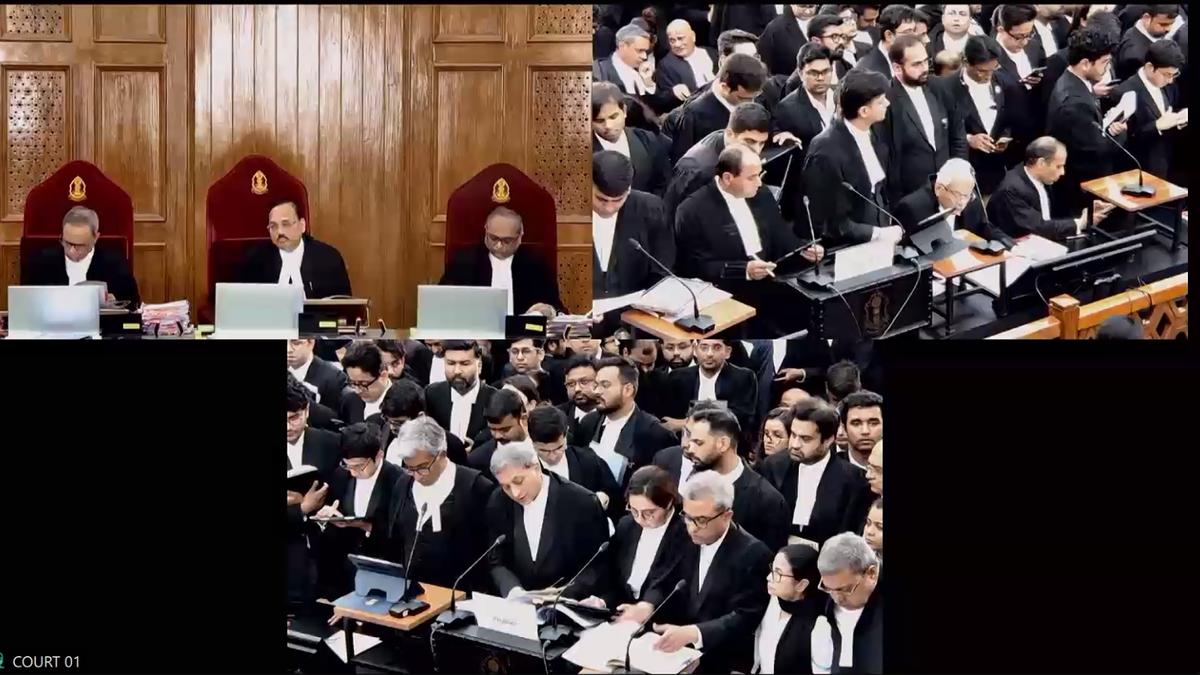
A CJI-led Bench of the Supreme Court issued a notice.
GK and monthly revision
West Bengal SIR hearing updates: 'Why only Bengal and not Assam?' Mamata Banerjee questions the hurry in conducting SIR exercise
The Supreme Court's CJI-led Bench issued a notice to the Election Commission of India (ECI) regarding the appointment of micro-observers for the SIR exercise in West Bengal. West Bengal Chief Minister Mamata Banerjee questioned the perceived urgency for Bengal, contrasting it with Assam. This development is significant for competitive exams as it highlights the judiciary's role in electoral oversight, the functions of constitutional bodies like the ECI, and federal relations.
Revision structure
Monthly events and exam calendar context
Static GK and one-liner notes
Quiz and mock-test revision path
Key points
Exam-ready takeaways
The notice was issued to the Election Commission of India (ECI).
The matter pertains to the appointment of micro-observers.
Micro-observers are intended to oversee the SIR exercise in West Bengal.
West Bengal CM Mamata Banerjee questioned the focus on Bengal over Assam for the SIR exercise.
Detailed analysis
Full exam-oriented breakdown
The recent development concerning the Supreme Court's notice to the Election Commission of India (ECI) regarding micro-observers for the 'SIR' exercise in West Bengal, coupled with Chief Minister Mamata Banerjee's questioning of the urgency compared to Assam, offers a rich landscape for understanding Indian democracy, federalism, and judicial oversight. While the exact acronym 'SIR' is not universally standard, given the context of ECI and micro-observers, it most likely refers to the 'Special Summary Revision' of Electoral Rolls, a periodic exercise crucial for updating voter lists. **Background Context and What Happened:** Electoral rolls are the bedrock of a democratic election. The Election Commission of India, a constitutional body established under Article 324, is mandated to prepare, revise, and update these rolls regularly to ensure that every eligible citizen is included and that deceased or shifted voters are removed. This process is known as Special Summary Revision (SSR) or sometimes simply 'revision' of electoral rolls. During this revision, claims for inclusion, objections to inclusion, and requests for correction of entries are invited from the public. To ensure the integrity and fairness of this crucial exercise, the ECI often deploys observers, and more specifically, 'micro-observers'. These micro-observers are usually central government employees deployed at polling stations or revision centres to meticulously monitor the process, identify discrepancies, and report directly to the ECI, thereby acting as the eyes and ears of the Commission on the ground. The current situation involves the Supreme Court's Chief Justice of India (CJI)-led bench issuing a notice to the ECI specifically on the appointment of these micro-observers for the revision exercise in West Bengal. This judicial intervention suggests that there might have been concerns or petitions challenging the ECI's process or the deployment strategy of these micro-observers in the state. Concurrently, West Bengal Chief Minister Mamata Banerjee publicly questioned the perceived 'hurry' and selective focus on Bengal for this exercise, asking why a similar urgency was not applied to Assam. **Key Stakeholders Involved:** 1. **Supreme Court of India:** As the apex judicial body, it acts as the ultimate guardian of the Constitution and ensures that constitutional bodies like the ECI function within their mandate and uphold principles of fairness and equality. Its intervention underscores the importance of electoral integrity. Its power is derived from various articles, including Article 32 (right to constitutional remedies) and Article 136 (special leave to appeal). 2. **Election Commission of India (ECI):** A permanent and independent constitutional body (Article 324) responsible for the superintendence, direction, and control of the preparation of electoral rolls and the conduct of elections to Parliament, State Legislatures, and the offices of President and Vice-President. Its decision-making regarding micro-observers is central to this issue. 3. **West Bengal Government/Chief Minister Mamata Banerjee:** The elected state government and its head, representing the interests of the state. Her questioning highlights potential concerns about federal overreach, political targeting, or perceived differential treatment by a central constitutional body. This brings to the fore the dynamics of Centre-State relations. 4. **Citizens/Voters of West Bengal:** Ultimately, the beneficiaries of a fair and accurate electoral roll. Their right to vote effectively depends on the integrity of this process. **Why This Matters for India and Historical Context:** This incident is highly significant for Indian democracy. Firstly, it reiterates the paramount importance of **electoral integrity**. An accurate electoral roll is the foundation of free and fair elections, without which the democratic process itself is compromised. The deployment of micro-observers is a key measure adopted by the ECI, particularly since the 1990s and early 2000s, to enhance transparency and prevent malpractices like bogus voting, multiple entries, or undue influence during the revision process. The **Representation of the People Act, 1950**, specifically deals with the preparation and revision of electoral rolls, while the **Representation of the People Act, 1951**, governs the conduct of elections. The ECI's powers to appoint observers are implicitly derived from Article 324 and explicitly from these Acts. Secondly, it highlights the delicate balance of **federalism** in India. State governments often express concerns when central agencies or constitutional bodies are perceived to act with a bias or disproportionate focus on one state over another. Mamata Banerjee's query about Assam underscores this perception of differential treatment, which can strain Centre-State relations and lead to political confrontations. Such situations often become flashpoints, especially in states with significant political rivalry or upcoming elections. Thirdly, the Supreme Court's intervention reinforces the principle of **judicial oversight** over constitutional bodies. While the ECI is an independent body, its actions are not immune to judicial review, especially when fundamental rights or the integrity of the democratic process are at stake. This ensures accountability and adherence to constitutional principles. **Future Implications:** The Supreme Court's final decision on this matter will have significant implications. It could set a precedent for how the ECI deploys its observers and micro-observers in the future, particularly in politically sensitive states. It might also clarify the extent of judicial intervention in the ECI's operational decisions related to electoral roll revisions. Furthermore, the episode will likely fuel ongoing debates about the independence of constitutional bodies and the nature of federal relations in India, especially concerning election management. For West Bengal, it means that the electoral roll revision process will proceed under heightened scrutiny, potentially impacting future elections. The ECI's response to the Supreme Court's notice and its justification for the specific deployment in West Bengal will be crucial for maintaining public trust in its impartiality. **Related Constitutional Articles, Acts, or Policies:** * **Article 324:** Vests the superintendence, direction, and control of elections in the Election Commission. * **Article 325:** States that no person shall be ineligible for inclusion in, or claim to be included in a special electoral roll on grounds of religion, race, caste or sex. * **Article 326:** Universal adult suffrage. * **Representation of the People Act, 1950:** Deals with the allocation of seats in the House of the People and in the State Legislative Assemblies, and the preparation of electoral rolls. * **Representation of the People Act, 1951:** Provides for the conduct of elections, qualifications and disqualifications for membership of Parliament and State Legislatures, corrupt practices, and election disputes. * **Article 136:** Grants the Supreme Court special leave to appeal from any judgment, decree, determination, sentence or order in any cause or matter passed or made by any court or tribunal in the territory of India.
How to study
Turn news into exam marks
Revise monthly events by exam family instead of reading random updates.
Pair one-liners with mock tests so mistakes become the next revision list.
Keep state job pages, calendar pages and GK packs connected in one path.