

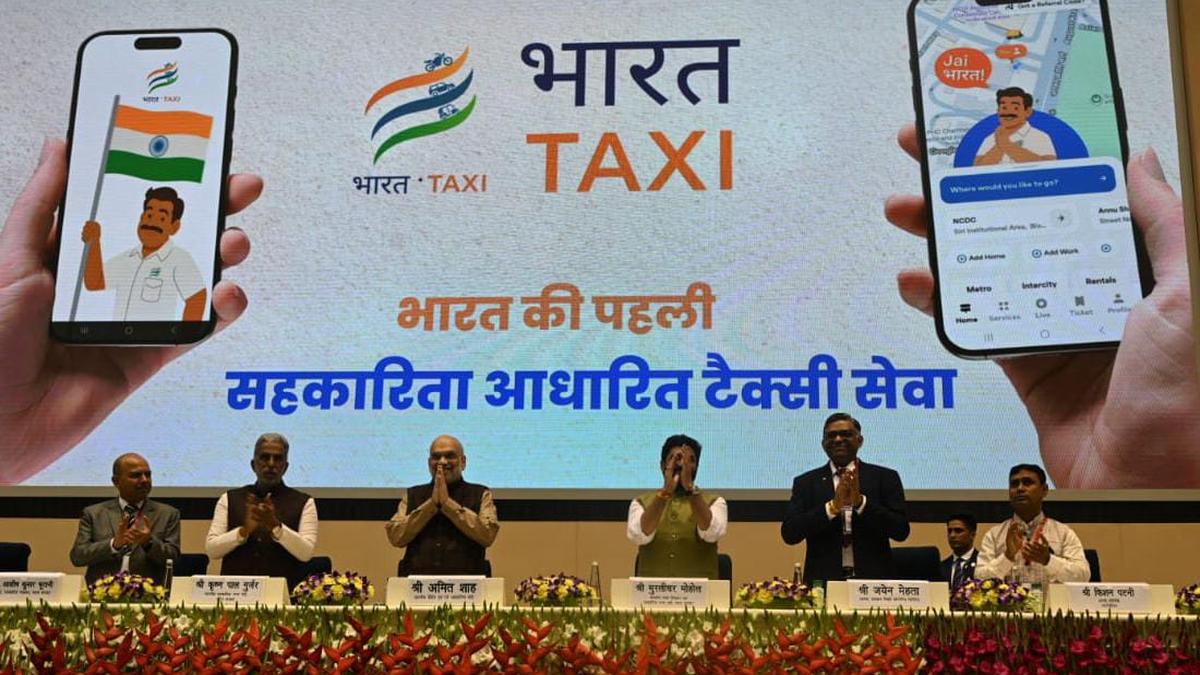
Bharat Taxi was launched by Union Cooperation Minister Amit Shah.
GK and monthly revision
Union Minister Amit Shah launches Bharat Taxi, first cooperative-led ride-hailing platform
Union Cooperation Minister Amit Shah launched "Bharat Taxi," India's first cooperative-led ride-hailing platform. This initiative aims to provide an alternative to existing aggregators, potentially empowering drivers through a cooperative model and offering competitive services to consumers. Its planned nationwide rollout in three years signifies a major government push in the cooperative sector, making it significant for competitive exam preparation on government initiatives and economic models.
Revision structure
Monthly events and exam calendar context
Static GK and one-liner notes
Quiz and mock-test revision path
Key points
Exam-ready takeaways
It is India's first cooperative-led ride-hailing platform.
The platform is planned for a nationwide rollout across the country within three years.
The planned coverage includes regions from Kashmir to Kanniyakumari.
The rollout will also extend from Dwarka to Kamakhya, indicating a comprehensive pan-India presence.
Detailed analysis
Full exam-oriented breakdown
The launch of "Bharat Taxi" by Union Cooperation Minister Amit Shah marks a significant development in India's evolving gig economy and the government's renewed focus on the cooperative sector. This initiative, touted as India's first cooperative-led ride-hailing platform, aims to offer a distinct alternative to the dominant app-based aggregators like Ola and Uber, promising a more equitable model for drivers and competitive services for consumers. **Background Context:** The ride-hailing sector in India has witnessed explosive growth over the last decade, transforming urban mobility. While offering convenience to commuters and employment opportunities to millions, the model employed by corporate aggregators has frequently faced criticism. Drivers often complain about declining incentives, high commission rates, opaque pricing mechanisms, and lack of social security, leading to precarious working conditions. Consumers, too, have expressed concerns over surge pricing and service quality issues. Recognizing these challenges, and in line with its vision of 'Sahakar se Samriddhi' (prosperity through cooperation), the Indian government has been actively promoting the cooperative model. The re-establishment of the Ministry of Cooperation in July 2021 underscored this commitment, aiming to strengthen and streamline the cooperative movement across various sectors. **What Happened:** On a specific date (though not provided in the quick summary, competitive exam aspirants should note that such launches are often tied to specific dates), Union Cooperation Minister Amit Shah officially launched Bharat Taxi. The core idea behind this platform is to empower drivers by making them stakeholders, or members, of a cooperative. Unlike traditional aggregators where drivers are independent contractors, a cooperative model allows drivers to collectively own and manage the platform, sharing profits and decision-making. The ambitious plan is to roll out Bharat Taxi nationwide within three years, covering the entire geographical expanse from Kashmir to Kanniyakumari and Dwarka to Kamakhya, indicating a comprehensive pan-India strategy. **Key Stakeholders Involved:** The primary stakeholders include the **Ministry of Cooperation**, which is spearheading this initiative as a policy enabler and promoter. The **drivers** themselves are crucial, as they are envisioned as the owners and primary beneficiaries of the cooperative. **Consumers** are another vital stakeholder, as the platform's success hinges on its ability to offer reliable and competitive services. Existing **ride-hailing aggregators** like Ola and Uber are indirect stakeholders, as Bharat Taxi is poised to become a direct competitor, potentially influencing market dynamics and pricing strategies. Various **cooperative federations and bodies** at national and state levels will likely be involved in the organizational and operational aspects of establishing and scaling these driver cooperatives. **Significance for India:** This initiative holds multi-faceted significance for India. Economically, it represents an attempt to formalize and bring social security to gig workers, addressing long-standing demands for fair wages and better working conditions. By allowing drivers to share profits and have a say in operations, it promotes a more equitable distribution of wealth. Socially, it aims to reduce exploitation and provide livelihood security, fostering inclusive growth. From a governance perspective, it demonstrates the government's active intervention to create alternative economic models that prioritize worker welfare and challenge the monopolistic tendencies of large tech platforms. It aligns with the broader push for 'Atmanirbhar Bharat' (self-reliant India) by promoting indigenous, community-led solutions. **Historical Context and Constitutional Provisions:** India has a rich history of successful cooperative movements, particularly in agriculture (like AMUL and IFFCO) and banking. The cooperative sector has traditionally played a vital role in rural development and empowerment. Constitutionally, the **97th Amendment Act, 2011**, gave constitutional status and protection to cooperative societies. It inserted a new **Part IXB** into the Constitution, dealing with cooperative societies. It also made the right to form cooperative societies a fundamental right under **Article 19(1)(c)** and included a new Directive Principle of State Policy under **Article 43B**, which mandates the state to promote voluntary formation, autonomous functioning, democratic control, and professional management of cooperative societies. This constitutional backing provides a strong legal framework for initiatives like Bharat Taxi. **Future Implications:** The success of Bharat Taxi will depend on several factors, including its ability to onboard a large number of drivers, provide seamless technology, ensure competitive pricing, and maintain high service standards. If successful, it could disrupt the existing ride-hailing market, compelling corporate aggregators to re-evaluate their business models and driver policies. It could also serve as a blueprint for other gig economy sectors (e.g., food delivery, logistics) to adopt cooperative models, fostering a more worker-centric digital economy. However, challenges related to capital investment, technological infrastructure, operational scalability, and maintaining democratic governance within large cooperatives will need to be carefully navigated. This initiative is a crucial step in formalizing the gig economy and could set a precedent for future policy interventions to safeguard worker rights in the digital age.
How to study
Turn news into exam marks
Revise monthly events by exam family instead of reading random updates.
Pair one-liners with mock tests so mistakes become the next revision list.
Keep state job pages, calendar pages and GK packs connected in one path.