

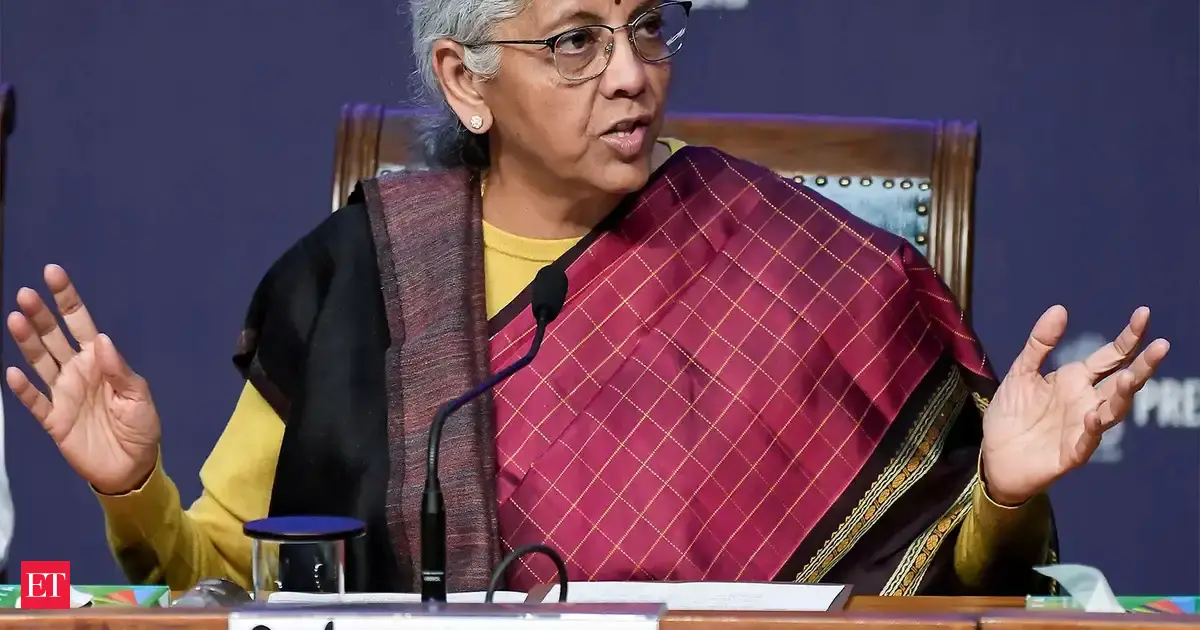
Union Finance Minister Nirmala Sitharaman welcomed the India-US interim trade deal.
GK and monthly revision
'Committed to negotiating broader US-India BTA': FM Nirmala Sitharaman hails trade deal
Union Finance Minister Nirmala Sitharaman welcomed an interim trade deal between India and the United States, signifying a commitment to stronger bilateral economic ties. This 'framework for an Interim Agreement' is a crucial step towards a broader U.S.-India Bilateral Trade Agreement (BTA). This development is significant for competitive exams, highlighting India's international trade policy and diplomatic relations.
Revision structure
Monthly events and exam calendar context
Static GK and one-liner notes
Quiz and mock-test revision path
Key points
Exam-ready takeaways
The deal is officially referred to as 'a framework for an Interim Agreement regarding reciprocal and mutually beneficial trade'.
India has reaffirmed its commitment to negotiating a broader U.S.-India Bilateral Trade Agreement (BTA).
The announcement was made by FM Sitharaman on X, sharing a joint statement.
The agreement aims to strengthen bilateral trade ties between India and the United States.
Detailed analysis
Full exam-oriented breakdown
The announcement by Union Finance Minister Nirmala Sitharaman regarding a 'framework for an Interim Agreement regarding reciprocal and mutually beneficial trade' between India and the United States marks a significant step in the evolving bilateral economic relationship. This interim deal is not merely a transactional agreement but a strategic move towards a broader U.S.-India Bilateral Trade Agreement (BTA), reflecting a deeper commitment to strengthening ties between the two largest democracies. **Background Context:** The trade relationship between India and the US has seen both periods of robust growth and occasional friction. While the US is one of India's largest trading partners and a key export destination, issues such as market access barriers, tariffs, and intellectual property rights have periodically strained relations. A notable point of contention was the US withdrawal of Generalized System of Preferences (GSP) benefits for India in June 2019, which impacted Indian exporters by increasing tariffs on certain products. Despite these challenges, both nations have consistently expressed a desire to enhance economic cooperation, recognizing the immense potential of their combined markets and strategic alignment. Efforts to resolve trade irritants and move towards a comprehensive trade deal have been ongoing for several years, with various rounds of discussions between trade representatives. **What Happened:** Finance Minister Nirmala Sitharaman announced on X (formerly Twitter) that India and the US have issued a joint statement outlining a 'framework for an Interim Agreement.' This interim arrangement is designed to address immediate trade concerns and facilitate smoother commerce while laying the groundwork for a more extensive BTA. The emphasis on 'reciprocal and mutually beneficial trade' indicates that the agreement aims to create a win-win situation, ensuring fair opportunities and benefits for both economies. This is a crucial distinction from unilateral concessions, suggesting a balanced approach to resolving trade issues and opening new avenues for cooperation. **Key Stakeholders Involved:** * **Indian Government:** Primarily the Ministry of Finance (led by FM Sitharaman) and the Ministry of Commerce and Industry, which are responsible for negotiating and implementing trade policies. Their commitment signifies a unified approach from the Indian side. * **US Government:** The Office of the United States Trade Representative (USTR) and the US Department of Commerce are the primary bodies involved in trade negotiations. The US administration's policy towards India often reflects broader geopolitical and economic objectives. * **Businesses:** Exporters and importers in both countries stand to benefit from reduced trade barriers, streamlined customs procedures, and increased market access. Sectors like agriculture, manufacturing, services, and technology are particularly keen observers. * **Consumers:** Potential benefits include a wider variety of goods and services, and possibly lower prices due to reduced tariffs. **Why This Matters for India:** * **Economic Growth:** A robust trade deal can significantly boost India's exports, enhance foreign direct investment (FDI), and integrate India more deeply into global supply chains. This aligns with India's 'Make in India' and 'Atmanirbhar Bharat' initiatives by creating opportunities for domestic industries to compete globally and attract investment. * **Market Access:** The interim agreement, and subsequently a BTA, could provide Indian products and services with greater access to the lucrative US market, especially for sectors where India has a competitive advantage. * **Strategic Partnership:** Beyond economics, this deal reinforces the strategic partnership between India and the US, which is crucial for regional stability and counterbalancing rising global challenges. It signals a shared commitment to a rules-based international order and economic cooperation. * **Addressing Trade Deficit:** While India generally has a trade surplus with the US, specific sectors might benefit from better market access to address imbalances and create new export avenues. **Historical Context:** India and the US have consistently sought to deepen economic engagement since India liberalized its economy in the early 1990s. The strategic partnership gained significant momentum in the 21st century, moving beyond traditional buyer-seller relationships to encompass defense, technology, and broader economic cooperation. However, a comprehensive Free Trade Agreement (FTA) or BTA has remained elusive, largely due to complexities around agriculture, intellectual property, and services. This interim deal suggests a pragmatic approach to build trust and resolve easier issues first, paving the way for more complex negotiations. **Future Implications:** The 'framework for an Interim Agreement' is a stepping stone. The ultimate goal is a broader BTA, which could encompass a wider array of issues such as digital trade, intellectual property protection, investment facilitation, and environmental and labor standards. Successfully negotiating a comprehensive BTA would signify a mature and resilient economic partnership. However, challenges remain, including differing perspectives on agricultural subsidies, data localization, and drug pricing. The success of this interim agreement will be crucial in building momentum and trust for the more intricate negotiations ahead. It could also influence India's approach to other trade agreements, such as its ongoing FTA discussions with the UK and EU, demonstrating its commitment to global economic integration. **Related Constitutional Articles, Acts, or Policies:** * **Article 253 of the Indian Constitution:** Empowers Parliament to make any law for implementing any treaty, agreement, or convention with any other country or any decision made at any international conference, association, or other body. This provides the constitutional backing for India to enter into and legislate on international trade agreements. * **Foreign Trade (Development and Regulation) Act, 1992:** This Act provides for the development and regulation of foreign trade and matters connected therewith or incidental thereto. It forms the legal framework for India's foreign trade policy and implementation of trade agreements. * **India's Foreign Trade Policy (FTP):** The government periodically announces its FTP, which outlines the vision, strategy, and measures for promoting India's exports and imports. Any trade deal with the US would align with the objectives of the current FTP, which often emphasizes diversification of markets and products. * **Atmanirbhar Bharat Abhiyan:** While promoting self-reliance, this policy also seeks to make India a part of global supply chains and a reliable global partner. Trade agreements like this one are consistent with this vision, aiming for strength through integration and competitiveness.
How to study
Turn news into exam marks
Revise monthly events by exam family instead of reading random updates.
Pair one-liners with mock tests so mistakes become the next revision list.
Keep state job pages, calendar pages and GK packs connected in one path.