

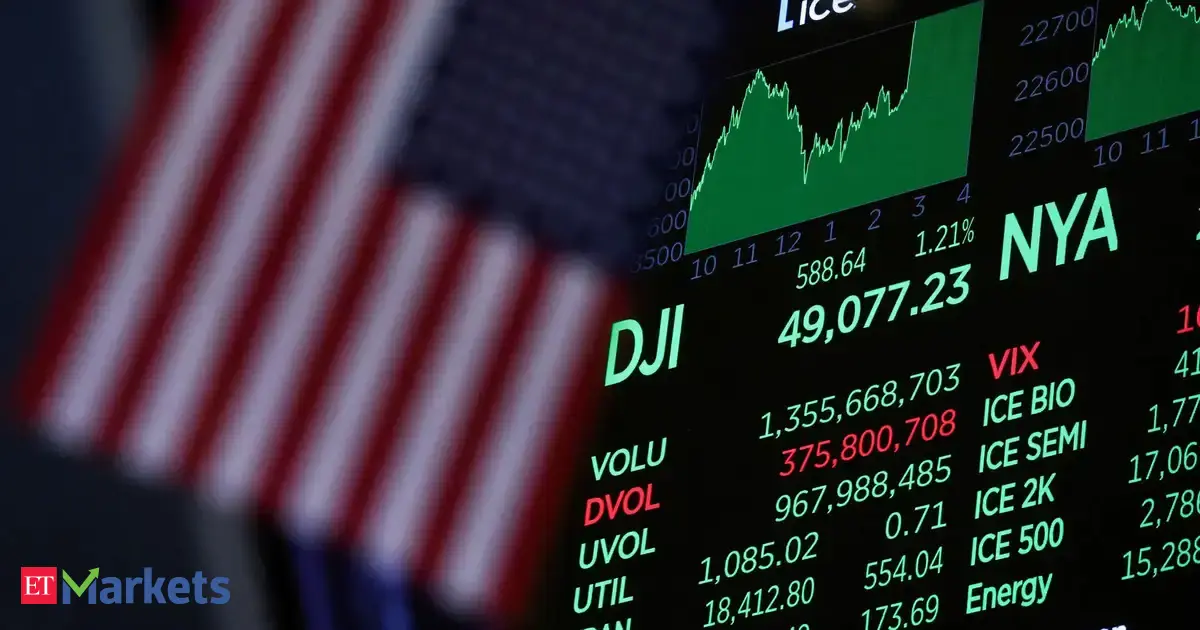
The Dow Jones Industrial Average (DJIA) surpassed the 50,000 level for the first time in its history.
GK and monthly revision
Dow Jones Industrial Average breaks 50,000 level for first time
The Dow Jones Industrial Average (DJIA) achieved a historic milestone by surpassing the 50,000 level for the first time, closing up 2.47%. This event signifies a broader market rally, driven by investor diversification beyond technology into economically sensitive companies like Caterpillar. For competitive exams, this highlights the importance of global economic indicators and factors influencing major stock market indices, crucial for understanding financial news.
Revision structure
Monthly events and exam calendar context
Static GK and one-liner notes
Quiz and mock-test revision path
Key points
Exam-ready takeaways
This historic milestone occurred on a Friday, with the index closing up 2.47%.
The rally was significantly boosted by gains in companies such as Caterpillar.
The event indicates a broader market rally extending beyond the technology sector.
Investor diversification into economically sensitive companies contributed to the Dow's outperformance.
Detailed analysis
Full exam-oriented breakdown
The Dow Jones Industrial Average (DJIA), a venerable barometer of the US stock market, recently achieved a historic milestone by surpassing the 50,000 level for the first time. This event, where the index closed up 2.47% on a particular Friday, signals robust investor confidence and a significant shift in market dynamics. To truly understand its implications, one must delve into its background, the forces at play, and its far-reaching significance, especially for an interconnected economy like India. **Background Context and What Happened:** The Dow Jones Industrial Average, established by Charles Dow in 1896, is one of the oldest and most widely recognized stock market indices globally. It tracks the performance of 30 large, publicly owned companies trading on the New York Stock Exchange (NYSE) and NASDAQ. Historically, the DJIA has served as a key indicator of the health of the US industrial sector and, by extension, the broader US economy. Its journey from its inception, through market crashes (like the Great Depression of 1929 or the 2008 financial crisis) and subsequent recoveries, reflects the long-term growth trajectory of American capitalism. The recent surge past 50,000 is particularly noteworthy. It didn't just happen in isolation; it was fueled by a broader market rally that extended beyond the technology sector, which had dominated gains for much of the post-pandemic recovery. The article specifically highlights significant contributions from "economically sensitive companies" like Caterpillar, a multinational manufacturer of construction and mining equipment. This indicates a diversification of investor interest, moving beyond high-growth tech stocks towards more traditional industrial and value-oriented companies that tend to perform well during periods of strong economic expansion. **Key Stakeholders Involved:** Several key stakeholders are intrinsically linked to such market movements. Firstly, **investors**, both institutional (pension funds, mutual funds, hedge funds) and retail, are the primary drivers. Their collective sentiment, risk appetite, and capital allocation decisions directly influence stock prices and, consequently, index levels. Secondly, the **constituent companies** of the DJIA, such as Caterpillar, are central. Their individual financial performance, earnings reports, and future outlook directly impact the index's value. A strong performance by these industrial giants suggests a healthy underlying economy. Thirdly, **governments and central banks**, particularly the US Federal Reserve, play a crucial role through their monetary and fiscal policies. Interest rate decisions, quantitative easing/tightening, and government spending packages significantly influence market liquidity, corporate profitability, and investor confidence. Lastly, the **global economy** itself is a major stakeholder. Interconnectedness means that economic conditions in major trading partners and geopolitical events can have ripple effects on US markets. **Why This Matters for India:** The DJIA crossing 50,000 is not merely a US-centric event; its implications resonate globally, including in India. Firstly, **Foreign Portfolio Investment (FPI)** is a critical channel. A strong US market can either attract capital away from emerging markets like India (if US returns are perceived as superior) or, conversely, signal a positive global economic outlook that encourages FPI flows into diverse markets, including India. Indian financial markets, regulated by the **Securities and Exchange Board of India (SEBI) Act, 1992**, are sensitive to these capital movements. Secondly, the **Indian export sector**, particularly IT services and certain manufactured goods, is heavily reliant on the health of the US economy. A robust US economy, indicated by a soaring Dow, often translates into increased demand for Indian goods and services, thereby boosting India's exports and contributing to its Balance of Payments. Thirdly, **remittances** from the Indian diaspora in the US are a significant source of foreign exchange for India. A strong US economy usually means better employment opportunities and higher earnings for these individuals, leading to increased remittances. Fourthly, global economic sentiment, often set by major economies like the US, influences investor confidence worldwide. A positive outlook from the US can spill over, creating a more favorable environment for India's economic growth and investment. **Historical Context and Future Implications:** The DJIA's journey is a testament to the long-term growth of the US economy, punctuated by periods of boom and bust. From its modest beginnings, it has overcome numerous challenges, including the dot-com bubble burst in 2000, the 2008 financial crisis, and the COVID-19 pandemic. Each recovery has pushed it to new highs, reflecting innovation, resilience, and adaptive economic policies. The current milestone, coming after a period of significant monetary stimulus and economic recovery post-pandemic, raises questions about sustainability. Future implications include potential concerns about **market overheating** or a **bubble**, which could prompt the Federal Reserve to tighten monetary policy through interest rate hikes. Such actions could impact global liquidity and capital flows, potentially affecting emerging markets like India. Conversely, if the rally is underpinned by genuine economic expansion and corporate earnings growth, it could signal a period of sustained global recovery, beneficial for international trade and investment. For India, this means carefully calibrating its monetary policy, guided by the **Monetary Policy Committee (MPC) of the Reserve Bank of India (RBI)**, to manage inflation and maintain financial stability amidst global shifts. The government's **fiscal policy**, articulated in the Union Budget, must also remain agile to leverage global opportunities and mitigate risks. While there are no direct constitutional articles about the DJIA, the overarching economic goals enshrined in the **Directive Principles of State Policy (DPSP)**, such as Article 38 (securing a social order for the promotion of welfare of the people) and Article 39 (principles of policy to be followed by the State for securing economic justice), are indirectly supported or challenged by global economic health. Regulations like the **Foreign Exchange Management Act (FEMA), 1999**, are crucial for managing cross-border financial flows influenced by such global market trends. **Broader Themes:** This event highlights several broader themes: the increasing **globalization and interdependence of economies**, where a major market's performance has ripple effects worldwide; the crucial **role of central banks** in managing economic cycles and influencing market sentiment; the ongoing evolution of **financial markets** and the importance of **diversification** for investors; and the constant interplay between economic fundamentals, investor psychology, and policy decisions.
How to study
Turn news into exam marks
Revise monthly events by exam family instead of reading random updates.
Pair one-liners with mock tests so mistakes become the next revision list.
Keep state job pages, calendar pages and GK packs connected in one path.