

Iran's Foreign Minister stated that Iran's missile programme is 'never negotiable'.
GK and monthly revision
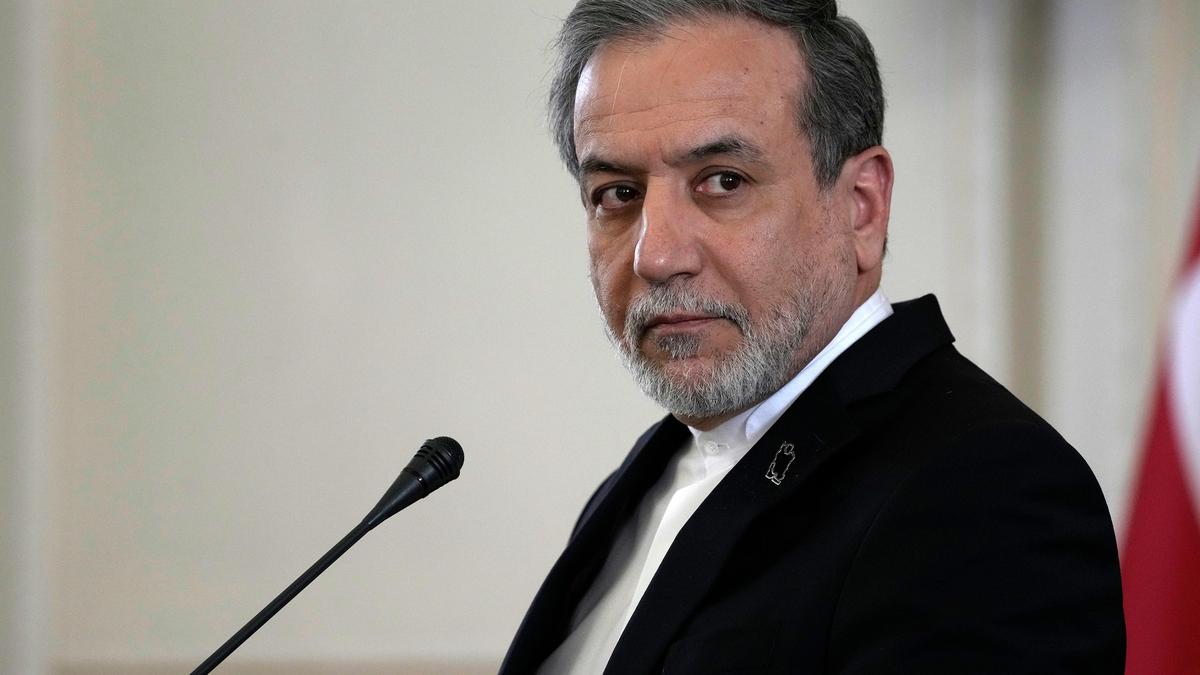
Iran FM says agreed with U.S. to hold next round of talks ‘soon’
Iran's Foreign Minister declared that the country's missile programme is a non-negotiable "defence issue", while also confirming an agreement with the U.S. to hold the next round of talks "soon". This highlights the persistent diplomatic stalemate and key points of contention between Iran and the U.S., which is crucial for understanding current international relations and geopolitical dynamics for competitive exams.
Revision structure
Monthly events and exam calendar context
Static GK and one-liner notes
Quiz and mock-test revision path
Key points
Exam-ready takeaways
The missile programme is considered by Iran as a 'defence issue'.
An agreement was reached with the United States to hold the next round of talks 'soon'.
The primary point of contention in talks between Iran and the U.S. remains Iran's missile capabilities.
The statement regarding non-negotiability was made by Iran's Foreign Minister.
Detailed analysis
Full exam-oriented breakdown
The recent statement by Iran's Foreign Minister, asserting the non-negotiability of its missile program as a 'defence issue' while confirming forthcoming talks with the U.S., encapsulates the enduring complexities and deep-seated mistrust that characterize Iran-U.S. relations. This development is not an isolated incident but a continuation of a protracted diplomatic dance with significant implications for global geopolitics, energy security, and regional stability. **Background Context: A Legacy of Sanctions and Distrust** To truly grasp the significance of this statement, one must delve into the history of Iran's nuclear and missile programs, and its contentious relationship with the West. The backdrop is the Joint Comprehensive Plan of Action (JCPOA), commonly known as the Iran Nuclear Deal, signed in 2015 between Iran and the P5+1 group (China, France, Germany, Russia, United Kingdom, and United States, plus the European Union). This landmark agreement aimed to limit Iran's nuclear program in exchange for sanctions relief. However, a major point of contention even then was Iran's ballistic missile program, which was not explicitly covered by the JCPOA. The U.S. under President Donald Trump unilaterally withdrew from the JCPOA in May 2018, reimposing crippling sanctions on Iran and initiating a 'maximum pressure' campaign. This move drastically escalated tensions, leading Iran to gradually roll back its commitments under the deal. The Biden administration, upon taking office, expressed a desire to return to the JCPOA, but insisted on addressing Iran's missile capabilities and its regional activities – issues Iran considers outside the scope of the nuclear deal and vital to its national security. **What Happened: The Impasse Continues** The current declaration by Iran's Foreign Minister underscores this fundamental divergence. By stating that the missile program is 'never negotiable' and framing it as a 'defence issue,' Iran is reaffirming its sovereign right to develop capabilities it deems necessary for its security in a volatile region. This stance directly clashes with U.S. and some European demands for curbs on Iran's ballistic missile development, which they view as destabilizing and potentially capable of carrying nuclear warheads. The agreement to hold talks 'soon' indicates a willingness for continued diplomatic engagement, yet the rigid positions on core issues suggest that any breakthrough will be arduous and slow. The primary point of contention, therefore, remains Iran's missile capabilities, alongside its nuclear enrichment levels and regional proxy activities. **Key Stakeholders and Their Motivations** Several key players are intricately involved. **Iran**, led by Supreme Leader Ali Khamenei and its pragmatic foreign policy establishment, views its missile program as a cornerstone of its defensive strategy against perceived threats, particularly from the U.S. and regional rivals like Israel and Saudi Arabia. It also serves as a deterrent and a symbol of national technological prowess. The **United States**, under President Biden, aims to prevent Iran from acquiring nuclear weapons and to curb its regional influence, while also seeking to reassure allies. The **E3 (France, Germany, UK)**, along with **China and Russia**, original signatories of the JCPOA, generally advocate for the deal's restoration and a diplomatic solution, often acting as intermediaries. **Regional powers like Israel and Saudi Arabia** are deeply concerned about Iran's nuclear ambitions and its missile program, viewing them as existential threats that could upset the regional balance of power, and they often lobby the U.S. for a tougher stance. **Significance for India: A Delicate Balancing Act** For India, developments in Iran hold profound significance across economic, political, and strategic dimensions. Economically, India is a major energy importer, and stability in the Persian Gulf is crucial for its energy security. While U.S. sanctions have significantly reduced India's oil imports from Iran, a stable Iran-U.S. relationship could potentially reopen avenues for energy trade. Strategically, Iran is a crucial partner in India's regional connectivity initiatives. The **Chabahar Port**, developed by India on Iran's southeastern coast, is vital for providing India with a sea-land route to Afghanistan and Central Asia, bypassing Pakistan. Continued tensions or stricter sanctions could impede the port's development and utility. The **International North-South Transport Corridor (INSTC)**, a multi-modal network connecting India, Iran, Afghanistan, Armenia, Azerbaijan, Russia, Central Asia, and Europe, also relies heavily on Iran as a transit hub. Politically, India maintains a policy of strategic autonomy, balancing its relationships with both the U.S. and Iran. Escalating tensions force India into a difficult position, requiring careful diplomacy to safeguard its interests without alienating either side. India's large diaspora in the Gulf region is also vulnerable to any instability. **Historical Context and Broader Themes** The current situation is rooted in decades of strained relations dating back to the 1979 Iranian Revolution, the subsequent Iran-Iraq War, and a history of U.S. sanctions. This ongoing saga highlights broader themes in international relations: the challenges of nuclear non-proliferation, the complexities of national sovereignty versus international security concerns, the impact of unilateral sanctions, and the delicate balance of power in West Asia. It also underscores the inherent difficulties in achieving lasting peace through coercive diplomacy. **Future Implications and Constitutional Linkages** The future remains uncertain. Continued diplomatic stalemate could lead to further escalation, potentially including military confrontations, increased regional instability, and a deeper arms race. It could also push Iran further towards nuclear weaponization capabilities, complicating global non-proliferation efforts. For India, this means continued challenges in maintaining its strategic interests and navigating complex geopolitical alignments. India's foreign policy, though not directly governed by specific constitutional articles on international disputes, is guided by the **Directive Principles of State Policy, particularly Article 51**, which mandates the state to promote international peace and security, maintain just and honorable relations between nations, foster respect for international law and treaty obligations, and encourage settlement of international disputes by arbitration. India's approach to the Iran issue, including its commitment to the Chabahar Port and INSTC, reflects these principles of fostering connectivity, peace, and multilateral engagement, even amidst global pressures. In essence, the Iran-U.S. dynamic is a high-stakes geopolitical chess game, with Iran's missile program at its core. Its resolution, or lack thereof, will profoundly shape the future of the Middle East and have significant ripple effects on global energy markets, trade routes, and the intricate web of international relations, directly impacting India's strategic calculations and development aspirations.
How to study
Turn news into exam marks
Revise monthly events by exam family instead of reading random updates.
Pair one-liners with mock tests so mistakes become the next revision list.
Keep state job pages, calendar pages and GK packs connected in one path.