

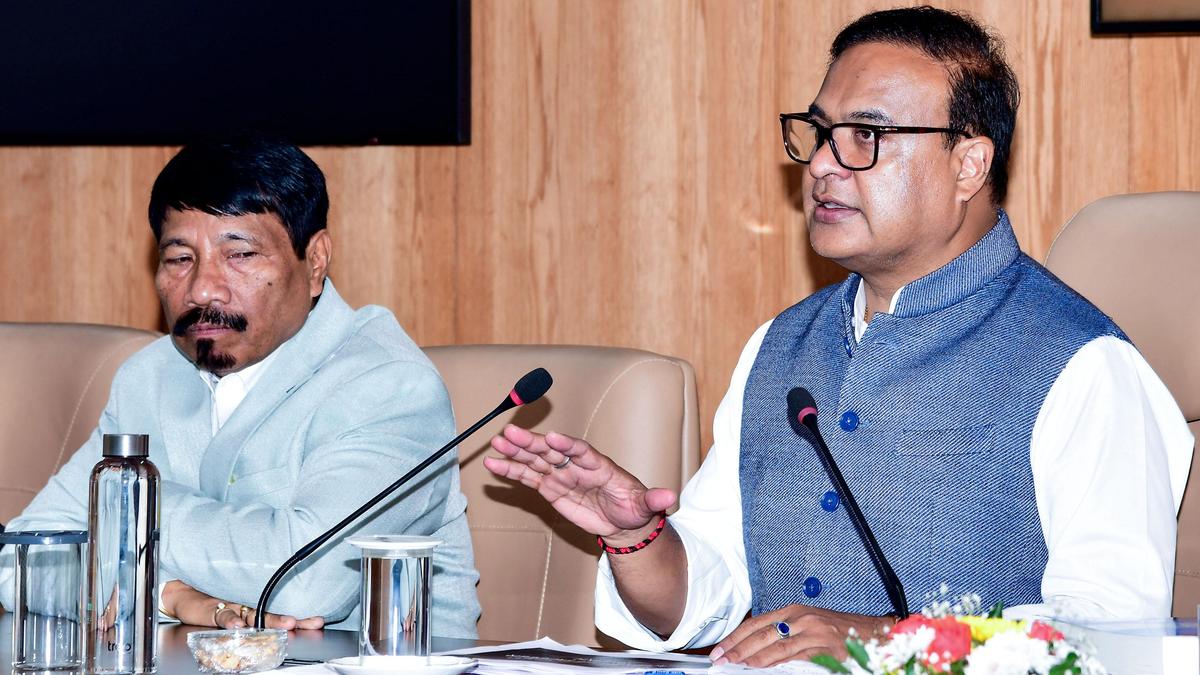
Assam CM Himanta Biswa Sarma accused Congress leader Gaurav Gogoi of a "deeper connection" with a Pakistan agent.
GK and monthly revision
Gaurav Gogoi, wife have 'deeper connection' with Pakistan agent; FCRA violated to pay her salary, Assam CM Himanta says
Assam CM Himanta Biswa Sarma has accused Congress leader Gaurav Gogoi and his wife of having a "deeper connection" with a Pakistan agent and violating the Foreign Contribution (Regulation) Act (FCRA). The CM alleged that FCRA was breached to pay Gogoi's wife's salary using foreign funds. Gogoi, the State Congress chief, dismissed these claims as baseless. This event underscores the relevance of the FCRA for competitive exams, particularly its provisions concerning foreign funding and political affiliations.
Revision structure
Monthly events and exam calendar context
Static GK and one-liner notes
Quiz and mock-test revision path
Key points
Exam-ready takeaways
The primary allegation against Gaurav Gogoi and his wife involves the violation of the Foreign Contribution (Regulation) Act (FCRA).
Specifically, it is alleged that the FCRA was violated to pay the salary of Gaurav Gogoi's wife using foreign funds.
Gaurav Gogoi, who also serves as the State Congress chief, termed the allegations "worse than a C-grade cinema" and "super flop".
The Foreign Contribution (Regulation) Act (FCRA) governs the acceptance and utilization of foreign contributions by individuals, associations, or companies in India.
Detailed analysis
Full exam-oriented breakdown
The recent allegations by Assam Chief Minister Himanta Biswa Sarma against Congress leader Gaurav Gogoi and his wife, concerning a "deeper connection" with a Pakistan agent and violations of the Foreign Contribution (Regulation) Act (FCRA), bring to the forefront critical aspects of India's internal security, political funding, and regulatory framework. This incident, while politically charged, offers a valuable lens through which to examine the nuances of foreign contributions and their oversight in India. **Background and the FCRA's Genesis** To understand the gravity of the allegations, one must first grasp the purpose and evolution of the FCRA. The Foreign Contribution (Regulation) Act was first enacted in 1976 during the Emergency, primarily to regulate the acceptance and utilisation of foreign contributions or hospitality by individuals, associations, or companies. The core objective was to prevent foreign interference in India's internal affairs, particularly by curbing the flow of funds that could be used for activities detrimental to national interest or political stability. Over the decades, the Act has been revised to adapt to changing geopolitical realities and internal security concerns. The FCRA, 2010, replaced the earlier Act, introducing more stringent provisions for registration, reporting, and utilisation of foreign funds. This was further tightened by the FCRA (Amendment) Act, 2020, which aimed to enhance transparency and accountability. **What Happened: The Allegations** Assam CM Himanta Biswa Sarma accused Gaurav Gogoi, who is also the State Congress chief, and his wife of having links with a 'Pakistan agent' and violating the FCRA. Specifically, the CM alleged that foreign funds were illegally used to pay Gogoi's wife's salary, implying a breach of FCRA provisions that prohibit certain individuals and entities from receiving foreign contributions and mandate strict reporting and end-use of such funds. Gaurav Gogoi vehemently denied these claims, terming them baseless and politically motivated, a common response in such high-stakes political accusations. **Key Stakeholders Involved** At the heart of this controversy are **Assam CM Himanta Biswa Sarma**, representing the ruling Bharatiya Janata Party (BJP), who made the allegations, and **Gaurav Gogoi**, a prominent leader of the Indian National Congress (INC), who is the accused. Gogoi's **wife** is also a stakeholder, as the alleged recipient of foreign funds. Beyond these individuals, the **Ministry of Home Affairs (MHA)** is a crucial stakeholder, as it is the nodal ministry responsible for administering and enforcing the FCRA. Any investigation into these allegations would primarily fall under the MHA's purview, potentially involving its agencies. The unnamed **'Pakistan agent'** represents an external element, raising national security concerns. **Significance for India and Broader Themes** This incident holds significant implications for India. Firstly, the allegation of a 'Pakistan agent' connection immediately elevates the matter to a national security concern. India has a long history of grappling with cross-border terrorism and espionage, making any such claim highly sensitive. Secondly, it underscores the ongoing debate about **transparency in political funding** and the regulation of foreign contributions. The FCRA's stringent nature is a testament to India's commitment to preventing external manipulation of its democratic processes. The 2020 amendments, for instance, prohibit public servants from receiving foreign contributions and make Aadhaar mandatory for FCRA registration, reflecting a stricter stance. If proven, such violations would highlight critical loopholes or deliberate circumvention of these laws. This also ties into the broader theme of **governance and accountability**, particularly for political figures and their associates. Furthermore, the political nature of the allegations highlights the intense **party politics** in India, where such charges often become tools in electoral battles and power struggles. **Historical Context and Constitutional/Legal Framework** The FCRA's journey from 1976 to its current form reflects India's evolving understanding of national security and sovereignty. The **Foreign Contribution (Regulation) Act, 2010**, and particularly the **FCRA (Amendment) Act, 2020**, are the direct legal frameworks in question. The 2020 amendment introduced several key changes: it reduced the limit for administrative expenses from 50% to 20% of foreign contributions, prohibited transfer of foreign contribution to any other person, and mandated that foreign contributions be received only in designated FCRA accounts at State Bank of India, New Delhi. These provisions are designed to ensure funds are used for their stated purpose and are not diverted. While no specific constitutional article is directly violated by an FCRA breach, the Act itself operates within the constitutional framework, balancing fundamental rights like freedom of association (Article 19(1)(c)) with national security and public order. **Future Implications** The immediate future will likely see calls for a thorough investigation into the allegations. If substantiated, it could lead to severe legal consequences under the FCRA, potentially involving the cancellation of FCRA registration (if any entity linked to Gogoi's wife had one), fines, and even imprisonment. Politically, it could significantly impact Gaurav Gogoi's career and the Congress party's image, especially in Assam. For the broader landscape, this incident reinforces the government's resolve to strictly implement the FCRA, potentially leading to increased scrutiny of all entities receiving foreign funds, including NGOs and other associations. It also serves as a stark reminder of the complexities and sensitivities surrounding foreign funding in a diverse and politically vibrant democracy like India, where national security concerns often intersect with political discourse and regulatory oversight.
How to study
Turn news into exam marks
Revise monthly events by exam family instead of reading random updates.
Pair one-liners with mock tests so mistakes become the next revision list.
Keep state job pages, calendar pages and GK packs connected in one path.