

Union Minister Piyush Goyal made the statement on India's economic position on February 8.
GK and monthly revision
India today negotiating trade deals from a position of strength, confidence: Piyush Goyal
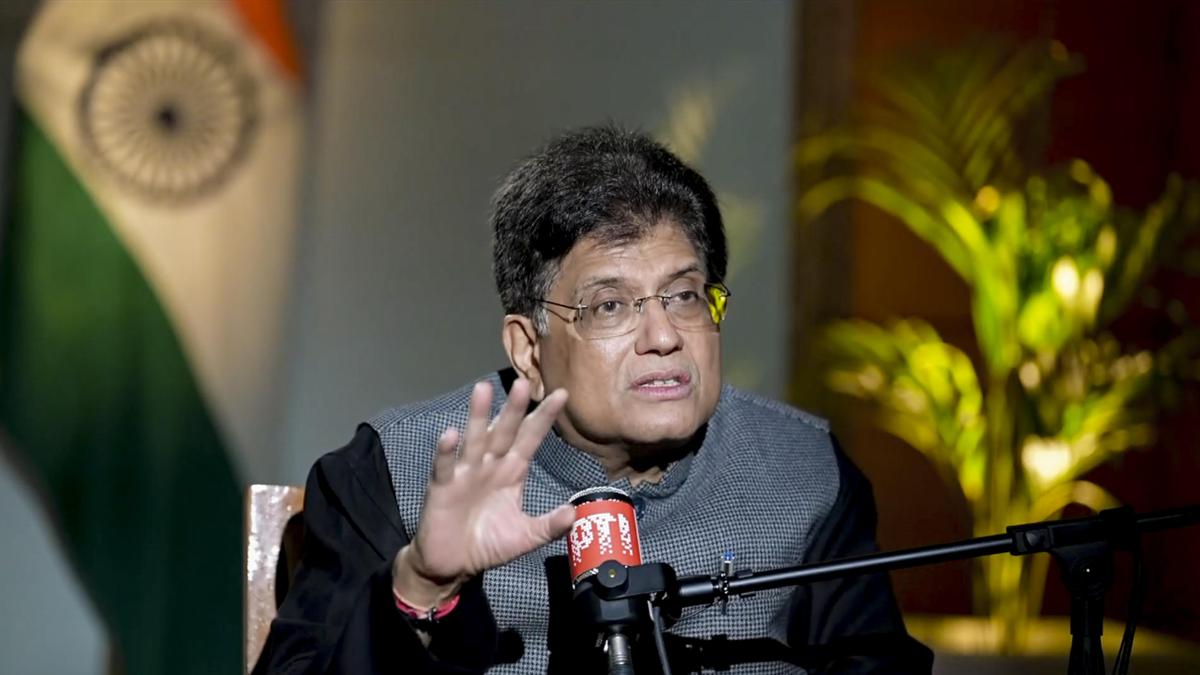
Union Minister Piyush Goyal stated on February 8 that India, currently a $4 trillion economy, is negotiating trade deals from a position of strength and confidence. He projected India to become a $30-35 trillion developed economy by 2047. This highlights the government's optimistic economic outlook and strategic approach to global trade, crucial for understanding India's long-term growth targets for competitive exams.
Revision structure
Monthly events and exam calendar context
Static GK and one-liner notes
Quiz and mock-test revision path
Key points
Exam-ready takeaways
India's economy is currently valued at $4 trillion.
India aims to become a developed economy by the year 2047.
The Indian economy is projected to reach $30-35 trillion by 2047.
Piyush Goyal asserted that India is negotiating trade deals from a position of strength and confidence.
Detailed analysis
Full exam-oriented breakdown
Union Minister Piyush Goyal's statement on February 8, projecting India as a $30-35 trillion developed economy by 2047 and negotiating trade deals from a position of strength, is a significant articulation of India's ambitious economic vision. This statement is rooted in India's recent economic performance and a strategic shift in its global engagement. **Background Context and What Happened:** India's economic journey since its independence in 1947 has been one of gradual evolution, marked by phases of state-led development, the transformative economic reforms of 1991, and a subsequent integration into the global economy. In recent decades, India has emerged as one of the fastest-growing major economies. The current government has emphasized structural reforms, ease of doing business, and boosting domestic manufacturing through initiatives like 'Make in India' and Production Linked Incentive (PLI) schemes. This has contributed to robust growth, leading to India becoming the 5th largest economy globally, surpassing the UK in 2022, and reaching a $4 trillion GDP mark in early 2024. Goyal's statement on February 8 underscores this newfound economic confidence, asserting that India is now in a strong position to negotiate favorable trade deals, moving away from a historically more cautious or defensive stance. The target year 2047 is particularly symbolic, coinciding with the centenary of India's independence, framing the economic goal within a broader national vision of 'Viksit Bharat' (Developed India). **Key Stakeholders Involved:** * **Government of India (GoI):** Primarily the Ministry of Commerce & Industry (headed by Piyush Goyal) and the Ministry of Finance, which formulate trade policies, negotiate agreements, and manage fiscal strategy. NITI Aayog also plays a crucial role in long-term economic planning, including the 'Vision India@2047' document. The Prime Minister's Office provides overarching strategic direction. * **Indian Businesses and Industry:** These are the primary beneficiaries and drivers of economic growth. Their competitiveness, innovation, and ability to integrate into global supply chains are vital for achieving the stated economic targets. They are directly impacted by the terms of trade deals. * **International Trading Partners:** Countries and blocs like the UK, EU, UAE, Australia, and the Gulf Cooperation Council (GCC), with whom India is actively negotiating Free Trade Agreements (FTAs) and Comprehensive Economic Partnership Agreements (CEPAs). Their willingness to engage and the terms they offer are crucial. * **International Organizations:** Bodies like the World Trade Organization (WTO), International Monetary Fund (IMF), and World Bank, which set global trade norms, provide economic forecasts, and influence the multilateral trading system. **Significance for India:** Achieving a $30-35 trillion economy by 2047 would fundamentally transform India. Economically, it implies a massive increase in per capita income, leading to significant poverty reduction and improved living standards. It would necessitate substantial investment in infrastructure, human capital (education and health), and technological innovation. Politically, a larger and more prosperous economy would translate into enhanced geopolitical influence, allowing India to play a more decisive role in shaping global governance and norms. Socially, it would mean a more skilled workforce, better public services, and potentially a reduction in regional disparities. The confidence in negotiating trade deals reflects India's strategic shift towards using economic diplomacy as a tool for national development and global assertion, balancing domestic interests with international integration. **Historical Context and Broader Themes:** Historically, India's trade policy post-independence was characterized by import substitution and protectionism to foster domestic industries. The 1991 reforms marked a pivot towards liberalization and globalization. However, India remained cautious about certain multilateral trade agreements, particularly after experiences with the WTO's Doha Round. The current approach, as articulated by Goyal, signifies a more proactive and assertive stance, seeking to leverage India's large domestic market and growing economic heft. This aligns with broader themes of India's rising global stature, its emphasis on 'Atmanirbhar Bharat' (self-reliant India) which seeks to integrate with global value chains from a position of strength, and its aspiration to be a 'Vishwaguru' (world leader). **Future Implications and Constitutional Provisions:** Realizing the 2047 vision requires sustained annual economic growth rates of 8-9% over the next two decades. This necessitates continued structural reforms in land, labor, and capital markets, significant investment in green energy transitions, enhanced productivity across all sectors (agriculture, manufacturing, services), and a robust, innovation-driven ecosystem. Challenges include global economic slowdowns, geopolitical instability, climate change impacts, and ensuring equitable distribution of growth benefits to prevent widening income disparities. The government's focus on digital infrastructure and skill development will be paramount. From a constitutional perspective, the Union government's power to negotiate and implement international trade deals is derived from **Entry 41 (Trade and commerce with foreign countries; import and export across customs frontiers; customs duties)** and **Entry 42 (Treaties and agreements with foreign countries; implementation of treaties, agreements and conventions with foreign countries)** of the **Union List** in the **Seventh Schedule** of the Constitution. The **Foreign Trade (Development and Regulation) Act, 1992**, provides the legislative framework for India's foreign trade policy. Additionally, policies like the **NITI Aayog's Vision India@2047** document provide a detailed roadmap for achieving the developed economy status, outlining key pillars of growth and development. The government's emphasis on trade from a position of strength also aligns with the broader objectives of India's foreign policy, which increasingly integrates economic diplomacy as a core component to secure national interests and promote prosperity.
How to study
Turn news into exam marks
Revise monthly events by exam family instead of reading random updates.
Pair one-liners with mock tests so mistakes become the next revision list.
Keep state job pages, calendar pages and GK packs connected in one path.